By the CNN Wire Staff
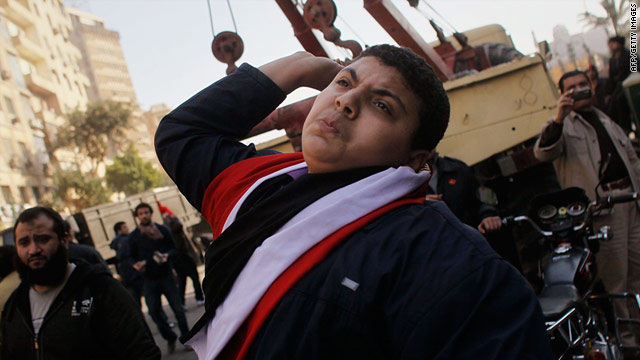
Cairo, Egypt (CNN) -- Pandemonium reigned Wednesday in the epicenter of Cairo's demonstrations, where violent street battles unfolded between supporters and foes of embattled President Hosni Mubarak.
State-run Nile TV flashed a warning ordering people to adhere to a government-imposed curfew and clear out of Tahrir Square. But curfews in the past few days have been largely ignored and a crowd, though a less intense one, remained in the downtown plaza into the night.
Earlier, tear gas and gunshots were fired to quell confrontational crowds and in one surreal moment, demonstrators thundered through the crowds on horses and camels. At least one man was pulled off his horse and beaten.
State television said the riders were pyramid workers who were protesting the negative economic impact of the crisis.Mubarak's announcement Tuesday that he will not seek re-election had been expected to dampen the passion of Egypt's nine-day uprising.
But the opposite rang true, at least in central Cairo's Tahrir Square, where a mob-rule mentality was in sharp contrast to the jubilant mood of tens of thousands of anti-Mubarak protesters the day before.
It remained unclear whether such confrontations were repeated elsewhere. Contesting rallies in Egypt's second-largest city, Alexandria, were largely peaceful. Other Cairo neighborhoods also remained calm.
Events in Egypt "have moved enormously quickly in a very volatile region of the world, the likes of which we have not seen in our lifetime," White House Press Secretary Robert Gibbs noted Wednesday."What we're watching," he said, "is history being made."
The sound of gunfire reverberated in Tahrir Square, which means "liberation" in Arabic. People hurled verbal insults, Molotov cocktails, rocks and anything else they could find -- shards of metal, sticks, shoes -- at one another. Desperate for more ammunition, they dismantled sidewalks and picked up chunks of cement to throw. They beat each other in what rapidly spiraled into utter mayhem.
Through the course of the afternoon, pro-Mubarak supporters added to their ranks and eventually overturned a military vehicle to surge forward past the Egyptian National Museum toward the center of Tahrir Square. Flames shot out from the awnings and doorways of several burning buildings and thick black smoke filled the air.
Some people expressed fears to journalists that a bloodbath would ensue.
Scores of people have already been wounded. Blood streaming down their faces, they were carried away from the square into a nearby makeshift clinic.Egypt's health minister said 611 people were injured, Nile TV reported. Many suffered head injuries. Ministry spokesman Abdel Rahman Shaheen also reported the death of a security forces member in an incident at a nearby bridge over the Nile River.
Protesters climbed atop army tanks, waving flags and chanting loudly.Each side in the chilling street battle fought to lay claim to this patch of central Cairo territory that has all along been the symbol of the uprising. But despite the extremely volatile altercations, the police were nowhere to be seen and the army did little to restore order.
Mubarak deployed the army Friday after police forces -- who don't have a clean track record with the Egyptian people -- used excessive force on protesters. The army said it would not attack peaceful demonstrations, but Wednesday morning, it urged a return to normalcy.
"Your message is received ... (your) demands became known," a Defense Ministry spokesman said on Nile TV. "And we are here and awake to protect the country for you ... not by power but by the love to Egypt. It is time to go back to normal life."
But the situation in Tahrir Square raised the issue of how long soldiers would stand by passively."The army seems now to be reneging on its commitment to protect peaceful protesters," said Hassiba Hadj Sahraoui, deputy director for the Middle East and North Africa at Amnesty International. "The fact that such violence is allowed to continue as the army stands there begs the question whether they have orders not to interfere."
Egyptian Finance Minister Samir Radwan said the army has made its mission clear: It will not harm its own people. He said the government was urging opposition leaders to begin dialogue.
"I don't care who's responsible," Radwan said of the ongoing chaos. "But I think any wise person should come to the table. This is not a blaming game. I am trying to save my country."
Nile TV sought to portray the unrest as a "foreign conspiracy" fueled by international journalists.Despite reports that shots had been fired, the television network's reporters denied any shooting had taken place and even that violence had broken out in Tahrir Square. It also said that members of the opposition Muslim Brotherhood were heading to the square "to throw balls of fire and to start acts of riots and violence."
CNN journalists could not corroborate such reports. Mubarak has in the past blamed the outlawed but tolerated Islamist umbrella organization for inciting revolt.
Foreign Ministry spokesman Hossam Zaki said the Cairo clashes represented "the very raw and high emotions" of the Egyptian people, and "what is required now is for people to calm down. I don't agree that the Egyptian government has lost control," he said, adding that the international community should not interfere in Egypt's internal affairs.
The dramatic and potentially deadly situation Wednesday erupted after pro-Mubarak demonstrators broke through a barricade separating them from anti-government protesters who have been amassing for more than a week in the downtown plaza.
The whole world was watching the crisis engulfing the Arab world's most populous nation, often a barometer for regional sentiment and action. In Washington, the Obama administration renewed its call for calm Wednesday.
"We continue to watch the events very closely, and it underscores that the transition needs to begin now," Gibbs said from the White House, adding that there needs to be "real change" in Egypt.
United Nations Secretary-General Ban Ki-moon echoed those sentiments after a meeting in London with British Prime Minister David Cameron.
A QUICK TOUR around the world Tech News Google+, Android, Iphone, Apple, Google, Facebook News and More ... ENJOY
Showing posts with label ElBaradei. Show all posts
Wednesday, February 2, 2011
Mubarak says he won't run again; protesters say it's not enough
By the CNN Wire Staff
Cairo, Egypt (CNN) -- Bowing to eight days of protests, Egyptian President Hosni Mubarak said Tuesday he will not seek office again in elections scheduled for September, but vowed to stay in the country and finish his term.
The concession, the largest the embattled president has made so far, was remarkable for a man who has held a tight grip on power for three decades. But it was unclear whether the offer would do anything to calm opposition groups and protesters who have called for Murarak's immediate resignation.
"My first responsibility now is to restore the stability and security of the homeland, to achieve a peaceful transition of power in an environment that will protect Egypt and Egyptians and which will allow for the responsibility to be given to whoever the people elect in the forthcoming elections," Mubarak said in a televised address Tuesday night.
The announcement rang flat in Cairo's Tahrir Square, where thousands of protesters erupted in chants of "Down with Mubarak!" and "The people want the president to be judged!" following his announcement. Some waved shoes in the air -- a deep insult in the Arab world -- and said they would continue their demonstrations until Mubarak quits outright.
Mohamed ElBaradei, the Nobel Peace Prize winner who has become a leading opposition figure, said Mubarak's decision was "an act of deception" that would only "extend the agony."
"Whoever gave him that advice gave him absolutely the wrong advice," ElBaradei said.
However, Arab League Secretary-General Amr Moussa, a former Egyptian foreign minister, said demonstrators should weigh what Mubarak has said before responding.
"I'm aware that there are certain currents in Egypt that will not see that as satisfactory and they need more," Moussa, a possible presidential contender himself, told CNN. But, he added, "I believe that there is something new that has been offered."
Mubarak has led Egypt for nearly 30 years since the 1981 assassination of his predecessor, Anwar Sadat, aided by an emergency decree that has allowed him to rule with an iron fist. But following demonstrations that have only grown in the past week, the 82-year-old former air force general told his people Tuesday night, "I have spent enough time serving Egypt.
"I will pursue the transfer of power in a way that will fulfill the people's demands, and that this new government will fulfill the people's demands and their hopes for political, economic and social progress," he said.
Tuesday's turnout in Cairo, Alexandria and other cities came despite efforts by the government to suspend rail service and cut off mobile phone and internet networks, and in spite of the mounting hardships facing Egyptians.
Banks and schools have been shuttered during the demonstrations, teller machine screens are dark and gas stations have run out of fuel. Long lines snaked around bakeries and supermarkets as shops began to ration how much food customers could buy.
In Alexandria, protesters clashed with supporters of Mubarak, leaving 12 people injured, said Qutb Hassanein, a member of an opposition group. The military was called in to restore calm.
Mohammed Mahmoud, a protester, said he was hit in the head by a stick during the clash.
"We don't want him (Mubarak). We are staying here until we die," he said.
Mubarak's announcement capped a day in which anti-government demonstrators stood shoulder-to-shoulder in Tahrir Square for a "march of millions." It comes less than three weeks after a wave of protests that forced Tunisia's longtime strongman to flee to Saudi Arabia in mid-January.
Protesters last week taunted, "Mubarak, Saudi Arabia is waiting for you." But despite calls for him to leave the country, the aging leader vowed Tuesday that "This dear country is my country ... and I will die on its land."
Opposition leader Ayman Nour called the speech "very depressing." Nour said Mubarak was already expected to step down at the end of his term -- but he is believed to be maneuvering to have his son, Gamal, succeed him.
"He did not at any point in his speech reject the possibility that his son could run for president," said Nour, who spent three years in prison after challenging Mubarak in Egypt's first multiparty presidential election in 2005. He said the protesters in Tahrir Square "are angrier than ever" after the address.
Mohammed Habib, deputy chairman of the officially banned Muslim Brotherhood, said Mubarak's speech was built around emotional appeals to his decades of military service and the presidency.
"After 30 years during which corruption and diminishing the strategic role of Egypt in the region became the norm, I do not feel it is time to appeal for people's emotion," Habib said. "We should say 'thank you' to him, 'and get out.' "
In Washington, President Barack Obama said he spoke with Mubarak soon after he announced he would not seek re-election. Obama called for an orderly transition in Egypt that, he said, should be meaningful, peaceful and must begin now. The U.S. president stressed the Egyptian people will be the ones to determine their own leaders and destiny.
In Cairo, the U.S. ambassador to Egypt, Margaret Scobey, met Tuesday with ElBaradei and will be speaking with leaders of other political movements, a senior State Department official said. The official cautioned that Scobey's talks with ElBaradei doesn't mean the United States favors him.
As in Tunisia, the protests have been fueled by economic woes, including a dramatic rise in the cost of living coupled with high unemployment. Despite the government's food subsidies, people are struggling, with an estimated 40% of the country living in poverty.
The majority of Egypt's population -- and the vast majority of its unemployed -- is under 30, and many protesters are young men looking for economic opportunities and a better life.
As the demonstrations grew, Mubarak fired his cabinet and ordered newly appointed Vice President Omar Suleiman to hold talks on political reform with opposition leaders. And on Monday, the military -- the foundation of the modern Egyptian state -- announced it would not open fire on peaceful protesters.
"I think it's all over with once the army makes that announcement," said Juan Cole, a Middle East historian at the University of Michigan. Cole said he had expected the regime to endure the crisis with the support of the military, but that the military appears to have "cut Mubarak loose."
Shibley Telhami, a University of Maryland professor and Brookings Institution analyst, said the military may have anchored the government but, "At some point, they are going to have to make a decision about protecting the institution beyond the man."
And Fouad Ajami, a Johns Hopkins University professor and Hoover Institution analyst, said Mubarak's invocation of his years of service was "almost pathetic."
"I believe the crowd was discovering its power as Mubarak was discovering his own weakness and the vulnerability of his own regime," Ajami said. Now, "No one believes his promises, and now no one really believes his threats."
The demonstrations had turned ugly last Friday, when thousands of riot and plainclothes police used brutal force to crack down on people on the streets.
Unconfirmed reports suggest up to 300 people may have been killed during the protests, U.N. High Commissioner for Human Rights Navi Pillay said Tuesday. Human Rights Watch has reported 80 deaths from two hospitals in Cairo, 36 in Alexandria and 13 in Suez.
CNN has not been able to independently confirm the death toll. But since the weekend, the army has replaced police as the enforcers of security, and the gatherings have been largely peaceful.
In recent days, protests inspired by the Tunisian outcome have spread to Algeria, Yemen, Jordan and Sudan. Calls for political reform prompted Jordan's King Abdullah II Tuesday to dismiss his government and appoint a new prime minister, and a Facebook page urged similar demonstrations in Syria.
John Entelis, director of Middle East studies at New York's Fordham University, said the Arab world is facing a "wave" of unrest sparked by the Tunisian revolt.
Cairo, Egypt (CNN) -- Bowing to eight days of protests, Egyptian President Hosni Mubarak said Tuesday he will not seek office again in elections scheduled for September, but vowed to stay in the country and finish his term.
The concession, the largest the embattled president has made so far, was remarkable for a man who has held a tight grip on power for three decades. But it was unclear whether the offer would do anything to calm opposition groups and protesters who have called for Murarak's immediate resignation.
"My first responsibility now is to restore the stability and security of the homeland, to achieve a peaceful transition of power in an environment that will protect Egypt and Egyptians and which will allow for the responsibility to be given to whoever the people elect in the forthcoming elections," Mubarak said in a televised address Tuesday night.
The announcement rang flat in Cairo's Tahrir Square, where thousands of protesters erupted in chants of "Down with Mubarak!" and "The people want the president to be judged!" following his announcement. Some waved shoes in the air -- a deep insult in the Arab world -- and said they would continue their demonstrations until Mubarak quits outright.
Mohamed ElBaradei, the Nobel Peace Prize winner who has become a leading opposition figure, said Mubarak's decision was "an act of deception" that would only "extend the agony."
"Whoever gave him that advice gave him absolutely the wrong advice," ElBaradei said.
However, Arab League Secretary-General Amr Moussa, a former Egyptian foreign minister, said demonstrators should weigh what Mubarak has said before responding.
"I'm aware that there are certain currents in Egypt that will not see that as satisfactory and they need more," Moussa, a possible presidential contender himself, told CNN. But, he added, "I believe that there is something new that has been offered."
Mubarak has led Egypt for nearly 30 years since the 1981 assassination of his predecessor, Anwar Sadat, aided by an emergency decree that has allowed him to rule with an iron fist. But following demonstrations that have only grown in the past week, the 82-year-old former air force general told his people Tuesday night, "I have spent enough time serving Egypt.
"I will pursue the transfer of power in a way that will fulfill the people's demands, and that this new government will fulfill the people's demands and their hopes for political, economic and social progress," he said.
Tuesday's turnout in Cairo, Alexandria and other cities came despite efforts by the government to suspend rail service and cut off mobile phone and internet networks, and in spite of the mounting hardships facing Egyptians.
Banks and schools have been shuttered during the demonstrations, teller machine screens are dark and gas stations have run out of fuel. Long lines snaked around bakeries and supermarkets as shops began to ration how much food customers could buy.
In Alexandria, protesters clashed with supporters of Mubarak, leaving 12 people injured, said Qutb Hassanein, a member of an opposition group. The military was called in to restore calm.
Mohammed Mahmoud, a protester, said he was hit in the head by a stick during the clash.
"We don't want him (Mubarak). We are staying here until we die," he said.
Mubarak's announcement capped a day in which anti-government demonstrators stood shoulder-to-shoulder in Tahrir Square for a "march of millions." It comes less than three weeks after a wave of protests that forced Tunisia's longtime strongman to flee to Saudi Arabia in mid-January.
Protesters last week taunted, "Mubarak, Saudi Arabia is waiting for you." But despite calls for him to leave the country, the aging leader vowed Tuesday that "This dear country is my country ... and I will die on its land."
Opposition leader Ayman Nour called the speech "very depressing." Nour said Mubarak was already expected to step down at the end of his term -- but he is believed to be maneuvering to have his son, Gamal, succeed him.
"He did not at any point in his speech reject the possibility that his son could run for president," said Nour, who spent three years in prison after challenging Mubarak in Egypt's first multiparty presidential election in 2005. He said the protesters in Tahrir Square "are angrier than ever" after the address.
Mohammed Habib, deputy chairman of the officially banned Muslim Brotherhood, said Mubarak's speech was built around emotional appeals to his decades of military service and the presidency.
"After 30 years during which corruption and diminishing the strategic role of Egypt in the region became the norm, I do not feel it is time to appeal for people's emotion," Habib said. "We should say 'thank you' to him, 'and get out.' "
In Washington, President Barack Obama said he spoke with Mubarak soon after he announced he would not seek re-election. Obama called for an orderly transition in Egypt that, he said, should be meaningful, peaceful and must begin now. The U.S. president stressed the Egyptian people will be the ones to determine their own leaders and destiny.
In Cairo, the U.S. ambassador to Egypt, Margaret Scobey, met Tuesday with ElBaradei and will be speaking with leaders of other political movements, a senior State Department official said. The official cautioned that Scobey's talks with ElBaradei doesn't mean the United States favors him.
As in Tunisia, the protests have been fueled by economic woes, including a dramatic rise in the cost of living coupled with high unemployment. Despite the government's food subsidies, people are struggling, with an estimated 40% of the country living in poverty.
The majority of Egypt's population -- and the vast majority of its unemployed -- is under 30, and many protesters are young men looking for economic opportunities and a better life.
As the demonstrations grew, Mubarak fired his cabinet and ordered newly appointed Vice President Omar Suleiman to hold talks on political reform with opposition leaders. And on Monday, the military -- the foundation of the modern Egyptian state -- announced it would not open fire on peaceful protesters.
"I think it's all over with once the army makes that announcement," said Juan Cole, a Middle East historian at the University of Michigan. Cole said he had expected the regime to endure the crisis with the support of the military, but that the military appears to have "cut Mubarak loose."
Shibley Telhami, a University of Maryland professor and Brookings Institution analyst, said the military may have anchored the government but, "At some point, they are going to have to make a decision about protecting the institution beyond the man."
And Fouad Ajami, a Johns Hopkins University professor and Hoover Institution analyst, said Mubarak's invocation of his years of service was "almost pathetic."
"I believe the crowd was discovering its power as Mubarak was discovering his own weakness and the vulnerability of his own regime," Ajami said. Now, "No one believes his promises, and now no one really believes his threats."
The demonstrations had turned ugly last Friday, when thousands of riot and plainclothes police used brutal force to crack down on people on the streets.
Unconfirmed reports suggest up to 300 people may have been killed during the protests, U.N. High Commissioner for Human Rights Navi Pillay said Tuesday. Human Rights Watch has reported 80 deaths from two hospitals in Cairo, 36 in Alexandria and 13 in Suez.
CNN has not been able to independently confirm the death toll. But since the weekend, the army has replaced police as the enforcers of security, and the gatherings have been largely peaceful.
In recent days, protests inspired by the Tunisian outcome have spread to Algeria, Yemen, Jordan and Sudan. Calls for political reform prompted Jordan's King Abdullah II Tuesday to dismiss his government and appoint a new prime minister, and a Facebook page urged similar demonstrations in Syria.
John Entelis, director of Middle East studies at New York's Fordham University, said the Arab world is facing a "wave" of unrest sparked by the Tunisian revolt.
"If it were not for Tunisia, none of this would be happening at this time or in this way," Entelis said.
Tuesday, February 1, 2011
Egyptians pack Liberation Square as protests gather more steam
By the CNN Wire Staff
Cairo, Egypt (CNN) -- Egypt teetered on a political precipice Tuesday as people fed up with their government amassed for a "march of millions" and vowed not to leave Cairo's central square until President Hosni Mubarak steps down.
A week of uprising, sometimes violent, took on the tones of revolution in the Arab world's most populous nation and the world watched, amazed at the possibility of emboldened popular discontent sparking change in the authoritarian state.
By afternoon, tens of thousands of demonstrators stood shoulder-to-shoulder in Cairo's Tahrir Square. In Arabic, the name means liberation. Never did it seem more true.
Tuesday's demonstrations were greater in intensity but largely peaceful, though no one can say with any certainty what will come next; whether another decisive show of people power will result in change or lead to repression.
There was an air of jubilation in Tahrir Square, as though the government was sure to cave. But the reality is that Mubarak has, thus far, refused to give.Helicopters hovered. Soldiers stood guard with their guns at key locations.
The Interior Ministry had announced it would shut down mobile phone networks in preparation for Tuesday's protests. But some cell phone service was still available Tuesday afternoon.
Banks and schools were shuttered and ATM screens were dark. Gas stations ran out of fuel. Long lines snaked around bakeries and supermarkets as shops began to ration how much food customers could buy.
State television reported Monday that the crisis has cost the country an estimated 69 billion Egyptian pounds (nearly $12 billion) and set its economy back six months.
Egypt's new finance minister, Samir Radwan, announced Tuesday that salaries would be disbursed through banks' automatic teller machines and owners of vandalized businesses would be compensated.
The internet was still down as Egyptians, despite the hardships, voiced their determination to carry on. They defied again a 3 p.m. curfew to demand that Mubarak step down.
Protesters set up their own checkpoints to keep weapons out of Tahrir Square.
The Egyptian army issued a statement thanking "all the citizens and the youth for working with their armed forces to protect public and private property."
The demonstrations turned ugly last Friday when thousands of riot and plainclothes police used brutal force to crack down on people on the streets. Since then, the army has replaced police as the enforcers of security and the gatherings have been largely peaceful.
Unconfirmed reports suggest up to 300 people may have been killed during the protests, U.N. High Commissioner for Human Rights Navi Pillay said Tuesday. CNN has not been able to independently confirm the death toll. Human Rights Watch has reported 80 deaths from two hospitals in Cairo, 36 in Alexandria and 13 in Suez.
"I urge the Egyptian authorities to ensure police and other security forces scrupulously avoid excessive use of force, and there needs to be a full investigation into the role of security forces in the violence that occurred over the past few days," Pillay said in a statement.
Amid the swirling tension, hope blossomed in the hearts of millions of Egyptians, many of whom have never dared to harbor such sentiment before.
Amr Badr, a young doctor, optimistically said his voice was important and that it "is going to be heard after today.
""This is our Egypt," Badr said with the conviction that the nation would be returned to people who, for three decades, have known nothing other than the iron hand of Mubarak.
People flooded into the square, bringing food and beverages to share. Some even set up tents to spend the night.Patriotic music blared amid chants of "Down with Mubarak."Scattered pro-Mubarak camps tried to defend the Egyptian leader. "No to the traitors," said one group of supporters making their way to the heart of the protests.
Inside the square, some protesters suggested marching toward Mubarak's presidential palace.One said, "Mubarak may have thick skin, but we have sharper nails."It will be "a very dramatic and perhaps even a decisive day," said Nicholas Burns, a professor of diplomacy at Harvard's Kennedy School of Government and a former U.S. undersecretary of state.
"If the military cracks down on peaceful demonstrators on the streets of Alexandria or Cairo, that will be a decisive factor," he said.The military had said Monday evening that it would not open fire on peaceful protesters.Mubarak, now 82, imposed an emergency decree after the 1981 assassination of his predecessor, Anwar Sadat and since then, has ruled accordingly. The wave of protests against his regime erupted after the uprising in Tunisia that ousted its longtime strongman January 14.
Cairo, Egypt (CNN) -- Egypt teetered on a political precipice Tuesday as people fed up with their government amassed for a "march of millions" and vowed not to leave Cairo's central square until President Hosni Mubarak steps down.
A week of uprising, sometimes violent, took on the tones of revolution in the Arab world's most populous nation and the world watched, amazed at the possibility of emboldened popular discontent sparking change in the authoritarian state.
By afternoon, tens of thousands of demonstrators stood shoulder-to-shoulder in Cairo's Tahrir Square. In Arabic, the name means liberation. Never did it seem more true.
Tuesday's demonstrations were greater in intensity but largely peaceful, though no one can say with any certainty what will come next; whether another decisive show of people power will result in change or lead to repression.
There was an air of jubilation in Tahrir Square, as though the government was sure to cave. But the reality is that Mubarak has, thus far, refused to give.Helicopters hovered. Soldiers stood guard with their guns at key locations.
The Interior Ministry had announced it would shut down mobile phone networks in preparation for Tuesday's protests. But some cell phone service was still available Tuesday afternoon.
Banks and schools were shuttered and ATM screens were dark. Gas stations ran out of fuel. Long lines snaked around bakeries and supermarkets as shops began to ration how much food customers could buy.
State television reported Monday that the crisis has cost the country an estimated 69 billion Egyptian pounds (nearly $12 billion) and set its economy back six months.
Egypt's new finance minister, Samir Radwan, announced Tuesday that salaries would be disbursed through banks' automatic teller machines and owners of vandalized businesses would be compensated.
The internet was still down as Egyptians, despite the hardships, voiced their determination to carry on. They defied again a 3 p.m. curfew to demand that Mubarak step down.
Protesters set up their own checkpoints to keep weapons out of Tahrir Square.
The Egyptian army issued a statement thanking "all the citizens and the youth for working with their armed forces to protect public and private property."
The demonstrations turned ugly last Friday when thousands of riot and plainclothes police used brutal force to crack down on people on the streets. Since then, the army has replaced police as the enforcers of security and the gatherings have been largely peaceful.
Unconfirmed reports suggest up to 300 people may have been killed during the protests, U.N. High Commissioner for Human Rights Navi Pillay said Tuesday. CNN has not been able to independently confirm the death toll. Human Rights Watch has reported 80 deaths from two hospitals in Cairo, 36 in Alexandria and 13 in Suez.
"I urge the Egyptian authorities to ensure police and other security forces scrupulously avoid excessive use of force, and there needs to be a full investigation into the role of security forces in the violence that occurred over the past few days," Pillay said in a statement.
Amid the swirling tension, hope blossomed in the hearts of millions of Egyptians, many of whom have never dared to harbor such sentiment before.
Amr Badr, a young doctor, optimistically said his voice was important and that it "is going to be heard after today.
""This is our Egypt," Badr said with the conviction that the nation would be returned to people who, for three decades, have known nothing other than the iron hand of Mubarak.
People flooded into the square, bringing food and beverages to share. Some even set up tents to spend the night.Patriotic music blared amid chants of "Down with Mubarak."Scattered pro-Mubarak camps tried to defend the Egyptian leader. "No to the traitors," said one group of supporters making their way to the heart of the protests.
Inside the square, some protesters suggested marching toward Mubarak's presidential palace.One said, "Mubarak may have thick skin, but we have sharper nails."It will be "a very dramatic and perhaps even a decisive day," said Nicholas Burns, a professor of diplomacy at Harvard's Kennedy School of Government and a former U.S. undersecretary of state.
"If the military cracks down on peaceful demonstrators on the streets of Alexandria or Cairo, that will be a decisive factor," he said.The military had said Monday evening that it would not open fire on peaceful protesters.Mubarak, now 82, imposed an emergency decree after the 1981 assassination of his predecessor, Anwar Sadat and since then, has ruled accordingly. The wave of protests against his regime erupted after the uprising in Tunisia that ousted its longtime strongman January 14.
Official: Egypt's Mubarak will not seek re-election
By the CNN Wire Staff
Cairo, Egypt (CNN) -- Egyptian President Hosni Mubarak has decided not to seek re-election, a senior U.S. official involved in the Obama administration's deliberations on Egypt said Tuesday.
The official cited "reliable contacts in Cairo" for the news and said that Mubarak will make an announcement about his intention."There have been a lot of mixed signals" over the past week, said the official, but such an announcement would be "a significant step in the right direction."
The official said the White House has made clear "at the highest levels" that it wanted Mubarak to state that neither he nor his son, Gamal, would be a presidential candidate in the next elections set for September.
Mubarak's decision comes as Egypt teeters on a political precipice and it's unclear whether it will satisfy angry and frustrated demonstrators who want his immediate removal. Many vowed Tuesday not to leave Cairo's central square until Mubarak steps down.
A week of uprising, sometimes violent, took on the tones of revolution in the Arab world's most populous nation and the world watched, amazed at the possibility of emboldened popular discontent sparking change in the authoritarian state.
By afternoon, demonstrators stood shoulder-to-shoulder in Cairo's Tahrir Square for a "march of millions." In Arabic, Tahrir means liberation. Never did it seem more true.Tuesday's demonstrations were greater in intensity but largely peaceful, though no one could say with any certainty what would come next; whether another decisive show of people power would result in change or lead to repression.
There was an air of jubilation in Tahrir Square, as though the government was sure to cave. But the reality through most of the day was that Mubarak had refused to yield.Helicopters hovered. Soldiers stood guard with their guns at key locations.
The Interior Ministry had announced it would shut down mobile phone networks in preparation for Tuesday's protests. But some cell phone service was still available Tuesday afternoon.
Banks and schools were shuttered and ATM screens were dark. Gas stations ran out of fuel. Long lines snaked around bakeries and supermarkets as shops began to ration how much food customers could buy. State television reported Monday that the crisis has cost the country an estimated 69 billion Egyptian pounds (nearly $12 billion) and set its economy back six months.
Egypt's new finance minister, Samir Radwan, announced Tuesday that salaries would be disbursed through banks' automatic teller machines and owners of vandalized businesses would be compensated. The internet was still down as Egyptians, despite the hardships, voiced their determination to carry on. They defied again a 3 p.m. curfew to demand that Mubarak step down.
Protesters set up their own checkpoints to keep weapons out of Tahrir Square.The Egyptian army issued a statement thanking "all the citizens and the youth for working with their armed forces to protect public and private property."
The demonstrations turned ugly last Friday when thousands of riot and plainclothes police used brutal force to crack down on people on the streets. Since then, the army has replaced police as the enforcers of security and the gatherings have been largely peaceful.Unconfirmed reports suggest up to 300 people may have been killed during the protests, U.N. High Commissioner for Human Rights Navi Pillay said Tuesday.
CNN has not been able to independently confirm the death toll. Human Rights Watch has reported 80 deaths from two hospitals in Cairo, 36 in Alexandria and 13 in Suez. "I urge the Egyptian authorities to ensure police and other security forces scrupulously avoid excessive use of force, and there needs to be a full investigation into the role of security forces in the violence that occurred over the past few days," Pillay said in a statement.
Amid the swirling tension, hope blossomed in the hearts of millions of Egyptians, many of whom have never dared to harbor such sentiment before.Amr Badr, a young doctor, optimistically said his voice was important and that it "is going to be heard after today.""This is our Egypt," Badr said with the conviction that the nation would be returned to people who, for three decades, have known nothing other than the iron hand of Mubarak.
People flooded into the square, bringing food and beverages to share. Some even set up tents to spend the night.Patriotic music blared amid chants of "Down with Mubarak."Scattered pro-Mubarak camps tried to defend the Egyptian leader. "No to the traitors," said one group of supporters making their way to the heart of the protests.
Inside the square, some protesters suggested marching toward Mubarak's presidential palace.One said, "Mubarak may have thick skin, but we have sharper nails."
It will be "a very dramatic and perhaps even a decisive day," said Nicholas Burns, a professor of diplomacy at Harvard's Kennedy School of Government and a former U.S. undersecretary of state."If the military cracks down on peaceful demonstrators on the streets of Alexandria or Cairo, that will be a decisive factor," he said.
The military had said Monday evening that it would not open fire on peaceful protesters.Mubarak, now 82, imposed an emergency decree after the 1981 assassination of his predecessor, Anwar Sadat and since then, has ruled accordingly. The wave of protests against his regime erupted after the uprising in Tunisia that ousted its longtime strongman January 14In recent days, protests inspired by the Tunisian outcome have spread to Algeria, Yemen, Jordan and Sudan. A Facebook page urged similar demonstrations in Syria.
In Jordan, calls for political reform prompted King Abdullah II Tuesday to dismiss his government and appoint a new prime minister.The protesters are calling for democratization -- for a government that they feel represents them. They want an end to what they complain is a corrupt regime. Some have even called for government leaders to stand trial for alleged criminal actions.
Egyptian opposition leader and Nobel laureate Mohamed ElBaradei told CNN that Mubarak must step down within two weeks.
Margaret Scobey, the U.S. ambassador to Egypt, met Tuesday with ElBaradei and will be speaking with leaders of other political movements, a senior State Department official said. The official cautioned that Scobey's talks with ElBaradei doesn't mean the United States favors him.A joint statement issued Tuesday by a so-called coalition of six political parties, including the banned opposition Muslim Brotherhood, laid out five demands for the government:
-- The resignation of Mubarak, whose presidency the opposition groups call illegitimate after a week of protests.
-- The formation of a transitional government to calm the unrest.
-- The establishment of a committee that will create a new constitution for the country, one that "will guarantee the principle of equality and the circulation of power."
-- The dissolution of parliamentary councils in the wake of "forged" elections.
-- The use of the military "to protect the country according to the constitution."
Mubarak fired his Cabinet on Saturday and designated his longtime intelligence chief Omar Suleiman as vice president, the first time he has filled that post since he came to power in 1981.Suleiman announced Monday that he had begun discussing reform with opposition parties. Speaking on the state television network, he said a reform package should be drawn up "expeditiously."
"The other parties will also have a role to play, which will lead to real political reform," Suleiman said.
But there were no details about what proposals might be on the table or which parties were taking part.Meanwhile, foreigners have started streaming out of Egypt. The U.S. State Department said 1,200 Americans have been evacuated and the British carrier BMI was organizing an extra flight to get 124 passengers out Tuesday. Other countries including China, India, Thailand and Australia were attempting to get stranded citizens out of Egypt.
Much of the Egyptian anger is driven by economic woes, including a dramatic rise in the cost of living coupled with high unemployment. Despite the government's food subsidies, people are struggling.
Egypt's economy was stagnant for decades, but in the past 10 years it began to grow, creating bigger differences between rich and poor, said Juan Cole, a Middle East historian at the University of Michigan.
The majority of Egypt's population is under 30 -- as is the vast majority of its unemployed. Many in the crowd are young men looking for economic opportunities and a better life.As one person in Tahrir Square put it to CNN: It's about putting bread on the table.
Sunday, January 30, 2011
Egypt protests: ElBaradei tells crowd 'change coming'
The BBC's Wyre Davies on another extraordinary day in Cairo
Leading Egyptian opposition figure Mohamed ElBaradei has joined thousands of protesters in Cairo defying a curfew to demand President Mubarak stand down.
Addressing the crowd in Tahrir (Liberation) Square, the Nobel peace prize winner urged patience, saying "change is coming".
In a tense sixth day of protests, the army sent tanks into the square only to see them blocked by demonstrators.
Air force jets and a helicopter repeatedly flew low over the square.
"You have taken back your rights and what we have begun cannot go back," Mr ElBaradei told the crowd.
Embattled President Hosni Mubarak earlier met top commanders during a visit to a military headquarters.
US Secretary of State Hillary Clinton has called for an "orderly transition" of power in Egypt.
She told ABC News that Washington wanted to see change that would bring about a democratic government.
The BBC's Jeremy Bowen, in Tahrir Square, said the arrival of a column of tanks and the sound of jets roaring overhead significantly raised the tension among the crowds.
In the northern port city of Alexandria, the BBC's John Simpson said more protests are being held there and the army is out in force.
However, widespread looting is making many people reluctant to leave their homes, he adds.
In Cairo on Sunday, there was no sign of the riot police with whom protesters have clashed violently in recent days, although state television said they were being ordered back on to the streets.
Late Sunday night, state television also reported that the 1600 (1400 GMT) curfew - which has been widely ignored - would be extended in Cairo, Alexandria and Suez to run from 1500 to 0800.
Clashes are reported to have left at least 100 people dead since rallies began on Tuesday in cities including Cairo, Suez and Alexandria. Thousands more have been injured.
Across Cairo, citizens have formed armed groups to protect their property from looters.
Meanwhile, al-Jazeera's broadcasts via an Egyptian satellite have been halted. The Egyptian government earlier ordered the Arabic TV channel, which has been showing blanket coverage of the protests, to shut down its operations in the country.
Although Sunday is the start of the working week in the Middle East, many businesses in Cairo are closed and internet access remains intermittent.
Across the country, thousands of prisoners are reported to have escaped from jails after overpowering their guards.
They are said to include senior members of the Muslim Brotherhood - the largest opposition group in Egypt.
On Sunday, a number of Egyptian political movements issued a joint statement calling on Mr ElBaradei to form a transitional government. The Muslim Brotherhood is also reported to have asked him to negotiate with Mr Mubarak's regime.
Mr ElBaradei, a former head of the UN's nuclear watchdog, is a leading advocate for political reform and a likely challenger for Egypt's presidency.
Correspondents say that although he has become a leading figurehead of the opposition, protesters have not yet called for him to be their leader.
President Mubarak, in an attempt to regain control, has appointed a vice-president - intelligence chief Omar Suleiman. Aviation Minister Ahmed Shafiq has been appointed prime minister.
The US government, which previously advised US citizens against non-essential travel to Egypt, is now advising Americans in Egypt to consider leaving as soon as possible.
The UK also advised its nationals in Cairo, Alexandria and Suez to leave if it is safe for them to do so.
A number of other European countries have also advised against visiting the country.
The unrest in Egypt follows the uprising in Tunisia which ousted President Zine al-Abidine Ben Ali two weeks ago after 23 years in power.
The Tunisian turmoil began with anger over rising food prices, high unemployment and anger at official corruption - problems which have also angered many people in Egypt.
"I bow to the people of Egypt in respect. I ask of you patience, change is coming in the next few days."
Mr ElBaradei has been asked by opposition groups to negotiate with the authorities on forming a national unity government.
However, the BBC's Jim Muir in Cairo said the former UN official did not attract the attention of the whole crowd, which contained other political factions.
Labels:
Cairo,
Down with Mubarak,
Egypt,
Egyptian government,
ElBaradei,
Eygpt,
middle east,
mubarak,
News,
Omar Suleiman,
protesters,
Violent
Subscribe to:
Posts (Atom)