By the CNN Wire Staff
Cairo, Egypt (CNN) -- Demonstrators have built a barbed-wire barricade and stacked piles of rocks throughout Cairo's Tahrir Square Friday, where they gathered to demand President Hosni Mubarak's resignation.
Military forces surrounded the square, and anti-government protesters manned their own security checkpoints, which included numerous blockades. The stream of demonstrators entering the square was steady at midday.
As midday prayers ended, anti-government protesters chanted, "He leaves, we don't leave" and "The blood of the martyrs will not be forgotten."
Anti-government protesters have pledged to bring droves of demonstrators to the square Friday for what they dubbed a "day of farewell" and "day of departure," referring to their push for Mubarak to resign. Elsewhere in Cairo, pro-government protesters said they were gathering in a mosque for a "day of loyalty."
But the pro-Mubarak groups were notably absent from Tahrir Square, where they clashed with anti-government protesters earlier this week.
In the northern port city of Alexandria, the streets leading to the Al Kaed Ibrahim mosque were packed as the midday sermon began.
"This is a great revolution and the whole regime, the entire system needs to be changed. The revolution must continue until all objectives are met," the mosque's imam told the crowd.
Writing on the walls leading to the mosque, where police and anti-government demonstrators clashed last Friday, said "Game OVER" and "Pharaoh's last day."There was very little military presence in Alexandria, but troops wearing riot gear toted automatic weapons near Cairo's Tahrir Square.
Security forces detained some people leaving the square, pointing guns at them and forcing them to lie on the ground early Friday. A burned-out car and a group of troops blocked the October 6 bridge, which crosses the Nile River and serves as an entrance to the square.
The anti-government protests were scheduled to start after Friday prayers, and some demonstrators suggested the group may march toward the presidential palace.
Mubarak is not gone, but his days are numbered. The leader agreed Tuesday to not seek re-election in September.In the bloody blur of days since his announcement that he would not stand for re-election, regime foes and supporters have clashed repeatedly in Tahrir Square, the center of anti-government demonstrations. Eight people have been killed and nearly 896 injured, according to the health ministry.
The atmosphere Friday morning was peaceful and optimistic, but tense. Some anti-government demonstrators smiled as they sang patriotic songs. Exhausted protesters slept on sidewalks inside the square. A man with an Egyptian flag wrapped around his head sat on a curb, flashing a victory sign.
A handful of pro-government protesters cheered as large vans filled with security forces arrived at Tahrir Square around 6 a.m. Friday (11 p.m. ET). It was unclear whether those inside were members of the military or police.
Mubarak told ABC News Thursday he would like to step down right away, but cannot because he does not want to risk plunging his nation into chaos.Vice President Omar Suleiman blamed the media for some of the unrest that has plagued his country since anti-government demonstrations began January 25.
"I actually blame certain friendly nations who have television channels, they are not friendly at all, who have intensified the youth against the nation and the state," Suleiman told Nile TV. "They have filled in the minds of the youth with wrongdoings, with allegations, and this is unacceptable."
Thursday saw an escalation of attacks on journalists covering the demonstrations. Many of those targeted asked whether the government was clearing them out of the way to cloak its actions.
"Why doesn't the government want us around? What is it that it plans to do in the next few days that it really doesn't want cameras to be able to report on?" New York Times columnist Nicholas Kristof told CNN.
Mubarak told ABC News correspondent Christiane Amanpour that he was troubled by the bloody clashes that broke out Wednesday in Tahrir Square.
As the United States and other countries condemned increasing attacks on journalists and diplomats, Mubarak rejected the notion that government instigated the violence in the country, instead blaming the Muslim Brotherhood, an Islamist umbrella group that is banned in Egypt.
"I don't care what people say about me," Mubarak told ABC. "Right now I care about my country, I care about Egypt.
"I was very unhappy about yesterday. I do not want to see Egyptians fighting each other," he said in the interview, which was conducted at the heavily guarded presidential palace, where the embattled leader has been staying with his family.
Mubarak said he never intended to seek re-election or for his son, Gamal, to seek the post. He made the comment to Amanpour in his son's presence.Mubarak's concession that he would not run for re-election has not been enough for tens of thousands of protesters demanding immediate change.
Top government leaders vowed to hold accountable perpetrators of the bloodshed and told protesters to return home."I want to thank the youth for all you have done," Suleiman said on state-run Nile TV. "You are the lights that have ignited reform in this period. Please give the (government a) chance to play its role. All of your demands have been met."
Suleiman told ABC that Egyptian troops will not force anti-Mubarak protesters to leave Tahrir Square.
Mubarak supporters, some believed to be paid government thugs, converged with anti-government crowds Wednesday in a confrontation that quickly evolved into continuing mayhem in Tahrir Square.Egyptian Prime Minister Ahmed Shafiq apologized repeatedly for the violence. He blamed infiltrators and a "complete disappearance" of police for the human toll in the "catastrophe."
Shafiq said he and Suleiman were meeting with the opposition -- including protesters in Tahrir Square. He said no one would be excluded from the national dialogue, including the Muslim Brotherhood.
The United States is stepping up pressure on the opposition to begin immediate negotiations with the Egyptian government."It's time for both of them to roll up their sleeves," a senior State Department official told CNN. "The government has to take some steps, but the opposition has to be willing to participate in negotiations as well."
Showing posts with label Cairo. Show all posts
Showing posts with label Cairo. Show all posts
Friday, February 4, 2011


Vodafone: Egypt forced us to send text messages

LONDON – Egyptian authorities forced Vodafone to broadcast pro-government text messages during the protests that have rocked the country, the U.K.-based mobile company said Thursday.
Micro-blogging site Twitter has been buzzing with screen grabs from Vodafone's Egyptian customers showing text messages sent over the course of the demonstrations against Egyptian President Hosni Mubarak's 30-year-old regime.
A text message received Sunday by an Associated Press reporter in Egypt appealed to the country's "honest and loyal men to confront the traitors and criminals and protect our people and honor." Another urged Egyptians to attend a pro-Mubarak rally in Cairo on Wednesday. The first was marked as coming from "Vodafone." The other was signed: "Egypt Lovers."
In a statement, Vodafone Group PLC said that the messages had been drafted by Egyptian authorities and that it had no power to change them.
"Vodafone Group has protested to the authorities that the current situation regarding these messages is unacceptable," the statement said. "We have made clear that all messages should be transparent and clearly attributable to the originator."
The company also said its competitors — including Egypt's Mobinil and the United Arab Emirates' Etisalat — were doing the same. Etisalat, known formally as Emirates Telecommunications Corp., declined comment.
Vodafone said the texts had been sent "since the start of the protests," which kicked off more than a week ago. Vodafone did not immediately return an e-mail asking why the company waited nearly 10 days to complain publicly. Its statement was released only after repeated inquiries by the AP.
The company declined to reveal how many such messages it had sent, or whether it was still pumping them out.
Vodafone has already come under fire for its role in the Internet blackout that cut Egypt off from the online world for several days. The company said the order to pull the plug on its Egyptian customers could not be ignored as it was legal under local law.
Vodafone was able to restore its data services on Wednesday — five days after it suspended all services in the country, according to company spokesman Bobby Leach.
The company, however, was still unable to provide mobile phone text message services as of Thursday evening, he said.
Adam Schreck in Kabul contributed to this report.
Mubarak tells ABC his resignation would cause chaos
By the CNN Wire Staff

Cairo, Egypt (CNN) -- Egyptian President Hosni Mubarak on Thursday blamed the outlawed Muslim Brotherhood for the violence unfolding in Cairo and said he would like to step down right away, but cannot because he does not want to risk plunging his nation into chaos, ABC News reported.
Mubarak told ABC correspondent Christiane Amanpour that he was troubled by the bloody clashes that broke out Wednesday in Tahrir Square, the center of anti-government demonstrations.
As the United States and other countries condemned increasing attacks on journalists and diplomats, Mubarak rejected the notion that government instigated the violence, instead blaming the Muslim Brotherhood, an Islamist umbrella group that is banned in Egypt.
"I don't care what people say about me," Mubarak told ABC. "Right now I care about my country, I care about Egypt."I was very unhappy about yesterday. I do not want to see Egyptians fighting each other," he said in the interview, which was conducted at the heavily guarded presidential palace where the embattled leader has been staying with his family.
Mubarak told ABC that U.S. President Barack Obama is a very good man but bristled at the notion of an ally's interference in internal problems. He said he told Obama: "You don't understand the Egyptian culture and what would happen if I step down now."
Obama has said he told Mubarak a transition must take place, and it "must be meaningful, it must be peaceful and it must begin now."
Mubarak said he never intended to seek re-election. Nor did he intend his son, Gamal, who was believed to be groomed as Mubarak's successor, to seek the post. He made the comment to Amanpour in his son's presence.\
Vice President Omar Suleiman, tapped as Mubarak's vice president last Saturday, publicly announced Thursday that Gamal Mubarak will not stand in September elections.
Mubarak, who has ruled Egypt for three decades, announced his decision to not run again last week. But that concession has not been enough for tens of thousands of protesters demanding immediate change.
His regime moved Thursday to quell the deadly revolt, telling protesters their demands had been met and cracking down on journalists and human rights activists bearing witness to the crisis.
All day long, Mubarak's supporters and foes clashed again to retain control of Tahrir Square, the central city plaza that has become the symbol of the 10-day Egyptian uprising. Many looked like medieval warriors, toting handcrafted shields while throwing stones and other objects.
Top government leaders vowed to hold accountable perpetrators of the bloodshed and told protesters to return home."I want to thank the youth for all you have done," Suleiman said on state-run Nile TV. "You are the lights that have ignited reform in this period. Please give the (government a) chance to play its role. All of your demands have been met."
Mubarak supporters, some believed to be paid government thugs, converged with anti-government crowds Wednesday in a confrontation that quickly evolved into continuing mayhem in Tahrir Square. At least eight people were killed and 836 injured, including 200 wounded within one hour Thursday morning, according to the health ministry.
Journalists covering the crisis also became targets -- beaten, bloodied, harassed and detained by men, most all in some way aligned with Mubarak.Numerous news outlets -- including the BBC, ABC News, the Washington Post and CNN -- reported members of their staffs had either been attacked or arrested. Amnesty International and Human Rights Watch also reported that staffers were detained.
In several cases, news personnel were accused of being "foreign spies," seized, whisked away, and often assaulted.
"The Egyptian government is employing a strategy of eliminating witnesses to their actions," said Mohamed Abdel Dayem of the Committee to Protect Journalists."The government has resorted to blanket censorship, intimidation, and today a series of deliberate attacks on journalists carried out by pro-government mobs," he said. "The situation is frightening not only because our colleagues are suffering abuse but because when the press is kept from reporting, we lose an independent source of crucial information."
The U.S. State Department publicly condemned the crackdown on journalists, and officials told CNN they have received reports that Egypt's Interior Ministry was involved.
Secretary of State Hillary Clinton called such attacks "a violation of international norms that guarantee freedom of the press, and it is unacceptable in any circumstances."
Increasingly concerned about the potential for further violence, Clinton called on the government, political parties and others to immediately begin talks "on a peaceful and orderly transition."
The leaders of France, Germany, Italy, Spain and Britain also urged a "rapid and peaceful transition," and the European Union foreign affairs chief, Catherine Ashton, called on Mubarak to act "as quickly as possible."
Egyptian Prime Minister Ahmed Shafiq apologized repeatedly for the violence. He blamed infiltrators and a "complete disappearance" of police for the human toll in the "catastrophe."
"This group got in and some clashes happened," Shafiq said, adding that he would look into whether the violence was part of an organized attempt to disband the opposition.
Suleiman said Thursday that unrest has done massive economic damage to the country."Unfortunately, the economic losses every day, I cannot estimate but it's going to have a huge impact in the future," he said. "Continuing with this strike is continuing with the paralysis of the state."A million tourists have left Egypt in the past three days, Suleiman said.
The government froze the bank accounts of former leaders and imposed a travel ban that restricts them from exiting the country, state-run television said. The travel ban will remain in effect "until national security is restored and the authorities and monitoring bodies have undergone their investigations," Nile TV said.
Among the leaders facing the punitive measures is Habib Adli, former minister of the interior, which oversees Egypt's police forces.Earlier, the sound of sustained gunfire echoed through central Cairo. The military maneuvered to separate the two sides but in the afternoon, in parts of the square, the soldiers were nowhere to be seen.Shafiq appealed to his compatriots, especially Egypt's youth, to show patience as the government's leadership goes through the transitional period.
"It has great meaning not to hurt each other, hurt our reputation," he said. "Do they want what happened in Tunisia to happen here?" Shafiq said, referring to the revolt in Tunisia that led to the ouster of the nation's longtime strongman in January and served as inspiration for other nations in the region that have seen similar demonstrations.
Shafiq said he and Suleiman were meeting with the opposition -- including protesters in Tahrir Square. He said no one would be excluded from the national dialogue, including the Muslim Brotherhood.But spokesman Essam El-Erian said the Muslim Brotherhood will not participate in talks with the regime."We refuse to sit with him," El-Erian said Thursday, referring to Suleiman.
Other key opposition groups have also rejected meeting invitations, including the secular liberal Wafd Party and the Al-Ghad party, led by former presidential candidate Ayman Nour.
In the nation's second-largest city of Alexandria, some signs of normality could be seen Thursday as trams returned to the streets for the first time in days.
A group of fishermen said they wanted life to get back to normal, and one Mubarak supporter said the protests in Cairo were humiliating.
Thursday, February 3, 2011
Day of uncertainty begins with gunfire in Egypt
By the CNN Wire Staff

Cairo, Egypt (CNN) -- In a way, the events of the past week may have been a prelude to what could happen in Egypt on Thursday.
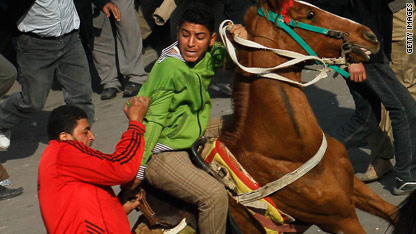
The military, which has until now said it would not use force on peaceful demonstrators, has urged anti-government protesters to return home. And supporters of embattled President Hosni Mubarak, who had been largely silent since the unrest began, came out in full force Wednesday, in one case wielding whips and thundering through the crowd on horses and camels.
As dawn broke Thursday, heavy gunfire reverberated in central Cairo as the two sides continued to face off at Tahrir Square -- the confrontations portending what awaits when Egypt awakes.
Egypt's minister of health said the number of injuries in Cairo's Tahrir Square has reached 829 -- including 200 within one hour on Thursday morning, state-run Nile TV reported. The minister also said four people were killed in Tahrir Square on Thursday morning.
CNN could not independently verify the figures.
A national security official in U.S. President Barack Obama's administration told CNN that the situation in the country could "turn really ugly" and the next 24 to 48 hours will be critical.
"Will the military continue to act responsibly? Or will it fracture?" said the official, who has been involved in Egypt deliberations. "Will Mubarak get it that the writing is on the wall and that he has to transition out quicker? Not sure anyone has the answers."
Meanwhile, chunks of concretes and Molotov cocktails flew in Tahrir Square during the escalating crisis Thursday.
The wounded were being carried into the square, largely held by anti-regime demonstrators, through an entrance that leads to the nearby Egyptian Museum. Several ambulances entered and left the square shortly before 4 a.m. Thursday.
The source of the gunfire was not immediately known.
Another U.S. official said the administration's conversations with Egyptian officials have turned tense and urgent -- with the U.S. side voicing hope the military will see the reality and pressure Mubarak to step down.
While the official was encouraged by signs that the military was not involved in the violence that broke out Wednesday, allowing such fights between supporters and opponents of Mubarak to go on "could fairly be interpreted as a choice, and a troubling choice."
This official voiced hope that "as time passes, the military will see which side it wants to be on for the good of the country and the society."
Some chanted a prayer Thursday after a day of violent street battles in central Cairo. People also shouted, "No one hurt anyone."
Sustained fire from automatic weapons, including from what sounded like a heavy machine gun, echoed around the square, the epicenter of nine days of protests calling for Mubarak's ouster.
Anti-government demonstrators hunkered down behind makeshift barricades in the square and outside the nearby national museum against the onslaught, which demonstrators said included plainclothes police officers.
"They're coming in with weapons. They're spreading violence," human rights activist Gigi Ibrahim told CNN on Wednesday. "We've had peaceful protests here since Friday and no violence here. Only today were we faced with this really violent reaction."
The pro-government protesters were not impeded by the army when they entered the square Thursday. Anti-regime protesters are now unhappy with troops -- whose commanders had promised Monday not to use force against peaceful demonstrations -- for standing by, he said.
Small fires burned in the square early Thursday, with some spreading to trees and walls.
Reported fatalities in the first eight days of demonstrations ranged as high as 300, but CNN could not independently confirm the death toll.
In one surreal moment, whip-wielding Mubarak supporters thundered through the crowd astride horses and camels, and at least one man was pulled off his mount and beaten. A Mubarak supporter who spoke to CNN said the riders were pyramid workers who were protesting the negative economic impact of the crisis.
"What you are seeing is the demonstration of the real Egyptian people who are trying to take back their country, trying to take back their street," said businessman Khaled Ahmed, who described himself as "pro-Egyptian."
But some observers said the pro-Mubarak push Wednesday was likely orchestrated by a regime bent on breaking up peaceful demonstrations.
"These are tactics that are well-known in Egypt," Michele Dunne, a senior associate at the Carnegie Endowment for International Peace, told CNN's John King.
Robert Kagan of the Brookings Institution said the "rent-a-thugs" were likely sanctioned and paid by the government. This is meant to create an image of chaos so the government can move in to restore order, he said.
"Mubarak has -- now, certainly, with the violence today, but even before that -- lost the confidence of the overwhelming number of the Egyptian people," Kagan said.
Desperate for more ammunition, they dismantled sidewalks and picked up chunks of concrete They beat each other in what rapidly spiraled into utter mayhem.
Hundreds of injured people were treated by doctors and medical staff, who turned to volunteers for assistance.
CNN iReporter Hunter Moore, 26, helped treat the wounded. The U.S. schoolteacher said Tuesday's crowds at Tahrir Square were mostly peaceful. "It went downhill really, really quickly" on Wednesday, he told CNN.
It was unclear whether such confrontations were being repeated elsewhere. Other Cairo neighborhoods were calm, and rallies in Egypt's second-largest city, Alexandria, were largely peaceful.
Mubarak's opponents had stood shoulder to shoulder in Tahrir Square to call for his immediate resignation in a massive rally on Tuesday. The 82-year-old president's announcement that night that he would spend the remaining seven months of his current term working to ensure a "peaceful transition of power" failed to satisfy them, and they vowed to keep up the pressure on him to resign.
The crisis has paralyzed the Egyptian economy, as the government has closed banks, idled trains and shuttered schools. Markets are running short of basic food staples, and the situation is hurting the ability of ordinary citizens to join the demonstrations, opposition activist Ziad Aly told CNN.
"We can't get enough bread. We can't get enough food supplies," he said.
Vice President Omar Suleiman reiterated the government stance that the people have been heard, that they should go home and that they should stop demonstrating. Protesters should respect the curfew and "enable people to return to their jobs and their daily lives, and to allow schools and universities to reopen," he said in a statement.
The state-run television network, Nile TV, sought to portray the unrest as a "foreign conspiracy" fueled by international journalists, several of whom -- including CNN's Anderson Cooper -- were attacked during Wednesday's clashes.
Despite reports that shots had been fired, Nile TV's reporters denied any shooting had taken place or even that violence had broken out in Tahrir Square. The network also said that members of the opposition Muslim Brotherhood were heading to the square "to throw balls of fire and to start acts of riots and violence."
When asked if that were true, Mohamed Morsy, a spokesman for the Muslim Brotherhood, said the action came from all segments of the Egyptian people, "not the Muslim Brotherhood only."
Morsy told CNN's Wolf Blitzer that the time for change is now, not when Mubarak's term ends.
"We need a new era, a new regime," Morsy said. "We have a constitution."
Asked whether Suleiman could lead the government until new elections, Morsy said the head of the country's supreme court should fulfill that role.
Mubarak's government bluntly told outsiders to mind their own business.
"Our interactions within our country are Egyptian affairs and nothing more than that," Foreign Ministry spokesman Hossam Zaki said. Egypt "will continue to be a beacon of moderation and stability in our region," he said, but its people must settle their differences without "intervention from the outside."
Though Mubarak's concessions were large and remarkable for a man who has held a tight grip on power for three decades, it was too little, too late for many Egyptians.
"He is unfortunately going to continue the agony for another six or seven months," opposition leader Mohamed ElBaradei said Tuesday night.
However, Mubarak supporter Waleed Tawfik told CNN that not all Egyptians agree that Mubarak should step down immediately.
"Change will not happen overnight. There's not a magical button for change. Change will take time," he said.
The Egyptian army can't sit on the sidelines too much longer, or it could risk unraveling, one foreign policy expert said.
The army needs to pick a course of action by Friday, when more mass protests are expected after prayers, Richard Haass, president of the Council on Foreign Relations, told CNN's "Parker Spitzer."

Cairo, Egypt (CNN) -- In a way, the events of the past week may have been a prelude to what could happen in Egypt on Thursday.
The military, which has until now said it would not use force on peaceful demonstrators, has urged anti-government protesters to return home. And supporters of embattled President Hosni Mubarak, who had been largely silent since the unrest began, came out in full force Wednesday, in one case wielding whips and thundering through the crowd on horses and camels.
As dawn broke Thursday, heavy gunfire reverberated in central Cairo as the two sides continued to face off at Tahrir Square -- the confrontations portending what awaits when Egypt awakes.
Egypt's minister of health said the number of injuries in Cairo's Tahrir Square has reached 829 -- including 200 within one hour on Thursday morning, state-run Nile TV reported. The minister also said four people were killed in Tahrir Square on Thursday morning.
CNN could not independently verify the figures.
A national security official in U.S. President Barack Obama's administration told CNN that the situation in the country could "turn really ugly" and the next 24 to 48 hours will be critical.
"Will the military continue to act responsibly? Or will it fracture?" said the official, who has been involved in Egypt deliberations. "Will Mubarak get it that the writing is on the wall and that he has to transition out quicker? Not sure anyone has the answers."
Meanwhile, chunks of concretes and Molotov cocktails flew in Tahrir Square during the escalating crisis Thursday.
The wounded were being carried into the square, largely held by anti-regime demonstrators, through an entrance that leads to the nearby Egyptian Museum. Several ambulances entered and left the square shortly before 4 a.m. Thursday.
The source of the gunfire was not immediately known.
Another U.S. official said the administration's conversations with Egyptian officials have turned tense and urgent -- with the U.S. side voicing hope the military will see the reality and pressure Mubarak to step down.
While the official was encouraged by signs that the military was not involved in the violence that broke out Wednesday, allowing such fights between supporters and opponents of Mubarak to go on "could fairly be interpreted as a choice, and a troubling choice."
This official voiced hope that "as time passes, the military will see which side it wants to be on for the good of the country and the society."
Some chanted a prayer Thursday after a day of violent street battles in central Cairo. People also shouted, "No one hurt anyone."
Sustained fire from automatic weapons, including from what sounded like a heavy machine gun, echoed around the square, the epicenter of nine days of protests calling for Mubarak's ouster.
Anti-government demonstrators hunkered down behind makeshift barricades in the square and outside the nearby national museum against the onslaught, which demonstrators said included plainclothes police officers.
"They're coming in with weapons. They're spreading violence," human rights activist Gigi Ibrahim told CNN on Wednesday. "We've had peaceful protests here since Friday and no violence here. Only today were we faced with this really violent reaction."
The pro-government protesters were not impeded by the army when they entered the square Thursday. Anti-regime protesters are now unhappy with troops -- whose commanders had promised Monday not to use force against peaceful demonstrations -- for standing by, he said.
Small fires burned in the square early Thursday, with some spreading to trees and walls.
Reported fatalities in the first eight days of demonstrations ranged as high as 300, but CNN could not independently confirm the death toll.
In one surreal moment, whip-wielding Mubarak supporters thundered through the crowd astride horses and camels, and at least one man was pulled off his mount and beaten. A Mubarak supporter who spoke to CNN said the riders were pyramid workers who were protesting the negative economic impact of the crisis.
"What you are seeing is the demonstration of the real Egyptian people who are trying to take back their country, trying to take back their street," said businessman Khaled Ahmed, who described himself as "pro-Egyptian."
But some observers said the pro-Mubarak push Wednesday was likely orchestrated by a regime bent on breaking up peaceful demonstrations.
"These are tactics that are well-known in Egypt," Michele Dunne, a senior associate at the Carnegie Endowment for International Peace, told CNN's John King.
Robert Kagan of the Brookings Institution said the "rent-a-thugs" were likely sanctioned and paid by the government. This is meant to create an image of chaos so the government can move in to restore order, he said.
"Mubarak has -- now, certainly, with the violence today, but even before that -- lost the confidence of the overwhelming number of the Egyptian people," Kagan said.
Desperate for more ammunition, they dismantled sidewalks and picked up chunks of concrete They beat each other in what rapidly spiraled into utter mayhem.
Hundreds of injured people were treated by doctors and medical staff, who turned to volunteers for assistance.
CNN iReporter Hunter Moore, 26, helped treat the wounded. The U.S. schoolteacher said Tuesday's crowds at Tahrir Square were mostly peaceful. "It went downhill really, really quickly" on Wednesday, he told CNN.
It was unclear whether such confrontations were being repeated elsewhere. Other Cairo neighborhoods were calm, and rallies in Egypt's second-largest city, Alexandria, were largely peaceful.
Mubarak's opponents had stood shoulder to shoulder in Tahrir Square to call for his immediate resignation in a massive rally on Tuesday. The 82-year-old president's announcement that night that he would spend the remaining seven months of his current term working to ensure a "peaceful transition of power" failed to satisfy them, and they vowed to keep up the pressure on him to resign.
The crisis has paralyzed the Egyptian economy, as the government has closed banks, idled trains and shuttered schools. Markets are running short of basic food staples, and the situation is hurting the ability of ordinary citizens to join the demonstrations, opposition activist Ziad Aly told CNN.
"We can't get enough bread. We can't get enough food supplies," he said.
Vice President Omar Suleiman reiterated the government stance that the people have been heard, that they should go home and that they should stop demonstrating. Protesters should respect the curfew and "enable people to return to their jobs and their daily lives, and to allow schools and universities to reopen," he said in a statement.
The state-run television network, Nile TV, sought to portray the unrest as a "foreign conspiracy" fueled by international journalists, several of whom -- including CNN's Anderson Cooper -- were attacked during Wednesday's clashes.
Despite reports that shots had been fired, Nile TV's reporters denied any shooting had taken place or even that violence had broken out in Tahrir Square. The network also said that members of the opposition Muslim Brotherhood were heading to the square "to throw balls of fire and to start acts of riots and violence."
When asked if that were true, Mohamed Morsy, a spokesman for the Muslim Brotherhood, said the action came from all segments of the Egyptian people, "not the Muslim Brotherhood only."
Morsy told CNN's Wolf Blitzer that the time for change is now, not when Mubarak's term ends.
"We need a new era, a new regime," Morsy said. "We have a constitution."
Asked whether Suleiman could lead the government until new elections, Morsy said the head of the country's supreme court should fulfill that role.
Mubarak's government bluntly told outsiders to mind their own business.
"Our interactions within our country are Egyptian affairs and nothing more than that," Foreign Ministry spokesman Hossam Zaki said. Egypt "will continue to be a beacon of moderation and stability in our region," he said, but its people must settle their differences without "intervention from the outside."
Though Mubarak's concessions were large and remarkable for a man who has held a tight grip on power for three decades, it was too little, too late for many Egyptians.
"He is unfortunately going to continue the agony for another six or seven months," opposition leader Mohamed ElBaradei said Tuesday night.
However, Mubarak supporter Waleed Tawfik told CNN that not all Egyptians agree that Mubarak should step down immediately.
"Change will not happen overnight. There's not a magical button for change. Change will take time," he said.
The Egyptian army can't sit on the sidelines too much longer, or it could risk unraveling, one foreign policy expert said.
The army needs to pick a course of action by Friday, when more mass protests are expected after prayers, Richard Haass, president of the Council on Foreign Relations, told CNN's "Parker Spitzer."
The Egyptian crisis is among the aftershocks of the revolt in Tunisia that forced that nation's longtime strongman to flee to Saudi Arabia in January. In Yemen, President Ali Abdullah Saleh -- who has been in office for 32 years -- said Wednesday he will not run for president nor hand over power to his son once his term ends in 2013.
Clashes erupt amid Cairo protests
The struggle for control of the future of Egypt continued in Cairo
Continue reading the main story
There have been fierce clashes in the Egyptian capital between supporters of President Hosni Mubarak and protesters calling on him to resign immediately.
Officials say a member of the security forces was killed and more than 600 people wounded in pitched battles in and around Cairo's Tahrir Square.
Gunshots have been heard in the area.
Earlier, the army urged people to go home following nine days of protests that led Mr Mubarak to vow not to stand for re-election in September.
The violence comes after more than a week of opposition demonstrations that have left about 300 people dead, according to UN estimates.
Counter-protests
Up to 2,000 anti-Mubarak demonstrators had spent Tuesday night in Tahrir Square, the main focus of the protests, saying the president's pledge was insufficient and chanting: "We will not leave!"
Continue reading the main story
On Wednesday, thousands of supporters of President Mubarak arrived in buses and surged into the square, dismantling barricades.
"Let the man (Mubarak) take care of you until his time is up," Mohamed Shafik, 51, told Reuters news agency. "Mubarak wants stability and we want stability as well."
One anti-government protester told the BBC that pro-Mubarak activists had initiated the violence.
"They started throwing stones at us," the man, named as Zaccaria, said. "Then some of us started throwing stones at them and then we chased them out of the square. They returned once again with the horses and the whips and the thugs."
Opposition supporters say many in the pro-government camp were paid by the authorities to demonstrate, and allowed into the square by the troops surrounding it.
Repeated bursts of gunfire have been heard. Some reports say troops fired warning shots to disperse the crowds.
Ibrahim Zadran, co-ordinator of the opposition National Association for Change, told the BBC that some pro-government activists had used firearms and shot 15 protesters.
BBC Middle East editor Jeremy Bowen, who has been to Tahrir Square, said he had seen people with nasty wounds.
Egyptian Health Minister Ahmed Sameh Farid told the Associated Press news agency that the dead man was a member of the security forces who fell off a bridge.
As darkness fell, people were seen throwing rocks and petrol bombs from rooftops on to the protesters below.
The clashes later died down, although there were petrol bomb incidents into the night. Many anti-government protesters remain in Tahrir Square.
The BBC's Yolande Knell in Cairo says the situation remains tense there as fires continue to burn outside the museum building.
International reactions
Clashes between the rival groups were also reported in Egypt's second city, Alexandria.
Continue
Late on Wednesday Vice-President Omar Suleiman urged "all citizens to return to their homes and abide by the curfew".
The violence drew condemnation from British Prime Minister David Cameron.
"If it turns out that the regime in any way has sponsored or tolerated this violence, that is completely unacceptable," he said after meeting UN Secretary General Ban Ki-moon in London.
Mr Ban said: "Any attack against the peaceful demonstrators is unacceptable and I strongly condemn it."
In Washington, the state department reiterated a call for all sides to show restraint.
In its earlier statement, Egypt's army called for demonstrators to return to their homes.
In a speech on Tuesday night Mr Mubarak - who has been in office for nearly 30 years - promised to leave at the next polls and pledged constitutional reform.
He said he would devote his remaining time in power to ensuring a peaceful transition.
US President Barack Obama responded by saying an orderly transition "must begin now".
Opposition leader Mohamed ElBaradei dismissed Mr Mubarak's move as "a trick" to stay in power, and Tahrir Square protesters have vowed to continue their demonstrations until Mr Mubarak quits.
Abdelhalim Kandil, leader of Egypt's Kifaya (Enough) opposition movement, said Mr Mubarak's offer not to serve a sixth term was not enough.
"I will tell you very simply that there is an unprecedented popular movement that rejects the presence of the president on a scope that has not been seen before, that is calling for the will of the people to be imposed," he said.
If Mr Mubarak does not step down, demonstrators have planned to march on the presidential palace.
Meanwhile, internet services were returning to the country, having been cut off for days by the government.
Subscribe to:
Posts (Atom)