By the CNN Wire Staff
Cairo, Egypt (CNN) -- Demonstrators have built a barbed-wire barricade and stacked piles of rocks throughout Cairo's Tahrir Square Friday, where they gathered to demand President Hosni Mubarak's resignation.
Military forces surrounded the square, and anti-government protesters manned their own security checkpoints, which included numerous blockades. The stream of demonstrators entering the square was steady at midday.
As midday prayers ended, anti-government protesters chanted, "He leaves, we don't leave" and "The blood of the martyrs will not be forgotten."
Anti-government protesters have pledged to bring droves of demonstrators to the square Friday for what they dubbed a "day of farewell" and "day of departure," referring to their push for Mubarak to resign. Elsewhere in Cairo, pro-government protesters said they were gathering in a mosque for a "day of loyalty."
But the pro-Mubarak groups were notably absent from Tahrir Square, where they clashed with anti-government protesters earlier this week.
In the northern port city of Alexandria, the streets leading to the Al Kaed Ibrahim mosque were packed as the midday sermon began.
"This is a great revolution and the whole regime, the entire system needs to be changed. The revolution must continue until all objectives are met," the mosque's imam told the crowd.
Writing on the walls leading to the mosque, where police and anti-government demonstrators clashed last Friday, said "Game OVER" and "Pharaoh's last day."There was very little military presence in Alexandria, but troops wearing riot gear toted automatic weapons near Cairo's Tahrir Square.
Security forces detained some people leaving the square, pointing guns at them and forcing them to lie on the ground early Friday. A burned-out car and a group of troops blocked the October 6 bridge, which crosses the Nile River and serves as an entrance to the square.
The anti-government protests were scheduled to start after Friday prayers, and some demonstrators suggested the group may march toward the presidential palace.
Mubarak is not gone, but his days are numbered. The leader agreed Tuesday to not seek re-election in September.In the bloody blur of days since his announcement that he would not stand for re-election, regime foes and supporters have clashed repeatedly in Tahrir Square, the center of anti-government demonstrations. Eight people have been killed and nearly 896 injured, according to the health ministry.
The atmosphere Friday morning was peaceful and optimistic, but tense. Some anti-government demonstrators smiled as they sang patriotic songs. Exhausted protesters slept on sidewalks inside the square. A man with an Egyptian flag wrapped around his head sat on a curb, flashing a victory sign.
A handful of pro-government protesters cheered as large vans filled with security forces arrived at Tahrir Square around 6 a.m. Friday (11 p.m. ET). It was unclear whether those inside were members of the military or police.
Mubarak told ABC News Thursday he would like to step down right away, but cannot because he does not want to risk plunging his nation into chaos.Vice President Omar Suleiman blamed the media for some of the unrest that has plagued his country since anti-government demonstrations began January 25.
"I actually blame certain friendly nations who have television channels, they are not friendly at all, who have intensified the youth against the nation and the state," Suleiman told Nile TV. "They have filled in the minds of the youth with wrongdoings, with allegations, and this is unacceptable."
Thursday saw an escalation of attacks on journalists covering the demonstrations. Many of those targeted asked whether the government was clearing them out of the way to cloak its actions.
"Why doesn't the government want us around? What is it that it plans to do in the next few days that it really doesn't want cameras to be able to report on?" New York Times columnist Nicholas Kristof told CNN.
Mubarak told ABC News correspondent Christiane Amanpour that he was troubled by the bloody clashes that broke out Wednesday in Tahrir Square.
As the United States and other countries condemned increasing attacks on journalists and diplomats, Mubarak rejected the notion that government instigated the violence in the country, instead blaming the Muslim Brotherhood, an Islamist umbrella group that is banned in Egypt.
"I don't care what people say about me," Mubarak told ABC. "Right now I care about my country, I care about Egypt.
"I was very unhappy about yesterday. I do not want to see Egyptians fighting each other," he said in the interview, which was conducted at the heavily guarded presidential palace, where the embattled leader has been staying with his family.
Mubarak said he never intended to seek re-election or for his son, Gamal, to seek the post. He made the comment to Amanpour in his son's presence.Mubarak's concession that he would not run for re-election has not been enough for tens of thousands of protesters demanding immediate change.
Top government leaders vowed to hold accountable perpetrators of the bloodshed and told protesters to return home."I want to thank the youth for all you have done," Suleiman said on state-run Nile TV. "You are the lights that have ignited reform in this period. Please give the (government a) chance to play its role. All of your demands have been met."
Suleiman told ABC that Egyptian troops will not force anti-Mubarak protesters to leave Tahrir Square.
Mubarak supporters, some believed to be paid government thugs, converged with anti-government crowds Wednesday in a confrontation that quickly evolved into continuing mayhem in Tahrir Square.Egyptian Prime Minister Ahmed Shafiq apologized repeatedly for the violence. He blamed infiltrators and a "complete disappearance" of police for the human toll in the "catastrophe."
Shafiq said he and Suleiman were meeting with the opposition -- including protesters in Tahrir Square. He said no one would be excluded from the national dialogue, including the Muslim Brotherhood.
The United States is stepping up pressure on the opposition to begin immediate negotiations with the Egyptian government."It's time for both of them to roll up their sleeves," a senior State Department official told CNN. "The government has to take some steps, but the opposition has to be willing to participate in negotiations as well."
Showing posts with label demonstrators. Show all posts
Showing posts with label demonstrators. Show all posts
Friday, February 4, 2011


Journalists report second day of detentions, harassment in Cairo
By the CNN Wire Staff

Cairo, Egypt (CNN) -- Journalists attempting to cover unprecedented unrest in Egypt reported being targeted, beaten, arrested and harassed by security forces and police for a second day Thursday.
Al Jazeera released a statement demanding that three of its journalists, detained by Egyptian security forces, be released. A fourth has been reported missing, the network said.The Washington Post reported, citing multiple witnesses, that its Cairo bureau chief, Leila Fadel, and photographer Linda Davidson were among two journalists arrested Thursday morning by the Egyptian Interior Ministry. The Post later said on its blog that Fadel had called to say she and Davidson were released, but the two were separated from Sufian Taha, their translator and a longtime Post employee, and their Egyptian driver, Mansour el-Sayed Mohammed Abo Gouda. The two men were unaccounted for, the Post said.
The New York Times reported Thursday that two of its reporters had been released after being detained overnight in Cairo.Others said their gear had been confiscated. And the BBC tweeted Thursday, "Egyptian security seize BBC equipment at Cairo Hilton in attempt to stop us broadcasting."
"Gear taken at hotel for its own security," one photojournalist posted online. "... See if we get it back."U.S. State Department officials told CNN they have information that Egypt's Interior Ministry was behind the journalist detentions, citing reports from the U.S. Embassy in Egypt. Department officials were expected to discuss the issue with the Egyptian Embassy in Washington and the Foreign Ministry in Cairo.
Department spokesman P.J. Crowley said the attacks and harassment of journalists seem to be part of an organized effort, but it was unclear who was directing it. "I don't think these are random attacks," he told reporters."There is a concerted campaign to intimidate international journalists in Cairo and interfere with their reporting," Crowley posted earlier Thursday on Twitter. "We condemn such actions."
A photojournalist for CNN-IBN, Rajesh Bhardwaj, was detained in Cairo's Tahrir Square, the site of bloody clashes between supporters and opponents of President Hosni Mubarak. He was taken away by the Egyptian Army and later released, but only after his identification card and tapes were destroyed, said Suhasini Haidar, CNN-IBN deputy foreign editor.
The Indian Ministry of External Affairs was advising Indian journalists in Egypt to avoid trouble spots.Other journalists reported being beaten and harassed by protesters."Situation on ground in Egypt very tense," CNN's Anderson Cooper tweeted Thursday. "Vehicle I was in attacked. My window smashed. All OK."
The Greek daily newspaper Kathimerini said one of its reporters, Petros Papaconstantinou, was beaten by protesters in Cairo's Tahrir Square. Papaconstantinou was clubbed in the head with a baton and stabbed in the foot, either with a knife or a screwdriver, said Xenia Kounalaki, head of the newspaper's foreign desk. A photographer also sustained minor injuries, Kounalaki said, and both were treated at a Cairo hospital and released.
Other journalists reported close calls. Marie Colvin of the Sunday Times of London said she was approached by a gang of men with knives in Imbaba, a poor neighborhood of Cairo. Another group of men, who also were strangers to her, pushed her into a store and locked it to protect her, she said.
In addition, several human rights groups reported their representatives had been detained.The Hisham Mubarak Law Center, a human rights law firm, was taken over by military police, as was the Egyptian Center for Economic and Social Rights, Oxfam International said in a statement. A total of eight people were detained, including the directors of both centers, the organization said.
Oxfam said several of its staff members were among those detained. Amnesty International and Human Rights Watch each said one of their researchers was detained at the law center. They were interrogated before being taken away to an unknown location in Cairo, Human Rights Watch said. All three groups called for the immediate release of their staffers.
Al Jazeera said Thursday that six of its journalists had been detained by Egyptian authorities in the past week, with equipment stolen and destroyed. "It has also faced unprecedented levels (of) interference in its broadcast signal across the Arab world," the network said in a statement.U.N. Secretary General Ban Ki-moon condemned the attacks.
"The freedom of speech, whether journalists or demonstrators -- they should be fully guaranteed and protected. That is a ground principle of democracy," he said.
Meanwhile, Shahira Amin, a reporter for Egypt's state-run Nile TV, resigned Thursday."I spent the day at Nile TV yesterday," she told CNN. "I was only allowed to air the pro-Mubarak rallies that were going on, as if nothing was happening at Tahrir Square. We weren't allowed to reveal any figures. There was a near total blackout," she said, calling it "hypocritical ... I just don't want to be part of it."
She said she should have resigned "ages ago. ... I was happy to spend the day in Tahrir Square where the people are. ... I am on their side."
"People are too scared to tell the truth," she said. "There is a built-in or inherent feeling that many Egyptian journalists have because of (the threat of) detention and arrest."She added, "I haven't been intimidated all these years. I have been telling the truth. I managed to get away with it until now. This time around, I just couldn't tell the truth, so I just walked out."
Journalists were also targeted on Wednesday, with some beaten, bloodied, harassed and detained by men, most of them apparently aligned in some way with Mubarak.Numerous news outlets -- including the BBC, ABC News and CNN -- reported members of their staffs had been attacked, mostly on the streets of Cairo. In several cases, news personnel were accused of being "foreign spies," seized, whisked away, and often assaulted.
Fox News reported Thursday that a reporter and cameraman, forced to flee their position after a Molotov cocktail ignited a fire, ran into pro-Mubarak protesters and were so severely beaten they spent the night in a hospital before being released Thursday.
"It was pandemonium. There was no control. Suddenly a man would come up to you and punch you in the face," said CNN's Cooper, describing being attacked by pro-Mubarak demonstrators along with two colleagues outside of Tahrir Square.
CNN's Hala Gorani got caught Wednesday morning in a stampede of demonstrators, some of whom were riding on camels and horses."I got slammed against the gates and was threatened by one of the pro-Mubarak protesters who was ... telling me to 'get out, get out!'" Gorani said. "The pro-Mubaraks, whoever they are, whoever sent them, are being threatening toward camera crews, journalists, anybody who looks like they may be onlookers."
A BBC correspondent, Rupert Wingfield-Hayes, and his crew were "arrested by members of the secret police" on Wednesday after interviewing a presidential adviser, the BBC reported. They were later released, the network said.The Dubai-based Al-Arabiya news network was among the worst hit, with its office damaged and several of its staff targeted. Among them was correspondent Ahmed Abdullah, who his editor confirmed Wednesday was found bloodied after being severely beaten by his captors. He was transported to a hospital,
Maurice Sarfatti told the Brussels-based Le Soir newspaper, which he writes for along with publications in Switzerland and France, that he "received a stream of blows to the face" from men claiming he backed leading opposition figure Mohamed ElBaradei."I am being guarded by two soldiers with Kalashnikovs (rifles) and bayonets," said Sarfatti, according to a translation from Le Soir. "They say I will be taken before the intelligence services. They say I am a spy."
The Committee to Protect Journalists, a New York-based advocacy organization, claimed that such accounts were all too commonplace around Cairo.In a news release, the group detailed about a dozen incidents, accusing men -- most of them described as pro-Mubarak demonstrators, "plainclothes police," uniformed officers and military -- of perpetrating attacks on reporters seen with cameras and notepads.
The group laid the blame for this violence squarely on Mubarak's administration, accusing it of scheming to suppress and stifle news coverage."The Egyptian strategy is employing a strategy of eliminating witnesses to their actions," said Mohamed Abdel Dayem, the committee's Middle East and North Africa program coordinator. "The government has resorted to blanket censorship, intimidation and, today, a series of deliberate attacks on journalists carried out by pro-government mobs."

Cairo, Egypt (CNN) -- Journalists attempting to cover unprecedented unrest in Egypt reported being targeted, beaten, arrested and harassed by security forces and police for a second day Thursday.
Al Jazeera released a statement demanding that three of its journalists, detained by Egyptian security forces, be released. A fourth has been reported missing, the network said.The Washington Post reported, citing multiple witnesses, that its Cairo bureau chief, Leila Fadel, and photographer Linda Davidson were among two journalists arrested Thursday morning by the Egyptian Interior Ministry. The Post later said on its blog that Fadel had called to say she and Davidson were released, but the two were separated from Sufian Taha, their translator and a longtime Post employee, and their Egyptian driver, Mansour el-Sayed Mohammed Abo Gouda. The two men were unaccounted for, the Post said.
The New York Times reported Thursday that two of its reporters had been released after being detained overnight in Cairo.Others said their gear had been confiscated. And the BBC tweeted Thursday, "Egyptian security seize BBC equipment at Cairo Hilton in attempt to stop us broadcasting."
"Gear taken at hotel for its own security," one photojournalist posted online. "... See if we get it back."U.S. State Department officials told CNN they have information that Egypt's Interior Ministry was behind the journalist detentions, citing reports from the U.S. Embassy in Egypt. Department officials were expected to discuss the issue with the Egyptian Embassy in Washington and the Foreign Ministry in Cairo.
Department spokesman P.J. Crowley said the attacks and harassment of journalists seem to be part of an organized effort, but it was unclear who was directing it. "I don't think these are random attacks," he told reporters."There is a concerted campaign to intimidate international journalists in Cairo and interfere with their reporting," Crowley posted earlier Thursday on Twitter. "We condemn such actions."
A photojournalist for CNN-IBN, Rajesh Bhardwaj, was detained in Cairo's Tahrir Square, the site of bloody clashes between supporters and opponents of President Hosni Mubarak. He was taken away by the Egyptian Army and later released, but only after his identification card and tapes were destroyed, said Suhasini Haidar, CNN-IBN deputy foreign editor.
The Indian Ministry of External Affairs was advising Indian journalists in Egypt to avoid trouble spots.Other journalists reported being beaten and harassed by protesters."Situation on ground in Egypt very tense," CNN's Anderson Cooper tweeted Thursday. "Vehicle I was in attacked. My window smashed. All OK."
The Greek daily newspaper Kathimerini said one of its reporters, Petros Papaconstantinou, was beaten by protesters in Cairo's Tahrir Square. Papaconstantinou was clubbed in the head with a baton and stabbed in the foot, either with a knife or a screwdriver, said Xenia Kounalaki, head of the newspaper's foreign desk. A photographer also sustained minor injuries, Kounalaki said, and both were treated at a Cairo hospital and released.
Other journalists reported close calls. Marie Colvin of the Sunday Times of London said she was approached by a gang of men with knives in Imbaba, a poor neighborhood of Cairo. Another group of men, who also were strangers to her, pushed her into a store and locked it to protect her, she said.
In addition, several human rights groups reported their representatives had been detained.The Hisham Mubarak Law Center, a human rights law firm, was taken over by military police, as was the Egyptian Center for Economic and Social Rights, Oxfam International said in a statement. A total of eight people were detained, including the directors of both centers, the organization said.
Oxfam said several of its staff members were among those detained. Amnesty International and Human Rights Watch each said one of their researchers was detained at the law center. They were interrogated before being taken away to an unknown location in Cairo, Human Rights Watch said. All three groups called for the immediate release of their staffers.
Al Jazeera said Thursday that six of its journalists had been detained by Egyptian authorities in the past week, with equipment stolen and destroyed. "It has also faced unprecedented levels (of) interference in its broadcast signal across the Arab world," the network said in a statement.U.N. Secretary General Ban Ki-moon condemned the attacks.
"The freedom of speech, whether journalists or demonstrators -- they should be fully guaranteed and protected. That is a ground principle of democracy," he said.
Meanwhile, Shahira Amin, a reporter for Egypt's state-run Nile TV, resigned Thursday."I spent the day at Nile TV yesterday," she told CNN. "I was only allowed to air the pro-Mubarak rallies that were going on, as if nothing was happening at Tahrir Square. We weren't allowed to reveal any figures. There was a near total blackout," she said, calling it "hypocritical ... I just don't want to be part of it."
She said she should have resigned "ages ago. ... I was happy to spend the day in Tahrir Square where the people are. ... I am on their side."
"People are too scared to tell the truth," she said. "There is a built-in or inherent feeling that many Egyptian journalists have because of (the threat of) detention and arrest."She added, "I haven't been intimidated all these years. I have been telling the truth. I managed to get away with it until now. This time around, I just couldn't tell the truth, so I just walked out."
Journalists were also targeted on Wednesday, with some beaten, bloodied, harassed and detained by men, most of them apparently aligned in some way with Mubarak.Numerous news outlets -- including the BBC, ABC News and CNN -- reported members of their staffs had been attacked, mostly on the streets of Cairo. In several cases, news personnel were accused of being "foreign spies," seized, whisked away, and often assaulted.
Fox News reported Thursday that a reporter and cameraman, forced to flee their position after a Molotov cocktail ignited a fire, ran into pro-Mubarak protesters and were so severely beaten they spent the night in a hospital before being released Thursday.
"It was pandemonium. There was no control. Suddenly a man would come up to you and punch you in the face," said CNN's Cooper, describing being attacked by pro-Mubarak demonstrators along with two colleagues outside of Tahrir Square.
CNN's Hala Gorani got caught Wednesday morning in a stampede of demonstrators, some of whom were riding on camels and horses."I got slammed against the gates and was threatened by one of the pro-Mubarak protesters who was ... telling me to 'get out, get out!'" Gorani said. "The pro-Mubaraks, whoever they are, whoever sent them, are being threatening toward camera crews, journalists, anybody who looks like they may be onlookers."
A BBC correspondent, Rupert Wingfield-Hayes, and his crew were "arrested by members of the secret police" on Wednesday after interviewing a presidential adviser, the BBC reported. They were later released, the network said.The Dubai-based Al-Arabiya news network was among the worst hit, with its office damaged and several of its staff targeted. Among them was correspondent Ahmed Abdullah, who his editor confirmed Wednesday was found bloodied after being severely beaten by his captors. He was transported to a hospital,
Maurice Sarfatti told the Brussels-based Le Soir newspaper, which he writes for along with publications in Switzerland and France, that he "received a stream of blows to the face" from men claiming he backed leading opposition figure Mohamed ElBaradei."I am being guarded by two soldiers with Kalashnikovs (rifles) and bayonets," said Sarfatti, according to a translation from Le Soir. "They say I will be taken before the intelligence services. They say I am a spy."
The Committee to Protect Journalists, a New York-based advocacy organization, claimed that such accounts were all too commonplace around Cairo.In a news release, the group detailed about a dozen incidents, accusing men -- most of them described as pro-Mubarak demonstrators, "plainclothes police," uniformed officers and military -- of perpetrating attacks on reporters seen with cameras and notepads.
The group laid the blame for this violence squarely on Mubarak's administration, accusing it of scheming to suppress and stifle news coverage."The Egyptian strategy is employing a strategy of eliminating witnesses to their actions," said Mohamed Abdel Dayem, the committee's Middle East and North Africa program coordinator. "The government has resorted to blanket censorship, intimidation and, today, a series of deliberate attacks on journalists carried out by pro-government mobs."
Mubarak tells ABC his resignation would cause chaos
By the CNN Wire Staff

Cairo, Egypt (CNN) -- Egyptian President Hosni Mubarak on Thursday blamed the outlawed Muslim Brotherhood for the violence unfolding in Cairo and said he would like to step down right away, but cannot because he does not want to risk plunging his nation into chaos, ABC News reported.
Mubarak told ABC correspondent Christiane Amanpour that he was troubled by the bloody clashes that broke out Wednesday in Tahrir Square, the center of anti-government demonstrations.
As the United States and other countries condemned increasing attacks on journalists and diplomats, Mubarak rejected the notion that government instigated the violence, instead blaming the Muslim Brotherhood, an Islamist umbrella group that is banned in Egypt.
"I don't care what people say about me," Mubarak told ABC. "Right now I care about my country, I care about Egypt."I was very unhappy about yesterday. I do not want to see Egyptians fighting each other," he said in the interview, which was conducted at the heavily guarded presidential palace where the embattled leader has been staying with his family.
Mubarak told ABC that U.S. President Barack Obama is a very good man but bristled at the notion of an ally's interference in internal problems. He said he told Obama: "You don't understand the Egyptian culture and what would happen if I step down now."
Obama has said he told Mubarak a transition must take place, and it "must be meaningful, it must be peaceful and it must begin now."
Mubarak said he never intended to seek re-election. Nor did he intend his son, Gamal, who was believed to be groomed as Mubarak's successor, to seek the post. He made the comment to Amanpour in his son's presence.\
Vice President Omar Suleiman, tapped as Mubarak's vice president last Saturday, publicly announced Thursday that Gamal Mubarak will not stand in September elections.
Mubarak, who has ruled Egypt for three decades, announced his decision to not run again last week. But that concession has not been enough for tens of thousands of protesters demanding immediate change.
His regime moved Thursday to quell the deadly revolt, telling protesters their demands had been met and cracking down on journalists and human rights activists bearing witness to the crisis.
All day long, Mubarak's supporters and foes clashed again to retain control of Tahrir Square, the central city plaza that has become the symbol of the 10-day Egyptian uprising. Many looked like medieval warriors, toting handcrafted shields while throwing stones and other objects.
Top government leaders vowed to hold accountable perpetrators of the bloodshed and told protesters to return home."I want to thank the youth for all you have done," Suleiman said on state-run Nile TV. "You are the lights that have ignited reform in this period. Please give the (government a) chance to play its role. All of your demands have been met."
Mubarak supporters, some believed to be paid government thugs, converged with anti-government crowds Wednesday in a confrontation that quickly evolved into continuing mayhem in Tahrir Square. At least eight people were killed and 836 injured, including 200 wounded within one hour Thursday morning, according to the health ministry.
Journalists covering the crisis also became targets -- beaten, bloodied, harassed and detained by men, most all in some way aligned with Mubarak.Numerous news outlets -- including the BBC, ABC News, the Washington Post and CNN -- reported members of their staffs had either been attacked or arrested. Amnesty International and Human Rights Watch also reported that staffers were detained.
In several cases, news personnel were accused of being "foreign spies," seized, whisked away, and often assaulted.
"The Egyptian government is employing a strategy of eliminating witnesses to their actions," said Mohamed Abdel Dayem of the Committee to Protect Journalists."The government has resorted to blanket censorship, intimidation, and today a series of deliberate attacks on journalists carried out by pro-government mobs," he said. "The situation is frightening not only because our colleagues are suffering abuse but because when the press is kept from reporting, we lose an independent source of crucial information."
The U.S. State Department publicly condemned the crackdown on journalists, and officials told CNN they have received reports that Egypt's Interior Ministry was involved.
Secretary of State Hillary Clinton called such attacks "a violation of international norms that guarantee freedom of the press, and it is unacceptable in any circumstances."
Increasingly concerned about the potential for further violence, Clinton called on the government, political parties and others to immediately begin talks "on a peaceful and orderly transition."
The leaders of France, Germany, Italy, Spain and Britain also urged a "rapid and peaceful transition," and the European Union foreign affairs chief, Catherine Ashton, called on Mubarak to act "as quickly as possible."
Egyptian Prime Minister Ahmed Shafiq apologized repeatedly for the violence. He blamed infiltrators and a "complete disappearance" of police for the human toll in the "catastrophe."
"This group got in and some clashes happened," Shafiq said, adding that he would look into whether the violence was part of an organized attempt to disband the opposition.
Suleiman said Thursday that unrest has done massive economic damage to the country."Unfortunately, the economic losses every day, I cannot estimate but it's going to have a huge impact in the future," he said. "Continuing with this strike is continuing with the paralysis of the state."A million tourists have left Egypt in the past three days, Suleiman said.
The government froze the bank accounts of former leaders and imposed a travel ban that restricts them from exiting the country, state-run television said. The travel ban will remain in effect "until national security is restored and the authorities and monitoring bodies have undergone their investigations," Nile TV said.
Among the leaders facing the punitive measures is Habib Adli, former minister of the interior, which oversees Egypt's police forces.Earlier, the sound of sustained gunfire echoed through central Cairo. The military maneuvered to separate the two sides but in the afternoon, in parts of the square, the soldiers were nowhere to be seen.Shafiq appealed to his compatriots, especially Egypt's youth, to show patience as the government's leadership goes through the transitional period.
"It has great meaning not to hurt each other, hurt our reputation," he said. "Do they want what happened in Tunisia to happen here?" Shafiq said, referring to the revolt in Tunisia that led to the ouster of the nation's longtime strongman in January and served as inspiration for other nations in the region that have seen similar demonstrations.
Shafiq said he and Suleiman were meeting with the opposition -- including protesters in Tahrir Square. He said no one would be excluded from the national dialogue, including the Muslim Brotherhood.But spokesman Essam El-Erian said the Muslim Brotherhood will not participate in talks with the regime."We refuse to sit with him," El-Erian said Thursday, referring to Suleiman.
Other key opposition groups have also rejected meeting invitations, including the secular liberal Wafd Party and the Al-Ghad party, led by former presidential candidate Ayman Nour.
In the nation's second-largest city of Alexandria, some signs of normality could be seen Thursday as trams returned to the streets for the first time in days.
A group of fishermen said they wanted life to get back to normal, and one Mubarak supporter said the protests in Cairo were humiliating.
Thursday, February 3, 2011
Protests start in Yemen, despite concession from president
From Mohammed Jamjoom, CNN

Sanaa,Yemen (CNN) -- What seemed like hundreds of anti-government protesters gathered near Sanaa University in Yemen's capital early Thursday morning, a clear indication that many in the country were not satisfied with President Ali Abdullah Saleh's recent announcement that he would not seek re-election.
Protesters of all ages chanted and held signs with messages against poverty and the government. Some proclaimed that Saleh needed to step down.
As the protest quickly grew, there was very litte visible security in the area.
Demonstrators had said they would continue Thursday with a planned "Day of Rage" march in Yemen despite Saleh's concession on Wednesday.
Trying to quell a growing discontent in the country, Saleh said he will not seek re-election once his current term ends in 2013, after more than three decades in office.
Saleh also said he won't install his son to replace him. He has asked his political opponents "to re-engage in dialogue in hopes of reaching a sustainable and reconcilable political agreement," the Yemeni government said.
Thursday's protest come amidst a similar ongoing unrest in Egypt and a revolt in Tunisia that forced that nation's longtime strongman to flee to Saudi Arabia in mid-January.
King Abdullah of Jordan, meanwhile, has sacked his government and appointed a new prime minister in the face of protests there.
In Yemen, Saleh had called an emergency parliamentary meeting ahead of Thursday's protests.
The protests -- which have also caught on to various extents in Algeria and Sudan -- have proved to be "a real watershed event for the Arab world," said Blake Hounshell, managing editor of Foreign Policy magazine. "It's really unprecedented."

Sanaa,Yemen (CNN) -- What seemed like hundreds of anti-government protesters gathered near Sanaa University in Yemen's capital early Thursday morning, a clear indication that many in the country were not satisfied with President Ali Abdullah Saleh's recent announcement that he would not seek re-election.
Protesters of all ages chanted and held signs with messages against poverty and the government. Some proclaimed that Saleh needed to step down.
As the protest quickly grew, there was very litte visible security in the area.
Demonstrators had said they would continue Thursday with a planned "Day of Rage" march in Yemen despite Saleh's concession on Wednesday.
Trying to quell a growing discontent in the country, Saleh said he will not seek re-election once his current term ends in 2013, after more than three decades in office.
Saleh also said he won't install his son to replace him. He has asked his political opponents "to re-engage in dialogue in hopes of reaching a sustainable and reconcilable political agreement," the Yemeni government said.
Thursday's protest come amidst a similar ongoing unrest in Egypt and a revolt in Tunisia that forced that nation's longtime strongman to flee to Saudi Arabia in mid-January.
King Abdullah of Jordan, meanwhile, has sacked his government and appointed a new prime minister in the face of protests there.
In Yemen, Saleh had called an emergency parliamentary meeting ahead of Thursday's protests.
The protests -- which have also caught on to various extents in Algeria and Sudan -- have proved to be "a real watershed event for the Arab world," said Blake Hounshell, managing editor of Foreign Policy magazine. "It's really unprecedented."
Saleh has been in office for 32 years and was last re-elected in 2006.
Day of uncertainty begins with gunfire in Egypt
By the CNN Wire Staff

Cairo, Egypt (CNN) -- In a way, the events of the past week may have been a prelude to what could happen in Egypt on Thursday.
The military, which has until now said it would not use force on peaceful demonstrators, has urged anti-government protesters to return home. And supporters of embattled President Hosni Mubarak, who had been largely silent since the unrest began, came out in full force Wednesday, in one case wielding whips and thundering through the crowd on horses and camels.
As dawn broke Thursday, heavy gunfire reverberated in central Cairo as the two sides continued to face off at Tahrir Square -- the confrontations portending what awaits when Egypt awakes.
Egypt's minister of health said the number of injuries in Cairo's Tahrir Square has reached 829 -- including 200 within one hour on Thursday morning, state-run Nile TV reported. The minister also said four people were killed in Tahrir Square on Thursday morning.
CNN could not independently verify the figures.
A national security official in U.S. President Barack Obama's administration told CNN that the situation in the country could "turn really ugly" and the next 24 to 48 hours will be critical.
"Will the military continue to act responsibly? Or will it fracture?" said the official, who has been involved in Egypt deliberations. "Will Mubarak get it that the writing is on the wall and that he has to transition out quicker? Not sure anyone has the answers."
Meanwhile, chunks of concretes and Molotov cocktails flew in Tahrir Square during the escalating crisis Thursday.
The wounded were being carried into the square, largely held by anti-regime demonstrators, through an entrance that leads to the nearby Egyptian Museum. Several ambulances entered and left the square shortly before 4 a.m. Thursday.
The source of the gunfire was not immediately known.
Another U.S. official said the administration's conversations with Egyptian officials have turned tense and urgent -- with the U.S. side voicing hope the military will see the reality and pressure Mubarak to step down.
While the official was encouraged by signs that the military was not involved in the violence that broke out Wednesday, allowing such fights between supporters and opponents of Mubarak to go on "could fairly be interpreted as a choice, and a troubling choice."
This official voiced hope that "as time passes, the military will see which side it wants to be on for the good of the country and the society."
Some chanted a prayer Thursday after a day of violent street battles in central Cairo. People also shouted, "No one hurt anyone."
Sustained fire from automatic weapons, including from what sounded like a heavy machine gun, echoed around the square, the epicenter of nine days of protests calling for Mubarak's ouster.
Anti-government demonstrators hunkered down behind makeshift barricades in the square and outside the nearby national museum against the onslaught, which demonstrators said included plainclothes police officers.
"They're coming in with weapons. They're spreading violence," human rights activist Gigi Ibrahim told CNN on Wednesday. "We've had peaceful protests here since Friday and no violence here. Only today were we faced with this really violent reaction."
The pro-government protesters were not impeded by the army when they entered the square Thursday. Anti-regime protesters are now unhappy with troops -- whose commanders had promised Monday not to use force against peaceful demonstrations -- for standing by, he said.
Small fires burned in the square early Thursday, with some spreading to trees and walls.
Reported fatalities in the first eight days of demonstrations ranged as high as 300, but CNN could not independently confirm the death toll.
In one surreal moment, whip-wielding Mubarak supporters thundered through the crowd astride horses and camels, and at least one man was pulled off his mount and beaten. A Mubarak supporter who spoke to CNN said the riders were pyramid workers who were protesting the negative economic impact of the crisis.
"What you are seeing is the demonstration of the real Egyptian people who are trying to take back their country, trying to take back their street," said businessman Khaled Ahmed, who described himself as "pro-Egyptian."
But some observers said the pro-Mubarak push Wednesday was likely orchestrated by a regime bent on breaking up peaceful demonstrations.
"These are tactics that are well-known in Egypt," Michele Dunne, a senior associate at the Carnegie Endowment for International Peace, told CNN's John King.
Robert Kagan of the Brookings Institution said the "rent-a-thugs" were likely sanctioned and paid by the government. This is meant to create an image of chaos so the government can move in to restore order, he said.
"Mubarak has -- now, certainly, with the violence today, but even before that -- lost the confidence of the overwhelming number of the Egyptian people," Kagan said.
Desperate for more ammunition, they dismantled sidewalks and picked up chunks of concrete They beat each other in what rapidly spiraled into utter mayhem.
Hundreds of injured people were treated by doctors and medical staff, who turned to volunteers for assistance.
CNN iReporter Hunter Moore, 26, helped treat the wounded. The U.S. schoolteacher said Tuesday's crowds at Tahrir Square were mostly peaceful. "It went downhill really, really quickly" on Wednesday, he told CNN.
It was unclear whether such confrontations were being repeated elsewhere. Other Cairo neighborhoods were calm, and rallies in Egypt's second-largest city, Alexandria, were largely peaceful.
Mubarak's opponents had stood shoulder to shoulder in Tahrir Square to call for his immediate resignation in a massive rally on Tuesday. The 82-year-old president's announcement that night that he would spend the remaining seven months of his current term working to ensure a "peaceful transition of power" failed to satisfy them, and they vowed to keep up the pressure on him to resign.
The crisis has paralyzed the Egyptian economy, as the government has closed banks, idled trains and shuttered schools. Markets are running short of basic food staples, and the situation is hurting the ability of ordinary citizens to join the demonstrations, opposition activist Ziad Aly told CNN.
"We can't get enough bread. We can't get enough food supplies," he said.
Vice President Omar Suleiman reiterated the government stance that the people have been heard, that they should go home and that they should stop demonstrating. Protesters should respect the curfew and "enable people to return to their jobs and their daily lives, and to allow schools and universities to reopen," he said in a statement.
The state-run television network, Nile TV, sought to portray the unrest as a "foreign conspiracy" fueled by international journalists, several of whom -- including CNN's Anderson Cooper -- were attacked during Wednesday's clashes.
Despite reports that shots had been fired, Nile TV's reporters denied any shooting had taken place or even that violence had broken out in Tahrir Square. The network also said that members of the opposition Muslim Brotherhood were heading to the square "to throw balls of fire and to start acts of riots and violence."
When asked if that were true, Mohamed Morsy, a spokesman for the Muslim Brotherhood, said the action came from all segments of the Egyptian people, "not the Muslim Brotherhood only."
Morsy told CNN's Wolf Blitzer that the time for change is now, not when Mubarak's term ends.
"We need a new era, a new regime," Morsy said. "We have a constitution."
Asked whether Suleiman could lead the government until new elections, Morsy said the head of the country's supreme court should fulfill that role.
Mubarak's government bluntly told outsiders to mind their own business.
"Our interactions within our country are Egyptian affairs and nothing more than that," Foreign Ministry spokesman Hossam Zaki said. Egypt "will continue to be a beacon of moderation and stability in our region," he said, but its people must settle their differences without "intervention from the outside."
Though Mubarak's concessions were large and remarkable for a man who has held a tight grip on power for three decades, it was too little, too late for many Egyptians.
"He is unfortunately going to continue the agony for another six or seven months," opposition leader Mohamed ElBaradei said Tuesday night.
However, Mubarak supporter Waleed Tawfik told CNN that not all Egyptians agree that Mubarak should step down immediately.
"Change will not happen overnight. There's not a magical button for change. Change will take time," he said.
The Egyptian army can't sit on the sidelines too much longer, or it could risk unraveling, one foreign policy expert said.
The army needs to pick a course of action by Friday, when more mass protests are expected after prayers, Richard Haass, president of the Council on Foreign Relations, told CNN's "Parker Spitzer."

Cairo, Egypt (CNN) -- In a way, the events of the past week may have been a prelude to what could happen in Egypt on Thursday.
The military, which has until now said it would not use force on peaceful demonstrators, has urged anti-government protesters to return home. And supporters of embattled President Hosni Mubarak, who had been largely silent since the unrest began, came out in full force Wednesday, in one case wielding whips and thundering through the crowd on horses and camels.
As dawn broke Thursday, heavy gunfire reverberated in central Cairo as the two sides continued to face off at Tahrir Square -- the confrontations portending what awaits when Egypt awakes.
Egypt's minister of health said the number of injuries in Cairo's Tahrir Square has reached 829 -- including 200 within one hour on Thursday morning, state-run Nile TV reported. The minister also said four people were killed in Tahrir Square on Thursday morning.
CNN could not independently verify the figures.
A national security official in U.S. President Barack Obama's administration told CNN that the situation in the country could "turn really ugly" and the next 24 to 48 hours will be critical.
"Will the military continue to act responsibly? Or will it fracture?" said the official, who has been involved in Egypt deliberations. "Will Mubarak get it that the writing is on the wall and that he has to transition out quicker? Not sure anyone has the answers."
Meanwhile, chunks of concretes and Molotov cocktails flew in Tahrir Square during the escalating crisis Thursday.
The wounded were being carried into the square, largely held by anti-regime demonstrators, through an entrance that leads to the nearby Egyptian Museum. Several ambulances entered and left the square shortly before 4 a.m. Thursday.
The source of the gunfire was not immediately known.
Another U.S. official said the administration's conversations with Egyptian officials have turned tense and urgent -- with the U.S. side voicing hope the military will see the reality and pressure Mubarak to step down.
While the official was encouraged by signs that the military was not involved in the violence that broke out Wednesday, allowing such fights between supporters and opponents of Mubarak to go on "could fairly be interpreted as a choice, and a troubling choice."
This official voiced hope that "as time passes, the military will see which side it wants to be on for the good of the country and the society."
Some chanted a prayer Thursday after a day of violent street battles in central Cairo. People also shouted, "No one hurt anyone."
Sustained fire from automatic weapons, including from what sounded like a heavy machine gun, echoed around the square, the epicenter of nine days of protests calling for Mubarak's ouster.
Anti-government demonstrators hunkered down behind makeshift barricades in the square and outside the nearby national museum against the onslaught, which demonstrators said included plainclothes police officers.
"They're coming in with weapons. They're spreading violence," human rights activist Gigi Ibrahim told CNN on Wednesday. "We've had peaceful protests here since Friday and no violence here. Only today were we faced with this really violent reaction."
The pro-government protesters were not impeded by the army when they entered the square Thursday. Anti-regime protesters are now unhappy with troops -- whose commanders had promised Monday not to use force against peaceful demonstrations -- for standing by, he said.
Small fires burned in the square early Thursday, with some spreading to trees and walls.
Reported fatalities in the first eight days of demonstrations ranged as high as 300, but CNN could not independently confirm the death toll.
In one surreal moment, whip-wielding Mubarak supporters thundered through the crowd astride horses and camels, and at least one man was pulled off his mount and beaten. A Mubarak supporter who spoke to CNN said the riders were pyramid workers who were protesting the negative economic impact of the crisis.
"What you are seeing is the demonstration of the real Egyptian people who are trying to take back their country, trying to take back their street," said businessman Khaled Ahmed, who described himself as "pro-Egyptian."
But some observers said the pro-Mubarak push Wednesday was likely orchestrated by a regime bent on breaking up peaceful demonstrations.
"These are tactics that are well-known in Egypt," Michele Dunne, a senior associate at the Carnegie Endowment for International Peace, told CNN's John King.
Robert Kagan of the Brookings Institution said the "rent-a-thugs" were likely sanctioned and paid by the government. This is meant to create an image of chaos so the government can move in to restore order, he said.
"Mubarak has -- now, certainly, with the violence today, but even before that -- lost the confidence of the overwhelming number of the Egyptian people," Kagan said.
Desperate for more ammunition, they dismantled sidewalks and picked up chunks of concrete They beat each other in what rapidly spiraled into utter mayhem.
Hundreds of injured people were treated by doctors and medical staff, who turned to volunteers for assistance.
CNN iReporter Hunter Moore, 26, helped treat the wounded. The U.S. schoolteacher said Tuesday's crowds at Tahrir Square were mostly peaceful. "It went downhill really, really quickly" on Wednesday, he told CNN.
It was unclear whether such confrontations were being repeated elsewhere. Other Cairo neighborhoods were calm, and rallies in Egypt's second-largest city, Alexandria, were largely peaceful.
Mubarak's opponents had stood shoulder to shoulder in Tahrir Square to call for his immediate resignation in a massive rally on Tuesday. The 82-year-old president's announcement that night that he would spend the remaining seven months of his current term working to ensure a "peaceful transition of power" failed to satisfy them, and they vowed to keep up the pressure on him to resign.
The crisis has paralyzed the Egyptian economy, as the government has closed banks, idled trains and shuttered schools. Markets are running short of basic food staples, and the situation is hurting the ability of ordinary citizens to join the demonstrations, opposition activist Ziad Aly told CNN.
"We can't get enough bread. We can't get enough food supplies," he said.
Vice President Omar Suleiman reiterated the government stance that the people have been heard, that they should go home and that they should stop demonstrating. Protesters should respect the curfew and "enable people to return to their jobs and their daily lives, and to allow schools and universities to reopen," he said in a statement.
The state-run television network, Nile TV, sought to portray the unrest as a "foreign conspiracy" fueled by international journalists, several of whom -- including CNN's Anderson Cooper -- were attacked during Wednesday's clashes.
Despite reports that shots had been fired, Nile TV's reporters denied any shooting had taken place or even that violence had broken out in Tahrir Square. The network also said that members of the opposition Muslim Brotherhood were heading to the square "to throw balls of fire and to start acts of riots and violence."
When asked if that were true, Mohamed Morsy, a spokesman for the Muslim Brotherhood, said the action came from all segments of the Egyptian people, "not the Muslim Brotherhood only."
Morsy told CNN's Wolf Blitzer that the time for change is now, not when Mubarak's term ends.
"We need a new era, a new regime," Morsy said. "We have a constitution."
Asked whether Suleiman could lead the government until new elections, Morsy said the head of the country's supreme court should fulfill that role.
Mubarak's government bluntly told outsiders to mind their own business.
"Our interactions within our country are Egyptian affairs and nothing more than that," Foreign Ministry spokesman Hossam Zaki said. Egypt "will continue to be a beacon of moderation and stability in our region," he said, but its people must settle their differences without "intervention from the outside."
Though Mubarak's concessions were large and remarkable for a man who has held a tight grip on power for three decades, it was too little, too late for many Egyptians.
"He is unfortunately going to continue the agony for another six or seven months," opposition leader Mohamed ElBaradei said Tuesday night.
However, Mubarak supporter Waleed Tawfik told CNN that not all Egyptians agree that Mubarak should step down immediately.
"Change will not happen overnight. There's not a magical button for change. Change will take time," he said.
The Egyptian army can't sit on the sidelines too much longer, or it could risk unraveling, one foreign policy expert said.
The army needs to pick a course of action by Friday, when more mass protests are expected after prayers, Richard Haass, president of the Council on Foreign Relations, told CNN's "Parker Spitzer."
The Egyptian crisis is among the aftershocks of the revolt in Tunisia that forced that nation's longtime strongman to flee to Saudi Arabia in January. In Yemen, President Ali Abdullah Saleh -- who has been in office for 32 years -- said Wednesday he will not run for president nor hand over power to his son once his term ends in 2013.
Wednesday, February 2, 2011
Opposing sides clash in fierce Cairo street battles
By the CNN Wire Staff

Cairo, Egypt (CNN) -- Pandemonium reigned Wednesday in the epicenter of Cairo's demonstrations, where violent street battles unfolded between supporters and foes of embattled President Hosni Mubarak.
State-run Nile TV flashed a warning ordering people to adhere to a government-imposed curfew and clear out of Tahrir Square. But curfews in the past few days have been largely ignored and a crowd, though a less intense one, remained in the downtown plaza into the night.
Earlier, tear gas and gunshots were fired to quell confrontational crowds and in one surreal moment, demonstrators thundered through the crowds on horses and camels. At least one man was pulled off his horse and beaten.
State television said the riders were pyramid workers who were protesting the negative economic impact of the crisis.Mubarak's announcement Tuesday that he will not seek re-election had been expected to dampen the passion of Egypt's nine-day uprising.
But the opposite rang true, at least in central Cairo's Tahrir Square, where a mob-rule mentality was in sharp contrast to the jubilant mood of tens of thousands of anti-Mubarak protesters the day before.
It remained unclear whether such confrontations were repeated elsewhere. Contesting rallies in Egypt's second-largest city, Alexandria, were largely peaceful. Other Cairo neighborhoods also remained calm.
Events in Egypt "have moved enormously quickly in a very volatile region of the world, the likes of which we have not seen in our lifetime," White House Press Secretary Robert Gibbs noted Wednesday."What we're watching," he said, "is history being made."
The sound of gunfire reverberated in Tahrir Square, which means "liberation" in Arabic. People hurled verbal insults, Molotov cocktails, rocks and anything else they could find -- shards of metal, sticks, shoes -- at one another. Desperate for more ammunition, they dismantled sidewalks and picked up chunks of cement to throw. They beat each other in what rapidly spiraled into utter mayhem.
Through the course of the afternoon, pro-Mubarak supporters added to their ranks and eventually overturned a military vehicle to surge forward past the Egyptian National Museum toward the center of Tahrir Square. Flames shot out from the awnings and doorways of several burning buildings and thick black smoke filled the air.
Some people expressed fears to journalists that a bloodbath would ensue.
Scores of people have already been wounded. Blood streaming down their faces, they were carried away from the square into a nearby makeshift clinic.Egypt's health minister said 611 people were injured, Nile TV reported. Many suffered head injuries. Ministry spokesman Abdel Rahman Shaheen also reported the death of a security forces member in an incident at a nearby bridge over the Nile River.
Protesters climbed atop army tanks, waving flags and chanting loudly.Each side in the chilling street battle fought to lay claim to this patch of central Cairo territory that has all along been the symbol of the uprising. But despite the extremely volatile altercations, the police were nowhere to be seen and the army did little to restore order.
Mubarak deployed the army Friday after police forces -- who don't have a clean track record with the Egyptian people -- used excessive force on protesters. The army said it would not attack peaceful demonstrations, but Wednesday morning, it urged a return to normalcy.
"Your message is received ... (your) demands became known," a Defense Ministry spokesman said on Nile TV. "And we are here and awake to protect the country for you ... not by power but by the love to Egypt. It is time to go back to normal life."
But the situation in Tahrir Square raised the issue of how long soldiers would stand by passively."The army seems now to be reneging on its commitment to protect peaceful protesters," said Hassiba Hadj Sahraoui, deputy director for the Middle East and North Africa at Amnesty International. "The fact that such violence is allowed to continue as the army stands there begs the question whether they have orders not to interfere."
Egyptian Finance Minister Samir Radwan said the army has made its mission clear: It will not harm its own people. He said the government was urging opposition leaders to begin dialogue.
"I don't care who's responsible," Radwan said of the ongoing chaos. "But I think any wise person should come to the table. This is not a blaming game. I am trying to save my country."
Nile TV sought to portray the unrest as a "foreign conspiracy" fueled by international journalists.Despite reports that shots had been fired, the television network's reporters denied any shooting had taken place and even that violence had broken out in Tahrir Square. It also said that members of the opposition Muslim Brotherhood were heading to the square "to throw balls of fire and to start acts of riots and violence."
CNN journalists could not corroborate such reports. Mubarak has in the past blamed the outlawed but tolerated Islamist umbrella organization for inciting revolt.
Foreign Ministry spokesman Hossam Zaki said the Cairo clashes represented "the very raw and high emotions" of the Egyptian people, and "what is required now is for people to calm down. I don't agree that the Egyptian government has lost control," he said, adding that the international community should not interfere in Egypt's internal affairs.
The dramatic and potentially deadly situation Wednesday erupted after pro-Mubarak demonstrators broke through a barricade separating them from anti-government protesters who have been amassing for more than a week in the downtown plaza.
The whole world was watching the crisis engulfing the Arab world's most populous nation, often a barometer for regional sentiment and action. In Washington, the Obama administration renewed its call for calm Wednesday.
"We continue to watch the events very closely, and it underscores that the transition needs to begin now," Gibbs said from the White House, adding that there needs to be "real change" in Egypt.
United Nations Secretary-General Ban Ki-moon echoed those sentiments after a meeting in London with British Prime Minister David Cameron.
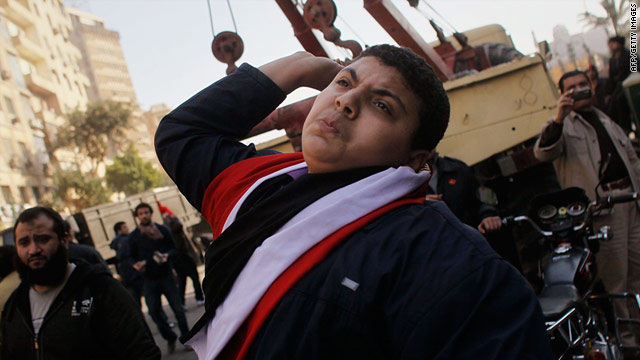
Cairo, Egypt (CNN) -- Pandemonium reigned Wednesday in the epicenter of Cairo's demonstrations, where violent street battles unfolded between supporters and foes of embattled President Hosni Mubarak.
State-run Nile TV flashed a warning ordering people to adhere to a government-imposed curfew and clear out of Tahrir Square. But curfews in the past few days have been largely ignored and a crowd, though a less intense one, remained in the downtown plaza into the night.
Earlier, tear gas and gunshots were fired to quell confrontational crowds and in one surreal moment, demonstrators thundered through the crowds on horses and camels. At least one man was pulled off his horse and beaten.
State television said the riders were pyramid workers who were protesting the negative economic impact of the crisis.Mubarak's announcement Tuesday that he will not seek re-election had been expected to dampen the passion of Egypt's nine-day uprising.
But the opposite rang true, at least in central Cairo's Tahrir Square, where a mob-rule mentality was in sharp contrast to the jubilant mood of tens of thousands of anti-Mubarak protesters the day before.
It remained unclear whether such confrontations were repeated elsewhere. Contesting rallies in Egypt's second-largest city, Alexandria, were largely peaceful. Other Cairo neighborhoods also remained calm.
Events in Egypt "have moved enormously quickly in a very volatile region of the world, the likes of which we have not seen in our lifetime," White House Press Secretary Robert Gibbs noted Wednesday."What we're watching," he said, "is history being made."
The sound of gunfire reverberated in Tahrir Square, which means "liberation" in Arabic. People hurled verbal insults, Molotov cocktails, rocks and anything else they could find -- shards of metal, sticks, shoes -- at one another. Desperate for more ammunition, they dismantled sidewalks and picked up chunks of cement to throw. They beat each other in what rapidly spiraled into utter mayhem.
Through the course of the afternoon, pro-Mubarak supporters added to their ranks and eventually overturned a military vehicle to surge forward past the Egyptian National Museum toward the center of Tahrir Square. Flames shot out from the awnings and doorways of several burning buildings and thick black smoke filled the air.
Some people expressed fears to journalists that a bloodbath would ensue.
Scores of people have already been wounded. Blood streaming down their faces, they were carried away from the square into a nearby makeshift clinic.Egypt's health minister said 611 people were injured, Nile TV reported. Many suffered head injuries. Ministry spokesman Abdel Rahman Shaheen also reported the death of a security forces member in an incident at a nearby bridge over the Nile River.
Protesters climbed atop army tanks, waving flags and chanting loudly.Each side in the chilling street battle fought to lay claim to this patch of central Cairo territory that has all along been the symbol of the uprising. But despite the extremely volatile altercations, the police were nowhere to be seen and the army did little to restore order.
Mubarak deployed the army Friday after police forces -- who don't have a clean track record with the Egyptian people -- used excessive force on protesters. The army said it would not attack peaceful demonstrations, but Wednesday morning, it urged a return to normalcy.
"Your message is received ... (your) demands became known," a Defense Ministry spokesman said on Nile TV. "And we are here and awake to protect the country for you ... not by power but by the love to Egypt. It is time to go back to normal life."
But the situation in Tahrir Square raised the issue of how long soldiers would stand by passively."The army seems now to be reneging on its commitment to protect peaceful protesters," said Hassiba Hadj Sahraoui, deputy director for the Middle East and North Africa at Amnesty International. "The fact that such violence is allowed to continue as the army stands there begs the question whether they have orders not to interfere."
Egyptian Finance Minister Samir Radwan said the army has made its mission clear: It will not harm its own people. He said the government was urging opposition leaders to begin dialogue.
"I don't care who's responsible," Radwan said of the ongoing chaos. "But I think any wise person should come to the table. This is not a blaming game. I am trying to save my country."
Nile TV sought to portray the unrest as a "foreign conspiracy" fueled by international journalists.Despite reports that shots had been fired, the television network's reporters denied any shooting had taken place and even that violence had broken out in Tahrir Square. It also said that members of the opposition Muslim Brotherhood were heading to the square "to throw balls of fire and to start acts of riots and violence."
CNN journalists could not corroborate such reports. Mubarak has in the past blamed the outlawed but tolerated Islamist umbrella organization for inciting revolt.
Foreign Ministry spokesman Hossam Zaki said the Cairo clashes represented "the very raw and high emotions" of the Egyptian people, and "what is required now is for people to calm down. I don't agree that the Egyptian government has lost control," he said, adding that the international community should not interfere in Egypt's internal affairs.
The dramatic and potentially deadly situation Wednesday erupted after pro-Mubarak demonstrators broke through a barricade separating them from anti-government protesters who have been amassing for more than a week in the downtown plaza.
The whole world was watching the crisis engulfing the Arab world's most populous nation, often a barometer for regional sentiment and action. In Washington, the Obama administration renewed its call for calm Wednesday.
"We continue to watch the events very closely, and it underscores that the transition needs to begin now," Gibbs said from the White House, adding that there needs to be "real change" in Egypt.
United Nations Secretary-General Ban Ki-moon echoed those sentiments after a meeting in London with British Prime Minister David Cameron.
A scene of violent chaos in Cairo
By the CNN Wire Staff

Cairo, Egypt (CNN) -- It started with verbal abuse, and then -- perhaps inevitably -- it got physical.
Supporters of Egypt's President Hosni Mubarak flooded into Cairo's Tahrir Square Wednesday after the president's opponents dominated the scene for more than a week.
Separated at first by barriers, the rival demonstrators exchanged insults, then began throwing anything they could find at each other, including shoes, rocks and sticks.
Suddenly the barriers came down. People surged toward each other in a chaotic scene that conjured images of a revolution.
Some injured protesters fell. Others stumbled through the crowd. Blood streamed down the faces of the injured.
Many of the injuries were serious, even though demonstrators wrapped sweatshirts and other clothes around their heads to protect themselves from flying stones.
Dozens of wounded were carried away, bleeding from gashes. It was impossible to tell from visits to a makeshift clinic which side was faring worse, CNN's Ben Wedeman said. He said simply: "They are all Egyptians."
A mosque served as a makeshift field hospital, staffed by volunteer doctors, he said.
Police were nowhere to be seen.
Army tanks surrounded the square, but the military proved unable or unwilling to separate the two sides. The hatches on their tanks and armored personnel carriers remained closed.
Some brave Egyptians tried to stop the violence, putting their bodies between the sides. Briefly they seemed to succeed. There was a lull in the violence. Some protesters from the rival camps embraced.
All at once, about 50 or 60 people carrying clubs and riding horses and camels charged into the square, beating some protesters. At least one man was pulled off his horse and beaten.
And the frenzy intensified. People tore paving stones out of the streets with crowbars and their bare hands, filling bags with rocks to use as an arsenal in the street battle.
Some ripped street signs out of the ground, using the metal as makeshift shields.
CNN's Hala Gorani was threatened by a pro-Mubarak supporter who told her to get out of the area.
"I was a little bit fearful," she said. Another protester stepped in and protected her, telling the first not to touch her because "she is with me."
She said she ran as fast as she could back to her colleagues.
"I'm fine, but I've got to say, this is a situation that can turn on a dime. There is a lot of anger coming from those protesters."
They are attacking journalists, she said, and will threaten anyone who looks Western with violence.
It was unclear whether there was shooting on the square. CNN's Fred Pleitgen and Anderson Cooper said they heard shots being fired, although Cooper suggested it may have been troops on the sidelines shooting into the air to try to restore order.
The interior ministry denied there was shooting.
CNN's Ivan Watson, overlooking the square from a hotel, did not hear any gunfire, he said, calling that "a blessing."
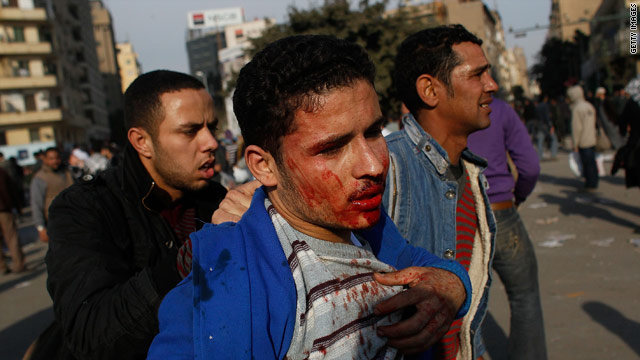
Cairo, Egypt (CNN) -- It started with verbal abuse, and then -- perhaps inevitably -- it got physical.
Supporters of Egypt's President Hosni Mubarak flooded into Cairo's Tahrir Square Wednesday after the president's opponents dominated the scene for more than a week.
Separated at first by barriers, the rival demonstrators exchanged insults, then began throwing anything they could find at each other, including shoes, rocks and sticks.
Suddenly the barriers came down. People surged toward each other in a chaotic scene that conjured images of a revolution.
Some injured protesters fell. Others stumbled through the crowd. Blood streamed down the faces of the injured.
Many of the injuries were serious, even though demonstrators wrapped sweatshirts and other clothes around their heads to protect themselves from flying stones.
Dozens of wounded were carried away, bleeding from gashes. It was impossible to tell from visits to a makeshift clinic which side was faring worse, CNN's Ben Wedeman said. He said simply: "They are all Egyptians."
A mosque served as a makeshift field hospital, staffed by volunteer doctors, he said.
Police were nowhere to be seen.
Army tanks surrounded the square, but the military proved unable or unwilling to separate the two sides. The hatches on their tanks and armored personnel carriers remained closed.
Some brave Egyptians tried to stop the violence, putting their bodies between the sides. Briefly they seemed to succeed. There was a lull in the violence. Some protesters from the rival camps embraced.
All at once, about 50 or 60 people carrying clubs and riding horses and camels charged into the square, beating some protesters. At least one man was pulled off his horse and beaten.
And the frenzy intensified. People tore paving stones out of the streets with crowbars and their bare hands, filling bags with rocks to use as an arsenal in the street battle.
Some ripped street signs out of the ground, using the metal as makeshift shields.
CNN's Hala Gorani was threatened by a pro-Mubarak supporter who told her to get out of the area.
"I was a little bit fearful," she said. Another protester stepped in and protected her, telling the first not to touch her because "she is with me."
She said she ran as fast as she could back to her colleagues.
"I'm fine, but I've got to say, this is a situation that can turn on a dime. There is a lot of anger coming from those protesters."
They are attacking journalists, she said, and will threaten anyone who looks Western with violence.
It was unclear whether there was shooting on the square. CNN's Fred Pleitgen and Anderson Cooper said they heard shots being fired, although Cooper suggested it may have been troops on the sidelines shooting into the air to try to restore order.
The interior ministry denied there was shooting.
CNN's Ivan Watson, overlooking the square from a hotel, did not hear any gunfire, he said, calling that "a blessing."
And somehow, amid the clashes, pockets of peace remained -- including around small groups who, amid the violence, dropped to their knees and faced Mecca. The time had come for daily prayers.
Mubarak says he won't run again; protesters say it's not enough
By the CNN Wire Staff

Cairo, Egypt (CNN) -- Bowing to eight days of protests, Egyptian President Hosni Mubarak said Tuesday he will not seek office again in elections scheduled for September, but vowed to stay in the country and finish his term.
The concession, the largest the embattled president has made so far, was remarkable for a man who has held a tight grip on power for three decades. But it was unclear whether the offer would do anything to calm opposition groups and protesters who have called for Murarak's immediate resignation.
"My first responsibility now is to restore the stability and security of the homeland, to achieve a peaceful transition of power in an environment that will protect Egypt and Egyptians and which will allow for the responsibility to be given to whoever the people elect in the forthcoming elections," Mubarak said in a televised address Tuesday night.
The announcement rang flat in Cairo's Tahrir Square, where thousands of protesters erupted in chants of "Down with Mubarak!" and "The people want the president to be judged!" following his announcement. Some waved shoes in the air -- a deep insult in the Arab world -- and said they would continue their demonstrations until Mubarak quits outright.
Mohamed ElBaradei, the Nobel Peace Prize winner who has become a leading opposition figure, said Mubarak's decision was "an act of deception" that would only "extend the agony."
"Whoever gave him that advice gave him absolutely the wrong advice," ElBaradei said.
However, Arab League Secretary-General Amr Moussa, a former Egyptian foreign minister, said demonstrators should weigh what Mubarak has said before responding.
"I'm aware that there are certain currents in Egypt that will not see that as satisfactory and they need more," Moussa, a possible presidential contender himself, told CNN. But, he added, "I believe that there is something new that has been offered."
Mubarak has led Egypt for nearly 30 years since the 1981 assassination of his predecessor, Anwar Sadat, aided by an emergency decree that has allowed him to rule with an iron fist. But following demonstrations that have only grown in the past week, the 82-year-old former air force general told his people Tuesday night, "I have spent enough time serving Egypt.
"I will pursue the transfer of power in a way that will fulfill the people's demands, and that this new government will fulfill the people's demands and their hopes for political, economic and social progress," he said.
Tuesday's turnout in Cairo, Alexandria and other cities came despite efforts by the government to suspend rail service and cut off mobile phone and internet networks, and in spite of the mounting hardships facing Egyptians.
Banks and schools have been shuttered during the demonstrations, teller machine screens are dark and gas stations have run out of fuel. Long lines snaked around bakeries and supermarkets as shops began to ration how much food customers could buy.
In Alexandria, protesters clashed with supporters of Mubarak, leaving 12 people injured, said Qutb Hassanein, a member of an opposition group. The military was called in to restore calm.
Mohammed Mahmoud, a protester, said he was hit in the head by a stick during the clash.
"We don't want him (Mubarak). We are staying here until we die," he said.
Mubarak's announcement capped a day in which anti-government demonstrators stood shoulder-to-shoulder in Tahrir Square for a "march of millions." It comes less than three weeks after a wave of protests that forced Tunisia's longtime strongman to flee to Saudi Arabia in mid-January.
Protesters last week taunted, "Mubarak, Saudi Arabia is waiting for you." But despite calls for him to leave the country, the aging leader vowed Tuesday that "This dear country is my country ... and I will die on its land."
Opposition leader Ayman Nour called the speech "very depressing." Nour said Mubarak was already expected to step down at the end of his term -- but he is believed to be maneuvering to have his son, Gamal, succeed him.
"He did not at any point in his speech reject the possibility that his son could run for president," said Nour, who spent three years in prison after challenging Mubarak in Egypt's first multiparty presidential election in 2005. He said the protesters in Tahrir Square "are angrier than ever" after the address.
Mohammed Habib, deputy chairman of the officially banned Muslim Brotherhood, said Mubarak's speech was built around emotional appeals to his decades of military service and the presidency.
"After 30 years during which corruption and diminishing the strategic role of Egypt in the region became the norm, I do not feel it is time to appeal for people's emotion," Habib said. "We should say 'thank you' to him, 'and get out.' "
In Washington, President Barack Obama said he spoke with Mubarak soon after he announced he would not seek re-election. Obama called for an orderly transition in Egypt that, he said, should be meaningful, peaceful and must begin now. The U.S. president stressed the Egyptian people will be the ones to determine their own leaders and destiny.
In Cairo, the U.S. ambassador to Egypt, Margaret Scobey, met Tuesday with ElBaradei and will be speaking with leaders of other political movements, a senior State Department official said. The official cautioned that Scobey's talks with ElBaradei doesn't mean the United States favors him.
As in Tunisia, the protests have been fueled by economic woes, including a dramatic rise in the cost of living coupled with high unemployment. Despite the government's food subsidies, people are struggling, with an estimated 40% of the country living in poverty.
The majority of Egypt's population -- and the vast majority of its unemployed -- is under 30, and many protesters are young men looking for economic opportunities and a better life.
As the demonstrations grew, Mubarak fired his cabinet and ordered newly appointed Vice President Omar Suleiman to hold talks on political reform with opposition leaders. And on Monday, the military -- the foundation of the modern Egyptian state -- announced it would not open fire on peaceful protesters.
"I think it's all over with once the army makes that announcement," said Juan Cole, a Middle East historian at the University of Michigan. Cole said he had expected the regime to endure the crisis with the support of the military, but that the military appears to have "cut Mubarak loose."
Shibley Telhami, a University of Maryland professor and Brookings Institution analyst, said the military may have anchored the government but, "At some point, they are going to have to make a decision about protecting the institution beyond the man."
And Fouad Ajami, a Johns Hopkins University professor and Hoover Institution analyst, said Mubarak's invocation of his years of service was "almost pathetic."
"I believe the crowd was discovering its power as Mubarak was discovering his own weakness and the vulnerability of his own regime," Ajami said. Now, "No one believes his promises, and now no one really believes his threats."
The demonstrations had turned ugly last Friday, when thousands of riot and plainclothes police used brutal force to crack down on people on the streets.
Unconfirmed reports suggest up to 300 people may have been killed during the protests, U.N. High Commissioner for Human Rights Navi Pillay said Tuesday. Human Rights Watch has reported 80 deaths from two hospitals in Cairo, 36 in Alexandria and 13 in Suez.
CNN has not been able to independently confirm the death toll. But since the weekend, the army has replaced police as the enforcers of security, and the gatherings have been largely peaceful.
In recent days, protests inspired by the Tunisian outcome have spread to Algeria, Yemen, Jordan and Sudan. Calls for political reform prompted Jordan's King Abdullah II Tuesday to dismiss his government and appoint a new prime minister, and a Facebook page urged similar demonstrations in Syria.
John Entelis, director of Middle East studies at New York's Fordham University, said the Arab world is facing a "wave" of unrest sparked by the Tunisian revolt.

Cairo, Egypt (CNN) -- Bowing to eight days of protests, Egyptian President Hosni Mubarak said Tuesday he will not seek office again in elections scheduled for September, but vowed to stay in the country and finish his term.
The concession, the largest the embattled president has made so far, was remarkable for a man who has held a tight grip on power for three decades. But it was unclear whether the offer would do anything to calm opposition groups and protesters who have called for Murarak's immediate resignation.
"My first responsibility now is to restore the stability and security of the homeland, to achieve a peaceful transition of power in an environment that will protect Egypt and Egyptians and which will allow for the responsibility to be given to whoever the people elect in the forthcoming elections," Mubarak said in a televised address Tuesday night.
The announcement rang flat in Cairo's Tahrir Square, where thousands of protesters erupted in chants of "Down with Mubarak!" and "The people want the president to be judged!" following his announcement. Some waved shoes in the air -- a deep insult in the Arab world -- and said they would continue their demonstrations until Mubarak quits outright.
Mohamed ElBaradei, the Nobel Peace Prize winner who has become a leading opposition figure, said Mubarak's decision was "an act of deception" that would only "extend the agony."
"Whoever gave him that advice gave him absolutely the wrong advice," ElBaradei said.
However, Arab League Secretary-General Amr Moussa, a former Egyptian foreign minister, said demonstrators should weigh what Mubarak has said before responding.
"I'm aware that there are certain currents in Egypt that will not see that as satisfactory and they need more," Moussa, a possible presidential contender himself, told CNN. But, he added, "I believe that there is something new that has been offered."
Mubarak has led Egypt for nearly 30 years since the 1981 assassination of his predecessor, Anwar Sadat, aided by an emergency decree that has allowed him to rule with an iron fist. But following demonstrations that have only grown in the past week, the 82-year-old former air force general told his people Tuesday night, "I have spent enough time serving Egypt.
"I will pursue the transfer of power in a way that will fulfill the people's demands, and that this new government will fulfill the people's demands and their hopes for political, economic and social progress," he said.
Tuesday's turnout in Cairo, Alexandria and other cities came despite efforts by the government to suspend rail service and cut off mobile phone and internet networks, and in spite of the mounting hardships facing Egyptians.
Banks and schools have been shuttered during the demonstrations, teller machine screens are dark and gas stations have run out of fuel. Long lines snaked around bakeries and supermarkets as shops began to ration how much food customers could buy.
In Alexandria, protesters clashed with supporters of Mubarak, leaving 12 people injured, said Qutb Hassanein, a member of an opposition group. The military was called in to restore calm.
Mohammed Mahmoud, a protester, said he was hit in the head by a stick during the clash.
"We don't want him (Mubarak). We are staying here until we die," he said.
Mubarak's announcement capped a day in which anti-government demonstrators stood shoulder-to-shoulder in Tahrir Square for a "march of millions." It comes less than three weeks after a wave of protests that forced Tunisia's longtime strongman to flee to Saudi Arabia in mid-January.
Protesters last week taunted, "Mubarak, Saudi Arabia is waiting for you." But despite calls for him to leave the country, the aging leader vowed Tuesday that "This dear country is my country ... and I will die on its land."
Opposition leader Ayman Nour called the speech "very depressing." Nour said Mubarak was already expected to step down at the end of his term -- but he is believed to be maneuvering to have his son, Gamal, succeed him.
"He did not at any point in his speech reject the possibility that his son could run for president," said Nour, who spent three years in prison after challenging Mubarak in Egypt's first multiparty presidential election in 2005. He said the protesters in Tahrir Square "are angrier than ever" after the address.
Mohammed Habib, deputy chairman of the officially banned Muslim Brotherhood, said Mubarak's speech was built around emotional appeals to his decades of military service and the presidency.
"After 30 years during which corruption and diminishing the strategic role of Egypt in the region became the norm, I do not feel it is time to appeal for people's emotion," Habib said. "We should say 'thank you' to him, 'and get out.' "
In Washington, President Barack Obama said he spoke with Mubarak soon after he announced he would not seek re-election. Obama called for an orderly transition in Egypt that, he said, should be meaningful, peaceful and must begin now. The U.S. president stressed the Egyptian people will be the ones to determine their own leaders and destiny.
In Cairo, the U.S. ambassador to Egypt, Margaret Scobey, met Tuesday with ElBaradei and will be speaking with leaders of other political movements, a senior State Department official said. The official cautioned that Scobey's talks with ElBaradei doesn't mean the United States favors him.
As in Tunisia, the protests have been fueled by economic woes, including a dramatic rise in the cost of living coupled with high unemployment. Despite the government's food subsidies, people are struggling, with an estimated 40% of the country living in poverty.
The majority of Egypt's population -- and the vast majority of its unemployed -- is under 30, and many protesters are young men looking for economic opportunities and a better life.
As the demonstrations grew, Mubarak fired his cabinet and ordered newly appointed Vice President Omar Suleiman to hold talks on political reform with opposition leaders. And on Monday, the military -- the foundation of the modern Egyptian state -- announced it would not open fire on peaceful protesters.
"I think it's all over with once the army makes that announcement," said Juan Cole, a Middle East historian at the University of Michigan. Cole said he had expected the regime to endure the crisis with the support of the military, but that the military appears to have "cut Mubarak loose."
Shibley Telhami, a University of Maryland professor and Brookings Institution analyst, said the military may have anchored the government but, "At some point, they are going to have to make a decision about protecting the institution beyond the man."
And Fouad Ajami, a Johns Hopkins University professor and Hoover Institution analyst, said Mubarak's invocation of his years of service was "almost pathetic."
"I believe the crowd was discovering its power as Mubarak was discovering his own weakness and the vulnerability of his own regime," Ajami said. Now, "No one believes his promises, and now no one really believes his threats."
The demonstrations had turned ugly last Friday, when thousands of riot and plainclothes police used brutal force to crack down on people on the streets.
Unconfirmed reports suggest up to 300 people may have been killed during the protests, U.N. High Commissioner for Human Rights Navi Pillay said Tuesday. Human Rights Watch has reported 80 deaths from two hospitals in Cairo, 36 in Alexandria and 13 in Suez.
CNN has not been able to independently confirm the death toll. But since the weekend, the army has replaced police as the enforcers of security, and the gatherings have been largely peaceful.
In recent days, protests inspired by the Tunisian outcome have spread to Algeria, Yemen, Jordan and Sudan. Calls for political reform prompted Jordan's King Abdullah II Tuesday to dismiss his government and appoint a new prime minister, and a Facebook page urged similar demonstrations in Syria.
John Entelis, director of Middle East studies at New York's Fordham University, said the Arab world is facing a "wave" of unrest sparked by the Tunisian revolt.
"If it were not for Tunisia, none of this would be happening at this time or in this way," Entelis said.
Tuesday, February 1, 2011
Google, Twitter help give voice to Egyptians

(CNN) -- Google has launched the latest salvo in an effort to overcome internet blackouts in Egypt during anti-government protests there.
"Like many people we've been glued to the news unfolding in Egypt and thinking of what we could do to help people on the ground,"Google said on its official blog.
The result was a collaboration between Google, Twitter and SayNow (a service Google acquired last week) to let people without access to the Web share messages on Twitter via voice mail.
The service, which is live now, offers three international phone numbers to call -- +16504194196 or +390662207294 or +97316199855.
For each call, the service will instantly post a message to Twitter with a link to listen to the message.
"We hope that this will go some way to helping people in Egypt stay connected at this very difficult time," the post said. "Our thoughts are with everyone there."
The blog post, by SayNow co-founder Ujjwal Singh and AbdelKarim Mardini, Google's product manager for North Africa and the Middle East, said people without internet access can listen to the messages by calling the same number or or going to twitter.com/speak2tweet. Twitter users can follow that account to see the messages in real time.
The messages also will be posted with the hashtag #egypt -- another way for Twitter users to follow them.One difficulty Egyptians may face, however, is that mobile-phone networks also have been shut down during the protests. Land lines, of course, could presumably still be used in areas where that is the case.
Last week, as demonstrators angry with the policies of Egyptian President Hosni Mubarak took to the streets, the government shut down social-media websites, then blacked out all internet access in much of the country.
On Tuesday, as protesters began what's being called a "march of millions," which many observers say could be a decisive day in the effort to oust Mubarak, there were fresh reports of the internet being shut off in much of Egypt.
Subscribe to:
Posts (Atom)