By the CNN Wire Staff
Cairo, Egypt (CNN) -- For more than a week, opponents of Egypt's President Hosni Mubarak had the upper hand in Cairo, protesting with near impunity in the face of police and an army that did little to stop them.
That all changed on Wednesday.
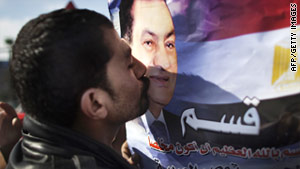
The morning after Mubarak dramatically announced he would not run for re-election in September, his supporters waded into Tahrir Square by the thousands and suddenly, serious, prolonged violence reigned in central Cairo.
There were immediate suspicions that the pro-Mubarak demonstrators were not simply average citizens standing up for the man who has led Egypt for three decades -- suspicions that proved at least partly founded.
As battles raged between the two sides, some pro-Mubarak protesters were captured by his opponents. Some were terrified to be caught and begged for their lives, screaming that the government had paid them to come out and protest. Others turned out to be carrying what seemed to be police identification, though they were dressed in plain clothes.
Shadi Hamid, a Brookings Institution analyst based in Qatar, told CNN that the use of hired muscle to break up demonstrations "is a longtime regime strategy."
"There are usually a line of thugs outside a protest who are waiting there," he said. "They're dressed in plain clothes, and then they'll usually go and attack the protesters. Egyptians have seen this for quite some time, and that's why they were able to recognize what was going on fairly quickly."
The global rights group Amnesty International said it has documented the use of unsavory forces by Egyptian authorities to disperse political gatherings in election years.
"It looks like much of this violence is being orchestrated by the Egyptian authorities in order to force an end to the anti-government protests, restore their control and cling onto power in the face of unprecedented public demands for them to go," said Hassiba Hadj Sahraoui, the deputy director for the Middle East and North Africa at Amnesty International.\
An Interior Ministry spokesman denied on state-run television that police identification cards had been confiscated from demonstrators. He said if they had been, they were were stolen or fake. But state television reporting Wednesday did not always match CNN's own observations of what was happening in Tahrir Square.
Several CNN journalists heard from pro-Mubarak demonstrators that they worked for the government. Staff from the national petrochemical company said they had been ordered to come and protest.
Amnesty International researchers said witnesses told them of "lorry loads" of pro-Mubarak supporters leaving Wednesday morning from Mahalla, north of Cairo.
"These (pro-Mubarak) protests were organized by the government and the ruling National Democratic Party," analyst Kamal Zakher told CNN. The government mustered government workers and lawmakers whose seats are threatened, he said.
"They were ordered to go out today. They are well organized and that is suspicious -- especially the use of camels and horses. These are abnormal techniques to demonstrate," he said, referring to the shocking charge of about 50 or 60 mounted men through Tahrir in the middle of the afternoon.
And Emad Shahin, a Mideast analyst at the University of Notre Dame, said "reliable contacts in Egypt" told him the counter-protesters were organized "by Mubarak himself," with the aid of businessmen who support him.
"The whole objective is actually to give the impression that there is still support for Mubarak and to force the demonstrators out of Tahrir Square," Shahin said. He said the embattled president "is presenting a very difficult choice before the Egyptian people -- either liberty or security -- and he is hoping that they will choose security at the expense of liberty."
In Washington, White House spokesman Robert Gibbs expressed concerns about the outbreak of violence."The president and this administration strongly condemn the outrageous and deplorable violence that's taking place on the streets of Cairo," Gibbs said."Obviously, if any of the violence is instigated by the government, it should stop immediately," Gibbs added.
State television called the pro-Mubarak demonstrators tourism workers. At least some Egyptians working in the tourism industry are known to be genuinely upset at the anti-Mubarak demonstrators, accusing them of hurting their business by bringing instability.
Zakher also said it was suspicious that security forces did not intervene to break up the violence."There were no police or military to separate the two crowds at the beginning and that's also suspicious enough to implicate the security agencies," Zakher said.
Journalist and protestor Reham Saeed told CNN she saw men with police uniforms go into hotels on the way to Tahrir Square and then come out wearing civilian clothes, joining the pro-Mubarak protesters. She called that an act of "betrayal."
State TV interviewed several people at the demonstration who said they backed the president because he had provided stability and independence.
"For 30 years, we lived in peace. President Mubarak kept us safe and secure for 30 years instead of being a country that takes orders from external forces just like (U.S. President Barack) Obama now wants," Iman Abu Futuh, a pro-Mubarak demonstrator, said on Nile TV. "They want us to be another Iraq and this will not happen."
Another man said, "I didn't cry when my father died. I cried when Mubarak spoke yesterday. I grew up watching him, seeing him, having him as my leader and the great president of this nation."
And a female demonstrator said: "Mubarak is our father. No one can insult and ridicule their elders. If we do that, we belittle ourselves. This is how we destroy our country."
A QUICK TOUR around the world Tech News Google+, Android, Iphone, Apple, Google, Facebook News and More ... ENJOY
Showing posts with label Amr Badr. Show all posts
Wednesday, February 2, 2011
Who are the pro-Mubarak demonstrators?
Labels:
Amr Badr,
Cairo,
Egypt,
Egyptian President,
Eygpt,
middle east,
mubarak,
News,
pro-Mubarak,
protesters,
Tahrir Square
Tuesday, February 1, 2011
Egyptians pack Liberation Square as protests gather more steam
By the CNN Wire Staff
Cairo, Egypt (CNN) -- Egypt teetered on a political precipice Tuesday as people fed up with their government amassed for a "march of millions" and vowed not to leave Cairo's central square until President Hosni Mubarak steps down.
A week of uprising, sometimes violent, took on the tones of revolution in the Arab world's most populous nation and the world watched, amazed at the possibility of emboldened popular discontent sparking change in the authoritarian state.
By afternoon, tens of thousands of demonstrators stood shoulder-to-shoulder in Cairo's Tahrir Square. In Arabic, the name means liberation. Never did it seem more true.
Tuesday's demonstrations were greater in intensity but largely peaceful, though no one can say with any certainty what will come next; whether another decisive show of people power will result in change or lead to repression.
There was an air of jubilation in Tahrir Square, as though the government was sure to cave. But the reality is that Mubarak has, thus far, refused to give.Helicopters hovered. Soldiers stood guard with their guns at key locations.
The Interior Ministry had announced it would shut down mobile phone networks in preparation for Tuesday's protests. But some cell phone service was still available Tuesday afternoon.
Banks and schools were shuttered and ATM screens were dark. Gas stations ran out of fuel. Long lines snaked around bakeries and supermarkets as shops began to ration how much food customers could buy.
State television reported Monday that the crisis has cost the country an estimated 69 billion Egyptian pounds (nearly $12 billion) and set its economy back six months.
Egypt's new finance minister, Samir Radwan, announced Tuesday that salaries would be disbursed through banks' automatic teller machines and owners of vandalized businesses would be compensated.
The internet was still down as Egyptians, despite the hardships, voiced their determination to carry on. They defied again a 3 p.m. curfew to demand that Mubarak step down.
Protesters set up their own checkpoints to keep weapons out of Tahrir Square.
The Egyptian army issued a statement thanking "all the citizens and the youth for working with their armed forces to protect public and private property."
The demonstrations turned ugly last Friday when thousands of riot and plainclothes police used brutal force to crack down on people on the streets. Since then, the army has replaced police as the enforcers of security and the gatherings have been largely peaceful.
Unconfirmed reports suggest up to 300 people may have been killed during the protests, U.N. High Commissioner for Human Rights Navi Pillay said Tuesday. CNN has not been able to independently confirm the death toll. Human Rights Watch has reported 80 deaths from two hospitals in Cairo, 36 in Alexandria and 13 in Suez.
"I urge the Egyptian authorities to ensure police and other security forces scrupulously avoid excessive use of force, and there needs to be a full investigation into the role of security forces in the violence that occurred over the past few days," Pillay said in a statement.
Amid the swirling tension, hope blossomed in the hearts of millions of Egyptians, many of whom have never dared to harbor such sentiment before.
Amr Badr, a young doctor, optimistically said his voice was important and that it "is going to be heard after today.
""This is our Egypt," Badr said with the conviction that the nation would be returned to people who, for three decades, have known nothing other than the iron hand of Mubarak.
People flooded into the square, bringing food and beverages to share. Some even set up tents to spend the night.Patriotic music blared amid chants of "Down with Mubarak."Scattered pro-Mubarak camps tried to defend the Egyptian leader. "No to the traitors," said one group of supporters making their way to the heart of the protests.
Inside the square, some protesters suggested marching toward Mubarak's presidential palace.One said, "Mubarak may have thick skin, but we have sharper nails."It will be "a very dramatic and perhaps even a decisive day," said Nicholas Burns, a professor of diplomacy at Harvard's Kennedy School of Government and a former U.S. undersecretary of state.
"If the military cracks down on peaceful demonstrators on the streets of Alexandria or Cairo, that will be a decisive factor," he said.The military had said Monday evening that it would not open fire on peaceful protesters.Mubarak, now 82, imposed an emergency decree after the 1981 assassination of his predecessor, Anwar Sadat and since then, has ruled accordingly. The wave of protests against his regime erupted after the uprising in Tunisia that ousted its longtime strongman January 14.
Cairo, Egypt (CNN) -- Egypt teetered on a political precipice Tuesday as people fed up with their government amassed for a "march of millions" and vowed not to leave Cairo's central square until President Hosni Mubarak steps down.
A week of uprising, sometimes violent, took on the tones of revolution in the Arab world's most populous nation and the world watched, amazed at the possibility of emboldened popular discontent sparking change in the authoritarian state.
By afternoon, tens of thousands of demonstrators stood shoulder-to-shoulder in Cairo's Tahrir Square. In Arabic, the name means liberation. Never did it seem more true.
Tuesday's demonstrations were greater in intensity but largely peaceful, though no one can say with any certainty what will come next; whether another decisive show of people power will result in change or lead to repression.
There was an air of jubilation in Tahrir Square, as though the government was sure to cave. But the reality is that Mubarak has, thus far, refused to give.Helicopters hovered. Soldiers stood guard with their guns at key locations.
The Interior Ministry had announced it would shut down mobile phone networks in preparation for Tuesday's protests. But some cell phone service was still available Tuesday afternoon.
Banks and schools were shuttered and ATM screens were dark. Gas stations ran out of fuel. Long lines snaked around bakeries and supermarkets as shops began to ration how much food customers could buy.
State television reported Monday that the crisis has cost the country an estimated 69 billion Egyptian pounds (nearly $12 billion) and set its economy back six months.
Egypt's new finance minister, Samir Radwan, announced Tuesday that salaries would be disbursed through banks' automatic teller machines and owners of vandalized businesses would be compensated.
The internet was still down as Egyptians, despite the hardships, voiced their determination to carry on. They defied again a 3 p.m. curfew to demand that Mubarak step down.
Protesters set up their own checkpoints to keep weapons out of Tahrir Square.
The Egyptian army issued a statement thanking "all the citizens and the youth for working with their armed forces to protect public and private property."
The demonstrations turned ugly last Friday when thousands of riot and plainclothes police used brutal force to crack down on people on the streets. Since then, the army has replaced police as the enforcers of security and the gatherings have been largely peaceful.
Unconfirmed reports suggest up to 300 people may have been killed during the protests, U.N. High Commissioner for Human Rights Navi Pillay said Tuesday. CNN has not been able to independently confirm the death toll. Human Rights Watch has reported 80 deaths from two hospitals in Cairo, 36 in Alexandria and 13 in Suez.
"I urge the Egyptian authorities to ensure police and other security forces scrupulously avoid excessive use of force, and there needs to be a full investigation into the role of security forces in the violence that occurred over the past few days," Pillay said in a statement.
Amid the swirling tension, hope blossomed in the hearts of millions of Egyptians, many of whom have never dared to harbor such sentiment before.
Amr Badr, a young doctor, optimistically said his voice was important and that it "is going to be heard after today.
""This is our Egypt," Badr said with the conviction that the nation would be returned to people who, for three decades, have known nothing other than the iron hand of Mubarak.
People flooded into the square, bringing food and beverages to share. Some even set up tents to spend the night.Patriotic music blared amid chants of "Down with Mubarak."Scattered pro-Mubarak camps tried to defend the Egyptian leader. "No to the traitors," said one group of supporters making their way to the heart of the protests.
Inside the square, some protesters suggested marching toward Mubarak's presidential palace.One said, "Mubarak may have thick skin, but we have sharper nails."It will be "a very dramatic and perhaps even a decisive day," said Nicholas Burns, a professor of diplomacy at Harvard's Kennedy School of Government and a former U.S. undersecretary of state.
"If the military cracks down on peaceful demonstrators on the streets of Alexandria or Cairo, that will be a decisive factor," he said.The military had said Monday evening that it would not open fire on peaceful protesters.Mubarak, now 82, imposed an emergency decree after the 1981 assassination of his predecessor, Anwar Sadat and since then, has ruled accordingly. The wave of protests against his regime erupted after the uprising in Tunisia that ousted its longtime strongman January 14.
Subscribe to:
Posts (Atom)