Showing posts with label News. Show all posts

Saturday, February 5, 2011

Will millions of people pay for iPad news?

By Julianne Pepitone,


NEW YORK (CNNMoney) -- Media companies are making big bets on tablet-friendly newspapers and magazines -- even as they bleed cash chasing a still-tiny audience.
"I've never seen anything quite like tablets taking off. I don't think you can afford not to make those investments," said Scott Ellison, mobile/connected platforms analyst at IDC.
But the investments are hefty, and fishing in a tablet-only pool is limiting. Apple sold 14.8 million iPads last year, and its nearest rival, Samsung's Galaxy Tab, shipped 2 million devices. That means there's 17 million potential readers at the moment.
Forecasts are bullish for the coming year: Tech companies have a staggering 100-plus iPad rivals in the works, and research firm eMarketer expects total tablet sales to hit 44 million in 2011. In 2012, it predicts tablet sales will top 81 million.
"Clearly the media industry is in need of a transformation, and they see tablets as an opportunity," said Allen Weiner, media analyst at Gartner. "We're about to enter a period of extreme experimentation."
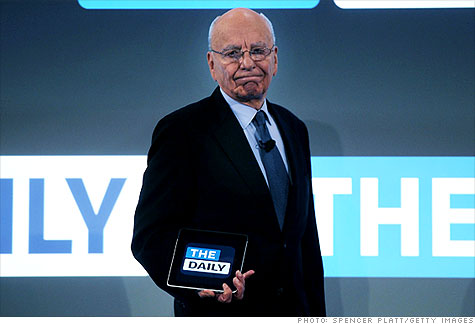
The iPad-only newspaper: The most extreme example is The Daily, the iPad-only publication that News Corp (NWS, Fortune 500) launched on Wednesday. CEO Rupert Murdoch committed around 100 staffers and an investment of $30 million to get it launched, and will spend $26 million a year to keep it running.
"Look at the massive investment News Corp. is making -- how many newspapers are willing and able to do that?" Weiner said. "The Daily is kind of a pilot program that everyone else will look to."
The Daily costs 99 cents a week, or $40 for a yearly subscription. To break even on its operating costs from subscriber revenue alone, The Daily would have to sell more than 650,000 subscriptions -- and that's without accounting for the cut Apple (AAPL, Fortune 500) takes for selling The Daily through its App Store.
Drawing more than 600,000 subscribers would be a gigantic feat, putting the publication among weekday subscription figures for big newspaper stalwarts -- somewhere between The Washington Post's 550,000 and The New York Times' 913,000.
Advertising sales is where publications typically get the bulk of their revenue. But there too, the math is tricky: eMarketer expects total mobile ad spending of $743 million in 2011 and $1 billion in 2012. That cash is spread through thousands of apps, movies, games and other content.
Murdoch will need to capture a significant chunk of it to keep The Daily in the black.
The numbers so far: Wired, Conde Nast's popular technology magazine, made headlines in June when it sold more than 100,000 single-copy iPad issues. But by December, Wired's iPad issue sales had fallen to just 24,000.
"There's a steak-and-sizzle question here," Weiner said. "How much is a one-time, 'check it out' sort of buy, and how much is a sustained audience?"
Glamour, also published by Conde, sold 4,300 digital editions in September, but then sales fell 20% in October -- and another 20% in November. Rodale-owned Men's Health sold just 2,100 digital editions in April, when the iPad debuted. Its tally has fluctuated between the mid-2,000s to the mid-3,000s in the months since.
All of those figures are un-audited, based on data the magazines voluntarily reported to the Audit Bureau of Circulations. Not all publications choose to do so.
"Since it's such a new area, we didn't want to penalize companies for reporting it incorrectly," an ABC representative said.
In its official reports, ABC lumps in tablet issues into a "digital" category along with Web subscriptions. Internet data tracker eMarketer does the same.
"The market is too new [and] too small for a reliable [tablet] breakout," an eMarketer representative said.
Gaining buzz and hooking the marketers: Subscriber revenue is nice, but analysts say advertising is where the real money will be made in the tablet space.
"The nexus of mobility, location and advertising is something the print space has not fully leveraged yet," IDC analyst Ellison said. "There's a lot to be done with advertising."
That rich media potential was what drew airline Virgin Atlantic to sign on as an advertiser in The Daily, said vice president of marketing Simon Bradley.
"We want to be known an an airline that's innovative and does things differently, which is exactly what The Daily has done," Bradley said. "It can be so much more than two-dimensional magazine ads."
Virgin's current ad in The Daily includes video, touch animation and social networking. Bradley said the company has received great feedback and is making plans for more.


Hague: UK is under cyber-attack

BBC
Attempts by cyber-criminals and hostile intelligence agencies to attack the British government have been outlined by the foreign secretary.
William Hague told a conference in Munich how government computers had been infected by a virus last year.
He also detailed an attempt to steal data from a UK defence contractor.
Mr Hague claimed cyberspace was providing "rich pickings" for criminals and urged governments to move faster to counter the threat.
In his speech, Mr Hague went into detail about some of the recent attacks to which systems in the UK have been exposed.
Some computers belonging to the British government had been infected with the "Zeus" computer virus, he said, after users had opened an e-mail purporting to come from the White House and followed a link.
Mr Hague said: "Our experts were able to clear up this infection but more sophisticated attacks such as these are becoming more common."
Defence contractors in the UK were also being targeted, the foreign secretary said, describing an attempt by someone masquerading as an employee of another defence firm to send a malicious file designed to steal information.
'Hostile state agency'
Mr Hague also said that last month three of his staff had been sent an e-mail apparently from another colleague in the Foreign Office. 
In fact the e-mail was "from a hostile state intelligence agency" and contained "code embedded in the attached document that would have attacked their machine."
The foreign secretary said the e-mail had been prevented from reaching its intended targets.
"These are the kind of threats we are now facing every day," he said.
Mr Hague said these kinds of cyber-threats called for a "global response", with like-minded countries agreeing standards of behaviour on the internet.
He added that the UK was determined to be at the forefront of attempts to safeguard liberties on the net, but warned that many countries were "actively working against us in a hostile manner." 

Obama to Mubarak: Listen to Egyptian people

By the CNN Wire Staff 


Washington (CNN) -- President Barack Obama said Friday that talks between the Egyptian government and its political opponents were under way, but warned that the mere "pretense of reform" would not be enough to resolve that country's deepening crisis.

The transition of power "must begin now" and lead to "free and fair elections," he declared. Negotiations must "include a broad representation of the Egyptian opposition," he told reporters.Asked if embattled President Hosni Mubarak needs to step down now -- as opposed to waiting for a successor to be chosen in Egypt's September elections -- Obama said Mubarak needs to consult with advisers and listen to what's "being voiced by the Egyptian people."

The Egyptian leader is "proud" but also a "patriot," Obama said. Mubarak needs to make a judgment about his legacy and the best "pathway forward." Violence and repression have no role in the "orderly transition process," he added. "The whole world is watching."

Obama noted he has had two conversations with Mubarak since the crisis began.The U.S. government has encouraged talks between Mubarak's government and its opponents over the past few days, in part out of recognition that an orderly transition to democracy could prove difficult if Mubarak suddenly steps down without laying any groundwork first.

"We can't dictate what an orderly transition means, but it's time for both of them to roll up their sleeves," one senior State Department official earlier Friday.Members of the opposition, a disparate group of at least six factions and political groups nominally headed by Mohamed ElBaradei, are still "jockeying," the official said, hedging their bets on how events will play out and some are refusing to negotiate unless and until Mubarak steps down.

The official said the administration believes Mubarak's vice president -- Omar Suleiman -- is sincere in his willingness to talk with the opposition, although talks are still in the initial stages.

U.S. lawmakers chimed in Thursday, with foreign policy veterans Sens. John Kerry, D-Massachusetts, and John McCain, R-Arizona, among those calling for Mubarak to step aside.

Thursday night, the U.S. Senate gave unanimous approval to a resolution calling for Mubarak to "immediately begin an orderly and peaceful transition to a democratic political system, including the transfer of power to an inclusive interim caretaker government, in coordination with leaders from Egypt's opposition, civil society, and military, to enact the necessary reforms to hold free, fair, and internationally credible elections this year."

Obama and Secretary of State Hillary Clinton, meanwhile, have condemned a string of attacks against journalists, human rights activists, and protesters in Egypt.

The United States continues "to be crystal clear that we oppose violence as a response to this crisis," Obama said Friday. On Thursday, Clinton called such incidents "a violation of international norms" and "unacceptable in any circumstances."

"It is especially in times of crisis that governments must demonstrate their adherence to (core universal) values," she said.

White House Press Secretary Robert Gibbs said Friday that the administration continues "to receive very disturbing reports" of "systematic targeting" of journalists in Egypt.

The increasingly urgent push for reform comes as the Egyptian government pushed back on what it called "vague" statements from the Obama administration about the pace of transition.

One Egyptian government official told CNN the United States has shown support for its "road map" for transitioning to democracy by the end of Mubarak's term in September, but said Obama's call for an "orderly transition" are at odds with his call for an immediate one.

The official said Mubarak is seen as a "receding figure" in Egyptian politics, but deposing him immediately would lead to a murky political process, which would prevent the free and fair elections the protesters are calling for. According to the Egyptian constitution, the presidency would be transferred to the speaker of the parliament if Mubarak leaves power without enacting certain legislative and constitutional reforms.

"Institutionally, there is support in Egypt for this road map among the military, vice president and prime minister," the official said. "The bureaucracy thinks it has a degree of legitimacy and if the objective continues to be deposing the president now, they clearly don't understand the advantage that this road map will create a constitutional and administrative voice to the transition and is not going to lead to confusion."

U.S. officials describe an opposition that is not altogether unified on whether to begin a dialogue with the government. Some, like former foreign minster and Arab League Secretary General Amre Moussa, said concessions made by Mubarak present an opportunity to build upon. Members of the Muslim Brotherhood had said that no talks should take place until Mubarak steps down.

"There are some people who see what is required to hold the type of elections they want to hold. They are looking at the administrative questions that have to be answered, and realize that will take a bit of time," the senior State Department official said. "They are focusing on elections and transformation of the system, rather than on Mubarak."

The Egyptian official said conversations with Washington suggest the United States understands this process, but public statements from Obama, Clinton, and U.S. government spokesmen have sent mixed messages."We understand the need to be vague and play to the street, but this is hardly the time," the official said.

The United States continues to reach out to every country in the Middle East, not only to solicit their analysis and advice, but also to assure nervous allies that the United States stands with them during this tumultuous time in the region.

"We are in a phase where the Mubarak era is ending in Egypt, either now or in September, and something this significant hasn't happened in the region in some time," the official said. "We are giving them the chance to give us their views and letting them know how significant this is."

Obama seeks quick Egypt handover


BBC

Barack Obama has called for an "orderly transition that begins right now" in Egypt and urged President Hosni Mubarak to "make the right decision".
The US president said Egypt's leader needed to listen to the Egyptian people and make a judgment on the way forward.
"The entire world is watching," Mr Obama said, adding the issues at stake would not be resolved through violence.
He spoke as tens of thousands of people protested in Egypt for an 11th day calling for Mr Mubarak to step down.
BBC North America editor Mark Mardell, in Washington, says President Obama went further than before in suggesting that Mr Mubarak should go.
But he could not quite bring himself to say the words - no doubt for very good diplomatic reasons, our correspondent adds.
"He [Mr Mubarak] needs to listen to what is voiced by the people and make a judgment about a pathway forward that is orderly, that is meaningful and serious," Mr Obama said during a joint news conference with Canadian Prime Minister Stephen Harper.
"I believe that President Mubarak cares about his country. He is proud, but he is also a patriot," Mr Obama said.

Friday, February 4, 2011

'Day of departure' rally in Egypt

The BBC's Jim Muir in Tahrir Square: "The sense of imminent attack has eased and people are relaxing"


Tens of thousands of Egyptians are taking part in a "day of departure" to try to oust President Hosni Mubarak.
There is an increased army presence in Cairo's Tahrir Square after unrest that has led to hundreds of casualties.
After Friday prayers were held in a relaxed atmosphere, the crowd started chanting for Mr Mubarak to go.
Mr Mubarak has said he is "fed up" with being in power but is resisting mounting pressure to resign as he says it would leave Egypt in chaos.
In his first interview since anti-government protests began, he told ABC News he would like to resign immediately. But he repeated that the country's Islamist opposition - the Muslim Brotherhood - would fill the power vacuum left by his absence.
'Silent majority'


The BBC's Jim Muir in Tahrir Square says tens of thousands have now gathered there, although with the checkpoints the movement into the square is more a trickle than a flood.
The stronger army presence secured the perimeter and the soldiers appear to be on good terms with the protesters.
The demonstrators chanted: "The army and people are united."
Defence Minister General Mohamed Hussein Tantawi and other military leaders joined the armed forces in the square.
The secretary general of the Arab League, Amr Moussa, who has not ruled out standing for president, is also reported to be in Tahrir Square.
Thorough checks for weapons were carried out ahead of Friday prayers, during which one cleric praised the "revolution of the young" and declared: "We want the head of the regime removed."
Our correspondent says the mood is relaxed but it is not quite the carnival atmosphere that existed before Wednesday - when pro-Mubarak gangs attacked anti-government protesters - and people are watchful.
The BBC's Wyre Davies in Egypt's second city, Alexandria, says there are also many more tanks and soldiers out on the streets there than before.
Supporters of Mr Mubarak have been calling Friday a "day of allegiance".
The general secretary of the ruling NDP, Ibrahim Kamel, has accused the West of betraying Egypt.
He vowed President Mubarak would not step down and that soon millions of Egyptians - "the silent majority" - would come out on to the streets to protest because "enough is enough".
Egypt's health ministry says eight people have been killed and more than 800 injured in the clashes in recent days. The United Nations estimates that more than 300 people have died since the unrest broke out on 25 January, with about 4,000 hurt.
US efforts


Egypt's Vice-President Omar Suleiman has appealed for calm and urged the protesters to accept Mr Mubarak's pledge that he would not stand for election again.
But it has now emerged that the White House has been in talks with Mr Suleiman about how Egypt can begin making a "meaningful transition" to a democratic government.
US Vice-President Joe Biden spoke to his Egyptian counterpart on Thursday, say diplomats.
The New York Times suggested that among the proposals was a plan for Mr Mubarak to resign immediately and hand power to a military-backed interim government under Mr Suleiman.
Neither the White House nor the state department have directly denied the report.
But a spokesman for President Barack Obama's National Security Council said it was "time to begin a peaceful, orderly and meaningful transition, with credible, inclusive negotiations".
The BBC's Mark Mardell in Washington says other reports suggest the US plan has already been rebuffed in Egypt, and that the administration has been surprised by the attitude of the military and Mr Suleiman.
The reports say officials believe Mr Suleiman was aware of the apparent campaign in recent days to intimidate the opposition, and are now wondering whether he is the right man to lead an interim government, says our corresponden
On Friday, UK Prime Minister David Cameron criticised the Egyptian government for its handling of the crisis.
"The steps taken so far haven't met the aspirations of the Egyptian people," he said.
In his interview with ABC News, Mr Mubarak denied that his administration was behind the violence of the last two days but said it had troubled him.
Mr Mubarak was speaking in the presidential palace, with his son Gamal at his side.
"I never intended to run [for president] again," Mr Mubarak said. "I never intended Gamal to be president after me."

Why are reporters being attacked?

By Ashley Fantz, CNN


(CNN) -- Attacks against journalists send a message.

"It clearly conveys that the government is not in favor of democratic reforms because journalists represent free speech, and free speech is crucial to democracy," said Kelly McBride, a media ethics teacher at the Poynter Institute, a U.S.-based professional journalism training center and think tank.

"The point of silencing a journalist is to pull the curtain over what's happening," she said. "The other reason is to create fear, to intimidate other reporters."

Journalists from Egypt, Great Britain, the United States, India, Australia, Greece and other countries have reported being jumped, beaten, detained and interrogated this week while reporting on the uprising against Egyptian President Hosni Mubarak.

At least one Swedish journalist was reportedly stabbed. One was marched back to her hotel at gunpoint. Many said their cameras and other equipment were smashed. A few are reportedly unaccounted for. First-hand accounts of the crackdown are lighting up Twitter. One of two correspondents from Canada's Globe and Mail newspaper tweeted a chilling timeline leading up to their apparent detainment.

In a one-day span, attacks on reporters included 30 detentions, 26 assaults and eight instances of equipment seized, and plainclothes and uniformed agents reportedly entered at least two hotels where international journalists were staying to confiscate media equipment, said the Committee to Protect Journalists, a New York-based organization, on Thursday.

"Mubarak forces have attacked the very breadth of global journalism: Their targets have included Egyptians and other Arab journalists, Russian and U.S. reporters, Europeans and South Americans," CPJ said in a news release.

The Egyptian government has publicly criticized the violence and denied involvement, but on Thursday, Vice President Omar Suleiman said international TV reporters are part of the problem.

"I actually blame certain friendly nations who have television channels, they're not friendly at all, who have intensified the youth against the nation and the state," Suleiman said in a TV address.

"They have filled in the minds of the youth with wrongdoings, with allegations and this is unacceptable. ... They should have never done that. They should have never sent this enemy spirit."The attacks and harassment of journalists seem to be part of an organized effort, said State Department spokesman Philip J. Crowley. In a tweet early Thursday, he said: "There is a concerted campaign to intimidate international journalists in Cairo and interfere with their reporting. We condemn such actions."

State Department officials told CNN they have information that Egypt's Interior Ministry was behind the journalist detentions, citing reports from the U.S. Embassy in Egypt.

But in an interview with CNN, Crowley stopped short of naming the people behind the violence and harassment. "I can't tell you who is directing it but with the increasing number of instances of people roughing up journalist(s), cars attacked, offices broken into, journalists detained, these do not seem to be random events," he said.

Crowley suggested the attackers' endgame is intimidation, to make reporters afraid to file stories about an anticipated increase in anti-Mubarak protesters likely to take to the streets this weekend.

The violence toward journalists in Egypt seems more brazen and systematic than in any recent conflict, said Mohamed Abdel Dayem of the CPJ. Since 1981, it has tracked attacks and deaths of reporters targeted for doing their jobs. The only conflict in recent times that compares to the current situation, Dayem said, is the Algerian civil war in the 1990s.

The high number of attacks in Egypt might be, in part, because there were already a large number of reporters working in Cairo bureaus before the protests against Mubarak began, McBride said. News organizations, at least until recently, considered Cairo a convenient and friendly base from which to travel to more hostile areas in Africa and the Middle East.

Of course, that doesn't lessen outrage right now about the way reporters are being treated. But will it matter a week from now, a month from now? Will it affect the outcome of the movement to democratize Egypt?"It's such a fast-moving story, it's impossible to know the answer now," said Barbara Cochran, a journalism professor at the University of Missouri School of Journalism. She was a vice president for news for National Public Radio and an executive producer of NBC's "Meet the Press."

She's covered several violent uprisings throughout her career, including China's Tiananmen Square protests in 1989."This is not like any other face-off between a regime that refuses to leave power and a people refusing to back down," she said.

"How it's covered, whether journalists will feel secure enough to cover it, will matter."Newer technology -- the Web, Twitter, Facebook, smaller and cheaper recording devices such as Flip Cams -- has liberated reporting in many ways, Cochran said. But it also made journalists easier targets.

"When I was working, you could get into a country, do the reporting and get out without anyone sending a tweet out about your presence," she said. "And there wasn't a huge rush to report immediately, as there is now with news agencies competing to be the first to report online what's happening."

The story in Egypt is also unique because the Egyptian government managed to shut off access to the internet, blocking information that bloggers might have provided.

Consider that without Twitter or other social media tools, 2009's popular protests against Iranian President Mahmoud Ahmadinejad over contested election results would have been largely underreported, McBride and Cochran said.

Foreign journalists were blocked from entering the country. Ultimately, Ahmadinejad remained in power."I thought Iran would (be the country) in my mind that hit rock bottom (in how it treated reporters), but what Mubarak is doing is unspeakable," said Dayem.

In denying that the Egyptian government is behind the violence, Mubarak told ABC News on Thursday that the Muslim Brotherhoodis to blame.

But there are other regions where sustained violence toward journalists has been raging for years, and little change has come of it. In Mexico, for instance, cartel violence continues despite the disappearance or death of more than 30 reporters since 2006, CPJ reported.Egypt, perhaps, seems different to Western audiences, said McBride.

"Cairo resonates with us. It's an ally, tourism is big there. Most people considered it safe. I think part of why this story has captivated an audience is because they are saying, 'This is not the Egypt I thought I knew.' "

Protesters in Cairo vow to continue demonstrations

By the CNN Wire Staff


Cairo, Egypt (CNN) -- Demonstrators have built a barbed-wire barricade and stacked piles of rocks throughout Cairo's Tahrir Square Friday, where they gathered to demand President Hosni Mubarak's resignation.


Military forces surrounded the square, and anti-government protesters manned their own security checkpoints, which included numerous blockades. The stream of demonstrators entering the square was steady at midday.


As midday prayers ended, anti-government protesters chanted, "He leaves, we don't leave" and "The blood of the martyrs will not be forgotten."


Anti-government protesters have pledged to bring droves of demonstrators to the square Friday for what they dubbed a "day of farewell" and "day of departure," referring to their push for Mubarak to resign. Elsewhere in Cairo, pro-government protesters said they were gathering in a mosque for a "day of loyalty."


But the pro-Mubarak groups were notably absent from Tahrir Square, where they clashed with anti-government protesters earlier this week.


In the northern port city of Alexandria, the streets leading to the Al Kaed Ibrahim mosque were packed as the midday sermon began.


"This is a great revolution and the whole regime, the entire system needs to be changed. The revolution must continue until all objectives are met," the mosque's imam told the crowd.


Writing on the walls leading to the mosque, where police and anti-government demonstrators clashed last Friday, said "Game OVER" and "Pharaoh's last day."There was very little military presence in Alexandria, but troops wearing riot gear toted automatic weapons near Cairo's Tahrir Square.


Security forces detained some people leaving the square, pointing guns at them and forcing them to lie on the ground early Friday. A burned-out car and a group of troops blocked the October 6 bridge, which crosses the Nile River and serves as an entrance to the square.


The anti-government protests were scheduled to start after Friday prayers, and some demonstrators suggested the group may march toward the presidential palace.


Mubarak is not gone, but his days are numbered. The leader agreed Tuesday to not seek re-election in September.In the bloody blur of days since his announcement that he would not stand for re-election, regime foes and supporters have clashed repeatedly in Tahrir Square, the center of anti-government demonstrations. Eight people have been killed and nearly 896 injured, according to the health ministry.


The atmosphere Friday morning was peaceful and optimistic, but tense. Some anti-government demonstrators smiled as they sang patriotic songs. Exhausted protesters slept on sidewalks inside the square. A man with an Egyptian flag wrapped around his head sat on a curb, flashing a victory sign.


A handful of pro-government protesters cheered as large vans filled with security forces arrived at Tahrir Square around 6 a.m. Friday (11 p.m. ET). It was unclear whether those inside were members of the military or police.


Mubarak told ABC News Thursday he would like to step down right away, but cannot because he does not want to risk plunging his nation into chaos.Vice President Omar Suleiman blamed the media for some of the unrest that has plagued his country since anti-government demonstrations began January 25.


"I actually blame certain friendly nations who have television channels, they are not friendly at all, who have intensified the youth against the nation and the state," Suleiman told Nile TV. "They have filled in the minds of the youth with wrongdoings, with allegations, and this is unacceptable."


Thursday saw an escalation of attacks on journalists covering the demonstrations. Many of those targeted asked whether the government was clearing them out of the way to cloak its actions.


"Why doesn't the government want us around? What is it that it plans to do in the next few days that it really doesn't want cameras to be able to report on?" New York Times columnist Nicholas Kristof told CNN.
Mubarak told ABC News correspondent Christiane Amanpour that he was troubled by the bloody clashes that broke out Wednesday in Tahrir Square.


As the United States and other countries condemned increasing attacks on journalists and diplomats, Mubarak rejected the notion that government instigated the violence in the country, instead blaming the Muslim Brotherhood, an Islamist umbrella group that is banned in Egypt.


"I don't care what people say about me," Mubarak told ABC. "Right now I care about my country, I care about Egypt.


"I was very unhappy about yesterday. I do not want to see Egyptians fighting each other," he said in the interview, which was conducted at the heavily guarded presidential palace, where the embattled leader has been staying with his family.


Mubarak said he never intended to seek re-election or for his son, Gamal, to seek the post. He made the comment to Amanpour in his son's presence.Mubarak's concession that he would not run for re-election has not been enough for tens of thousands of protesters demanding immediate change.


Top government leaders vowed to hold accountable perpetrators of the bloodshed and told protesters to return home."I want to thank the youth for all you have done," Suleiman said on state-run Nile TV. "You are the lights that have ignited reform in this period. Please give the (government a) chance to play its role. All of your demands have been met."


Suleiman told ABC that Egyptian troops will not force anti-Mubarak protesters to leave Tahrir Square.


Mubarak supporters, some believed to be paid government thugs, converged with anti-government crowds Wednesday in a confrontation that quickly evolved into continuing mayhem in Tahrir Square.Egyptian Prime Minister Ahmed Shafiq apologized repeatedly for the violence. He blamed infiltrators and a "complete disappearance" of police for the human toll in the "catastrophe."


Shafiq said he and Suleiman were meeting with the opposition -- including protesters in Tahrir Square. He said no one would be excluded from the national dialogue, including the Muslim Brotherhood.


The United States is stepping up pressure on the opposition to begin immediate negotiations with the Egyptian government."It's time for both of them to roll up their sleeves," a senior State Department official told CNN. "The government has to take some steps, but the opposition has to be willing to participate in negotiations as well."