Showing posts with label Violent. Show all posts

Thursday, February 3, 2011

Day of uncertainty begins with gunfire in Egypt

By the CNN Wire Staff


Cairo, Egypt (CNN) -- In a way, the events of the past week may have been a prelude to what could happen in Egypt on Thursday.
The military, which has until now said it would not use force on peaceful demonstrators, has urged anti-government protesters to return home. And supporters of embattled President Hosni Mubarak, who had been largely silent since the unrest began, came out in full force Wednesday, in one case wielding whips and thundering through the crowd on horses and camels.
As dawn broke Thursday, heavy gunfire reverberated in central Cairo as the two sides continued to face off at Tahrir Square -- the confrontations portending what awaits when Egypt awakes.
Egypt's minister of health said the number of injuries in Cairo's Tahrir Square has reached 829 -- including 200 within one hour on Thursday morning, state-run Nile TV reported. The minister also said four people were killed in Tahrir Square on Thursday morning.

CNN could not independently verify the figures.
A national security official in U.S. President Barack Obama's administration told CNN that the situation in the country could "turn really ugly" and the next 24 to 48 hours will be critical.
"Will the military continue to act responsibly? Or will it fracture?" said the official, who has been involved in Egypt deliberations. "Will Mubarak get it that the writing is on the wall and that he has to transition out quicker? Not sure anyone has the answers."
Meanwhile, chunks of concretes and Molotov cocktails flew in Tahrir Square during the escalating crisis Thursday.
The wounded were being carried into the square, largely held by anti-regime demonstrators, through an entrance that leads to the nearby Egyptian Museum. Several ambulances entered and left the square shortly before 4 a.m. Thursday.
The source of the gunfire was not immediately known.
Another U.S. official said the administration's conversations with Egyptian officials have turned tense and urgent -- with the U.S. side voicing hope the military will see the reality and pressure Mubarak to step down.
While the official was encouraged by signs that the military was not involved in the violence that broke out Wednesday, allowing such fights between supporters and opponents of Mubarak to go on "could fairly be interpreted as a choice, and a troubling choice."
This official voiced hope that "as time passes, the military will see which side it wants to be on for the good of the country and the society."
Some chanted a prayer Thursday after a day of violent street battles in central Cairo. People also shouted, "No one hurt anyone."

Sustained fire from automatic weapons, including from what sounded like a heavy machine gun, echoed around the square, the epicenter of nine days of protests calling for Mubarak's ouster.
Anti-government demonstrators hunkered down behind makeshift barricades in the square and outside the nearby national museum against the onslaught, which demonstrators said included plainclothes police officers.
"They're coming in with weapons. They're spreading violence," human rights activist Gigi Ibrahim told CNN on Wednesday. "We've had peaceful protests here since Friday and no violence here. Only today were we faced with this really violent reaction."
The pro-government protesters were not impeded by the army when they entered the square Thursday. Anti-regime protesters are now unhappy with troops -- whose commanders had promised Monday not to use force against peaceful demonstrations -- for standing by, he said.
Small fires burned in the square early Thursday, with some spreading to trees and walls.
Reported fatalities in the first eight days of demonstrations ranged as high as 300, but CNN could not independently confirm the death toll.
In one surreal moment, whip-wielding Mubarak supporters thundered through the crowd astride horses and camels, and at least one man was pulled off his mount and beaten. A Mubarak supporter who spoke to CNN said the riders were pyramid workers who were protesting the negative economic impact of the crisis.
"What you are seeing is the demonstration of the real Egyptian people who are trying to take back their country, trying to take back their street," said businessman Khaled Ahmed, who described himself as "pro-Egyptian."
But some observers said the pro-Mubarak push Wednesday was likely orchestrated by a regime bent on breaking up peaceful demonstrations.
"These are tactics that are well-known in Egypt," Michele Dunne, a senior associate at the Carnegie Endowment for International Peace, told CNN's John King.
Robert Kagan of the Brookings Institution said the "rent-a-thugs" were likely sanctioned and paid by the government. This is meant to create an image of chaos so the government can move in to restore order, he said.
"Mubarak has -- now, certainly, with the violence today, but even before that -- lost the confidence of the overwhelming number of the Egyptian people," Kagan said.
Desperate for more ammunition, they dismantled sidewalks and picked up chunks of concrete They beat each other in what rapidly spiraled into utter mayhem.
Hundreds of injured people were treated by doctors and medical staff, who turned to volunteers for assistance.
CNN iReporter Hunter Moore, 26, helped treat the wounded. The U.S. schoolteacher said Tuesday's crowds at Tahrir Square were mostly peaceful. "It went downhill really, really quickly" on Wednesday, he told CNN.
It was unclear whether such confrontations were being repeated elsewhere. Other Cairo neighborhoods were calm, and rallies in Egypt's second-largest city, Alexandria, were largely peaceful.
Mubarak's opponents had stood shoulder to shoulder in Tahrir Square to call for his immediate resignation in a massive rally on Tuesday. The 82-year-old president's announcement that night that he would spend the remaining seven months of his current term working to ensure a "peaceful transition of power" failed to satisfy them, and they vowed to keep up the pressure on him to resign.
The crisis has paralyzed the Egyptian economy, as the government has closed banks, idled trains and shuttered schools. Markets are running short of basic food staples, and the situation is hurting the ability of ordinary citizens to join the demonstrations, opposition activist Ziad Aly told CNN.
"We can't get enough bread. We can't get enough food supplies," he said.
Vice President Omar Suleiman reiterated the government stance that the people have been heard, that they should go home and that they should stop demonstrating. Protesters should respect the curfew and "enable people to return to their jobs and their daily lives, and to allow schools and universities to reopen," he said in a statement.
The state-run television network, Nile TV, sought to portray the unrest as a "foreign conspiracy" fueled by international journalists, several of whom -- including CNN's Anderson Cooper -- were attacked during Wednesday's clashes.
Despite reports that shots had been fired, Nile TV's reporters denied any shooting had taken place or even that violence had broken out in Tahrir Square. The network also said that members of the opposition Muslim Brotherhood were heading to the square "to throw balls of fire and to start acts of riots and violence."
When asked if that were true, Mohamed Morsy, a spokesman for the Muslim Brotherhood, said the action came from all segments of the Egyptian people, "not the Muslim Brotherhood only."
Morsy told CNN's Wolf Blitzer that the time for change is now, not when Mubarak's term ends.
"We need a new era, a new regime," Morsy said. "We have a constitution."
Asked whether Suleiman could lead the government until new elections, Morsy said the head of the country's supreme court should fulfill that role.
Mubarak's government bluntly told outsiders to mind their own business.
"Our interactions within our country are Egyptian affairs and nothing more than that," Foreign Ministry spokesman Hossam Zaki said. Egypt "will continue to be a beacon of moderation and stability in our region," he said, but its people must settle their differences without "intervention from the outside."
Though Mubarak's concessions were large and remarkable for a man who has held a tight grip on power for three decades, it was too little, too late for many Egyptians.
"He is unfortunately going to continue the agony for another six or seven months," opposition leader Mohamed ElBaradei said Tuesday night.
However, Mubarak supporter Waleed Tawfik told CNN that not all Egyptians agree that Mubarak should step down immediately.
"Change will not happen overnight. There's not a magical button for change. Change will take time," he said.
The Egyptian army can't sit on the sidelines too much longer, or it could risk unraveling, one foreign policy expert said.
The army needs to pick a course of action by Friday, when more mass protests are expected after prayers, Richard Haass, president of the Council on Foreign Relations, told CNN's "Parker Spitzer."
The Egyptian crisis is among the aftershocks of the revolt in Tunisia that forced that nation's longtime strongman to flee to Saudi Arabia in January. In Yemen, President Ali Abdullah Saleh -- who has been in office for 32 years -- said Wednesday he will not run for president nor hand over power to his son once his term ends in 2013.

Wednesday, February 2, 2011

A scene of violent chaos in Cairo

By the CNN Wire Staff


Cairo, Egypt (CNN) -- It started with verbal abuse, and then -- perhaps inevitably -- it got physical.
Supporters of Egypt's President Hosni Mubarak flooded into Cairo's Tahrir Square Wednesday after the president's opponents dominated the scene for more than a week.
Separated at first by barriers, the rival demonstrators exchanged insults, then began throwing anything they could find at each other, including shoes, rocks and sticks.
Suddenly the barriers came down. People surged toward each other in a chaotic scene that conjured images of a revolution.

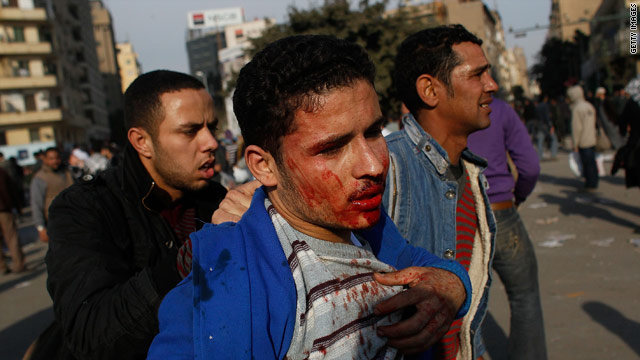
Some injured protesters fell. Others stumbled through the crowd. Blood streamed down the faces of the injured.
Many of the injuries were serious, even though demonstrators wrapped sweatshirts and other clothes around their heads to protect themselves from flying stones.
Dozens of wounded were carried away, bleeding from gashes. It was impossible to tell from visits to a makeshift clinic which side was faring worse, CNN's Ben Wedeman said. He said simply: "They are all Egyptians."
A mosque served as a makeshift field hospital, staffed by volunteer doctors, he said.
Police were nowhere to be seen.
Army tanks surrounded the square, but the military proved unable or unwilling to separate the two sides. The hatches on their tanks and armored personnel carriers remained closed.
Some brave Egyptians tried to stop the violence, putting their bodies between the sides. Briefly they seemed to succeed. There was a lull in the violence. Some protesters from the rival camps embraced.
All at once, about 50 or 60 people carrying clubs and riding horses and camels charged into the square, beating some protesters. At least one man was pulled off his horse and beaten.
And the frenzy intensified. People tore paving stones out of the streets with crowbars and their bare hands, filling bags with rocks to use as an arsenal in the street battle.

Some ripped street signs out of the ground, using the metal as makeshift shields.
CNN's Hala Gorani was threatened by a pro-Mubarak supporter who told her to get out of the area.
"I was a little bit fearful," she said. Another protester stepped in and protected her, telling the first not to touch her because "she is with me."
She said she ran as fast as she could back to her colleagues.
"I'm fine, but I've got to say, this is a situation that can turn on a dime. There is a lot of anger coming from those protesters."
They are attacking journalists, she said, and will threaten anyone who looks Western with violence.

It was unclear whether there was shooting on the square. CNN's Fred Pleitgen and Anderson Cooper said they heard shots being fired, although Cooper suggested it may have been troops on the sidelines shooting into the air to try to restore order.
The interior ministry denied there was shooting.
CNN's Ivan Watson, overlooking the square from a hotel, did not hear any gunfire, he said, calling that "a blessing."
And somehow, amid the clashes, pockets of peace remained -- including around small groups who, amid the violence, dropped to their knees and faced Mecca. The time had come for daily prayers.

Tuesday, February 1, 2011

Huge protests fan Egypt unrest


The BBC's John Simpson describes the scene in Cairo's Tahrir Square
Egyptian protesters are holding huge rallies in Cairo and other cities as they step up their efforts to force President Hosni Mubarak from power.
Organisers have been hoping to bring one million people on to the streets of the capital. The demonstration is the biggest since the protests began.
The atmosphere has been festive, with protesters singing and chanting.
Protest leaders, including Mohamed ElBaradei, have called on Mr Mubarak to step down by Friday at the latest.
"They hope that this will end today or Friday at the latest, and they called the coming Friday 'the Friday of departure', but I hope that President Mubarak will take heed before then and leave the country after 30 years of rule and give the people a chance, and I don't expect that he wants to see more blood," Mr ElBaradei told al-Arabiya TV.
Senior figures in the ruling National Democratic Party say there may be a statement from Mr Mubarak in the next few hours.
There are reports that Mr Mubarak has met special US envoy Frank Wisner, a former ambassador to Egypt who was sent back to Cairo on Monday.
Festive atmosphere
BBC correspondents in Cairo's Tahrir Square say the crowds there are much bigger than on the previous seven days of protests.
The BBC's Jim Muir says that hours after dusk and despite a theoretical 1500 (1300 GMT) curfew and bitter cold the square is still full of people.
Egypt's powerful army has vowed it will not use force against the protesters.
Many carried placards and banners daubed with anti-Mubarak slogans. Earlier, crowds cheered as an effigy of the president was hung from a set of traffic lights in the square.
But the BBC's John Simpson in the square says the demonstration has not been the critical moment people thought it would be, and it has not reached a tipping point.
There is a danger that the demonstrators could lose the initiative if a march to the presidential palace planned for Friday fails to budge Mr Mubarak, but it is hard to see how he can continue in power, he adds.
Meanwhile, new Vice-President Omar Suleiman said he would hold cross-party talks on constitutional reform.
Mr Mubarak reshuffled his cabinet on Monday to try to head off the protests, replacing the widely despised Interior Minister Habib al-Adly.
Prime Minister Ahmad Shafiq told state TV the new government would ensure bread supplies, tackle security problems and "review our entire political, constitutional and legislative situation, into something more satisfactory and appropriate for us as Egyptian citizens".
"Everything is subject to amendments, without limits," he said.
The UN human rights chief, Navi Pillay, says 300 people may been killed across the country since the protests began a week ago. They followed an internet campaign and were partly inspired by the ousting of President Zine al-Abidine Ben Ali in Tunisia last month.
Egypt has since cut off the internet in the country and text messaging services have been disrupted.
In Egypt's second biggest city, Alexandria, thousands of people have gathered to call for the president to step down.
Thousands more were out in the streets in Suez, and the Associated Press news agency reported protests in Mansoura, north of Cairo, and the southern cities of Assiut and Luxor.
With limited bus, train and internal flight services, access to the capital has been restricted.
Unnamed security officials were reported as saying all roads and public transportation to Cairo had been shut down.
Some protesters camped out in Tahrir Square on Monday night, saying they would stay there until Mr Mubarak's 30-year rule ended.
One demonstrator, Tarek Shalabi, told the BBC that groups were camped out in tents or sleeping out in the square, and described the atmosphere as "overwhelming".
"We're here because we want to make a statement. We're not going until Mubarak steps down," he said.
He said a stage had been set up where people could go up and make speeches, read out poetry or sing or chant political slogans.Meanwhile, crowds of pro-Mubarak demonstrators held counter-protests elsewhere in the capital, raising fears of possible confrontations between the different groups.
'Legitimate'
On Monday, the Egyptian army said it respected the "legitimate rights of the people".
In its statement, carried on Egyptian media, the military said: "To the great people of Egypt, your armed forces, acknowledging the legitimate rights of the people... have not and will not use force against the Egyptian people."
Correspondents say the announcement is absolutely critical because it takes away a huge measure of uncertainty from the mind of any potential demonstrator.
A coalition of political opposition groups - incorporating the Muslim Brotherhood, political parties such as that led by Mr ElBaradei, and other prominent figures - has reportedly met, and told the Egyptian government that it will begin talks on its demands only after Mr Mubarak has stood down.
Concerns have also grown about the economy, as global oil prices on Monday topped $100 (£62) a barrel amid fears over the ongoing unrest.

Monday, January 31, 2011

Egypt's Mubarak opens door to talks with rival political parties

By the CNN Wire Staff

(CNN) -- After 30 years of mostly unchallenged rule, Egyptian President Hosni Mubarak opened the door Sunday to talks with rival political parties while calling out those who, he claimed, used religion to "spread fear" through rampant hooliganism.

According to a transcript of his comments to leaders of his new government read on state-run Nile TV, Mubarak acknowledged what he called "peaceful demonstrations" as well as grievances about the economy. Thousands of protesters have hit the streets of Cairo, Alexandria and beyond calling for the president's ouster as well as substantial reforms.
"The current stage requires us to reorganize the country's priorities in a way that acknowledges the legitimate demands of the people," he said.

The president, again recognizing the depth of the unrest, urged those charged with shaping the new Cabinet -- specifically, his newly appointed Prime Minister Ahmed Shafiq -- to pursue "a wide range of dialogue with all the (political) parties."

Such discussions, he said, "will achieve the democratic process."
Mubarak called on new government leaders to "stand against anyone committing any forms of corruption" and stressed "the necessity to continue with fair, serious and effective new steps for more political, constitutional and legislative reforms."

As he did in a nationally televised early Saturday, Mubarak referenced the unsettled security situation across the country, in part due to a void created after police largely abandoned their posts.
He called on new government leaders to "stop all the violence by whoever commits it," while appearing to criticize the Muslim Brotherhood, the country's largest opposition party.
"The citizens and the young people of Egypt have gone out to the streets in peaceful demonstration asking for their right for the freedom of speech," Mubarak said. "However, their demonstrations have been infiltrated by a group of people who use the name of religion who don't take into consideration the constitution rights and citizenship values."

The president claimed that such people of "giving the chance for criminal groups to loot and confiscate public and private property, spread fires and spread fear."
Mubarak commanded the new leaders "to take care of the people," so that they again felt safe from looters and other criminal elements. Mubarak expressed hope that the military could succeed in protecting Egypt and its institutions and soon go back to its original goal, "which is to defend the country and its sovereignty."
The military itself addressed the public Sunday through a statement read on state-run Nile TV.

An unnamed man dressed in a military uniform urged people to respect the government-ordered curfew so that authorities can more easily capture those accused of looting and destruction in recent days.

In the comments, described as the third statement by Egypt's armed forces since the unrest began, the soldier also asked citizens to help detain outlaws as well as the hundreds who have recently escaped from prisons.

Whereas Mubarak's earlier speech dwelled mostly on security, his comments Sunday touched relatively more on substantive political and economic reforms.

The president offered few specific ideas, besides ordering that government subsidies not be touched. Yet he did charge the new government to "regain the trust in our economy." He mentioned the need to "control unemployment," keep inflation low and keep prices of key commodities in check.

"I trust in your ability to realize new economic achievements (and) to relieve the suffering of the people," Mubarak said.


Sunday, January 30, 2011

Egypt protests: ElBaradei tells crowd 'change coming'


The BBC's Wyre Davies on another extraordinary day in Cairo

Leading Egyptian opposition figure Mohamed ElBaradei has joined thousands of protesters in Cairo defying a curfew to demand President Mubarak stand down.
Addressing the crowd in Tahrir (Liberation) Square, the Nobel peace prize winner urged patience, saying "change is coming".
In a tense sixth day of protests, the army sent tanks into the square only to see them blocked by demonstrators.
Air force jets and a helicopter repeatedly flew low over the square.
"You have taken back your rights and what we have begun cannot go back," Mr ElBaradei told the crowd.
Embattled President Hosni Mubarak earlier met top commanders during a visit to a military headquarters.
US Secretary of State Hillary Clinton has called for an "orderly transition" of power in Egypt.
She told ABC News that Washington wanted to see change that would bring about a democratic government.
The BBC's Jeremy Bowen, in Tahrir Square, said the arrival of a column of tanks and the sound of jets roaring overhead significantly raised the tension among the crowds.
In the northern port city of Alexandria, the BBC's John Simpson said more protests are being held there and the army is out in force.
However, widespread looting is making many people reluctant to leave their homes, he adds.
In Cairo on Sunday, there was no sign of the riot police with whom protesters have clashed violently in recent days, although state television said they were being ordered back on to the streets.
Late Sunday night, state television also reported that the 1600 (1400 GMT) curfew - which has been widely ignored - would be extended in Cairo, Alexandria and Suez to run from 1500 to 0800.
Clashes are reported to have left at least 100 people dead since rallies began on Tuesday in cities including Cairo, Suez and Alexandria. Thousands more have been injured.
Across Cairo, citizens have formed armed groups to protect their property from looters.
Meanwhile, al-Jazeera's broadcasts via an Egyptian satellite have been halted. The Egyptian government earlier ordered the Arabic TV channel, which has been showing blanket coverage of the protests, to shut down its operations in the country.
Although Sunday is the start of the working week in the Middle East, many businesses in Cairo are closed and internet access remains intermittent.
Across the country, thousands of prisoners are reported to have escaped from jails after overpowering their guards.
They are said to include senior members of the Muslim Brotherhood - the largest opposition group in Egypt.
On Sunday, a number of Egyptian political movements issued a joint statement calling on Mr ElBaradei to form a transitional government. The Muslim Brotherhood is also reported to have asked him to negotiate with Mr Mubarak's regime.
Mr ElBaradei, a former head of the UN's nuclear watchdog, is a leading advocate for political reform and a likely challenger for Egypt's presidency.
Correspondents say that although he has become a leading figurehead of the opposition, protesters have not yet called for him to be their leader.
President Mubarak, in an attempt to regain control, has appointed a vice-president - intelligence chief Omar Suleiman. Aviation Minister Ahmed Shafiq has been appointed prime minister.
The US government, which previously advised US citizens against non-essential travel to Egypt, is now advising Americans in Egypt to consider leaving as soon as possible.
The UK also advised its nationals in Cairo, Alexandria and Suez to leave if it is safe for them to do so.
A number of other European countries have also advised against visiting the country.
The unrest in Egypt follows the uprising in Tunisia which ousted President Zine al-Abidine Ben Ali two weeks ago after 23 years in power.
The Tunisian turmoil began with anger over rising food prices, high unemployment and anger at official corruption - problems which have also angered many people in Egypt.


"I bow to the people of Egypt in respect. I ask of you patience, change is coming in the next few days."
Mr ElBaradei has been asked by opposition groups to negotiate with the authorities on forming a national unity government.
However, the BBC's Jim Muir in Cairo said the former UN official did not attract the attention of the whole crowd, which contained other political factions.

Egypt's Internet disconnect reaches 24 hours


cnet - by Declan McCullagh

Egypt's unprecedented Internet disconnection has now lasted 24 hours without signs of ending.
At this time yesterday, one by one, the country's electronic links to the outside world fell silent. It started at 2:12 p.m. PT with the mostly state-owned Telecom Egypt disabling its networks, with four smaller network providers following suit between 2:13 p.m. PT and 2:25 p.m. PT.
Egyptian President Hosni Mubarak appeared on state television at approximately 2:15 p.m. PT today to announce that he would sack his cabinet but would not resign--an indication that no end to the disconnect was near. "I will not be lax or tolerant," he said, according to an Al Jazeera English translation. There's a fine line, he said, between permitting free speech and allowing chaos to spread.
Yesterday's network disconnection was followed soon after by mobile networks pulling the plug as well. Vodafone confirmed in a statement that "all mobile operators in Egypt have been instructed to suspend services in selected areas." So did Mobinil, the country's largest mobile provider. (See CNET's previous coverage.)
Those outages come as four days of clashes between security forces and tens of thousands of protesters continued on the streets of Cairo and other major cities, despite an official curfew in effect Friday evening. Tanks have taken up positions around some TV stations and foreign embassies, and Al Jazeera English is reporting that the end of three decades of autocratic rule by Mubarak may be nearing.
U.S. Secretary of State Hillary Clinton said in a speech earlier today that "we urge the Egyptian authorities to allow peaceful protests and to reverse the unprecedented steps it has taken to cut off communications."
"We think the government, as many of us have said throughout the day, need to turn the Internet and social-networking sites back on," White House press secretary Robert Gibbs said. He added: "Individual freedoms includes the freedom to access the Internet and the freedom to--to use social-networking sites."
Egypt's Internet connections aren't completely down: the Noor Group appears to be the only Internet provider in Egypt that's fully functioning. Cairo-based bloggers have speculated that its unique status grows out of its client list, which includes western firms including ExxonMobil, Toyota, Hyatt, Nestle, Fedex, Coca-Cola, and Pfizer, plus the Egyptian stock exchange.
An analysis posted by network analyst Andree Toonk, who runs a Web site devoted to monitoring networks, shows that before the outage, there were 2,903 Egyptian networks publicly accessible via the Internet. Today, there are only 327 networks.
This chart, provided by Akamai, shows the precipitous drop in traffic to Egypt yesterday.
This chart, provided by Akamai, shows the precipitous drop in traffic to and from Egypt yesterday.
(Credit: Akamai)
 
A chart prepared by European networking organization RIPE provides a detailed glimpse at how Egypt's network went dark. Until yesterday afternoon, there was the normal noise of networks being added and deleted, followed by a sharp spike yesterday between 2 p.m. and 2:30 p.m. ET. There's been virtually no activity since.
Before yesterday's outage, Egyptian use of the Tor anonymizing network had experienced a dramatic spike that coincided with the beginning of widespread protests. Normal usage was hovering around 400 users a day, but leaped to more than 1,200 as of January 24. (Here's a different view.)
Contrary to some reports, however, there's no evidence that Syria's Internet connection is down. Compare this chart from an Egyptian provider showing the network going completely dark with this one from the government-owned Syrian Telecommunications Establishment that depicts normal activity.
The rumors about Syria originated a few hours ago when Al Arabiya news service said that "Syria suspends all Internet services," and followed up with a denial from the authorities. Reuters reported earlier this week that Syrian authorities have banned programs that allow access to Facebook Chat from cell phones.
There are some parallels. The now-defunct HotWired site, succeeded by Wired.com, reported in 1996 that "the U.S. government has quietly pulled the plug on Iran's Internet connection." During a state of emergency in Bangladesh in 2007, satellite providers were ordered to cease airing any news shows. And in Burma later that year, the country's ruling military junta pulled the plug on the nation's limited Internet access.
But Burma is not Egypt, a country of more than 80 million people equipped with tens of millions of computers and cell phones--who have now found themselves almost entirely disconnected from the rest of the world.
Egypt receives more than $1.3 billion annually from U.S. taxpayers in the form of military aid, according to the U.S. State Department.
"Thanks to the blanket communications shutdown, the protests today took place in an information vacuum," according to a dispatch from Index on Censorship's Egypt regional editor Ashraf Khalil in Cairo. "On Tuesday, even during the demonstration, everybody was checking Twitter both to coordinate and for news on what was happening across the country. This time nobody knew what was happening anywhere else--not even on the other side of the river in Tahrir Square."

Saturday, January 29, 2011

Egypt protests: Mubarak names Omar Suleiman as VP - BBC


from BBC
Egypt's President Hosni Mubarak has named intelligence chief Omar Suleiman as his first ever vice-president as he struggles to regain control of the country.
Aviation minister Ahmed Shafiq has also been appointed as prime minister.
Tens of thousands of protesters remain on the streets in Egypt, defying a curfew and army warnings.
There have been clashes in Alexandria, Cairo and Ismailiya. At least 74 people have been killed in the last two days.
In Cairo, police fired rubber bullets and tear gas in clashes with protesters at the interior ministry, but the army did not intervene. Injuries have been reported.
Cairo, Alexandria and Suez are under an extended curfew from 1600 to 0800 (1400-0600 GMT).
'Live bullets'
Cairo's central Tahrir (Liberation) Square remains filled with protesters. Troops and armoured vehicles have been deployed but have not yet taken any action.


A BBC Arabic correspondent at the scene reported a friendly atmosphere between the army and the demonstrators.
But clashes between the protesters and the riot police have left at least 74 people dead since rallies began on Tuesday. About 2,000 people have been injured.
"Live bullets have been fired at protesters, aimed at their heads," Dr Yaser Sayyed at the Sayyed Galal Hospital in Cairo told BBC Arabic.
"We have seen more than 20 cases of headshots with the bullet wounds on the front of the head and exit wounds on the other side, skulls fractured... in addition to chest wounds."
The army advised people to obey the curfew and avoid gathering in groups.
Looters rampaged through a number of upper-class neighbourhoods in Cairo, while in Alexandria there were reports of widespread looting of supermarket chains.
Some residents have formed committees to protect their homes and buildings.
Egyptian-born cleric Sheikh Yusuf al-Qaradawi has said Mr Mubarak must stand down.
"I advise President Mubarak to leave his position and to leave Egypt," the influential cleric said. "There is no other solution to this problem but for [Mr] Mubarak to go."
'Reluctant to fire'
Hundreds of foreign tourists and Egyptian nationals are at Cairo's main airport seeking flights out of the country.
The UK has advised against all but essential travel to Cairo, Alexandria, Luxor and Suez.
The US has issued warnings to its nationals to cancel non-essential travel to Egypt. A number of European countries have also advised against visiting the country.
In Abu Za'abal prison in Cairo, a political prisoner told the BBC that 120 inmates took control of one sector of the jail.
Speaking by mobile phone, Mohamed Mahmud Sami - who has been in prison for 17 years - said: "Security forces are trying to storm in, but we can see that the soldiers are reluctant to fire at us, as if they want to side with the rebelling people of Egypt."
Cairo stock exchange will be closed on Sunday - a full trading day in the Middle East - because of the turmoil in the city.
After a day of violent protests on Friday, President Mubarak appeared on state TV to announce he was sacking his government. The cabinet has now formally resigned.
Mobile phone services have been restored in Cairo, but the internet remains down.
In Suez, soldiers were on the streets after the city's police fled following Friday's violence in which the main police station was burned down.
And a BBC Arabic producer reported that prison inmates rioted in the city of Manufiya, north-west of Cairo.
US President Barack Obama spoke to Mr Mubarak on Friday and urged him to uphold promises of reform. The US will review its aid of $1.5bn (£1.1bn) to Egypt based on events in the coming days.
The unrest in Egypt follows an uprising in Tunisia two weeks ago which toppled President Zine al-Abidine Ben Ali after 23 years in power.
The Tunisian upheaval began with anger over rising food prices, high unemployment and anger at official corruption - problems which have also left many people in Egypt feeling frustrated and resentful of their leadership.


Revolution of the people': Egyptians return to streets


Egyptian President Hosni Mubarak named a vice president Saturday for the first time since coming to power nearly 30 years ago — a clear step toward setting up a successor in the midst of the biggest anti-government protests of his regime.
After five days of protests, Cairo was engulfed in chaos.
NBC News' Richard Engel reported dramatic scenes of tanks and armored personnel carriers fanning out across the city of 18 million, guarding key government buildings. He told msnbc there was rampant looting and protesters, many smeared in red, screaming and yelling in the streets.
Lawlessness was spreading fast. At least three people were killed as they stormed the Interior Ministry on Saturday. Protesters carried their bodies through the crowd. At least 62 have died nationwide since the uprising. Officials say an additional 2,000 people have been injured.
Residents of affluent neighborhoods were boarding up their houses against gangs of thugs roaming the streets with knives and sticks and gunfire was heard in some neighborhoods.
The military was protecting major tourist and archaeological sites such as the Egyptian Museum, home to some of the country's most treasured antiquities, as well as the Cabinet building. The military closed the pyramids on the outskirts of Cairo — Egypt's premiere tourist site.
'Down with Mubarak' On Friday, protesters burned down the headquarters of Mubarak's ruling party along the Nile and set fire to other buildings, roaming the streets of downtown Cairo in defiance of a night curfew enforced by the first army deployment.
Thousands of protesters defied the curfew for the second night Saturday, standing their ground in the main Tahrir Square in a resounding rejection of Mubarak's attempt to hang onto power with promises of reform and a new government.
"What we want is for Mubarak to leave, not just his government," Mohammed Mahmoud, a demonstrator in the city's main Tahrir Square, said Saturday. "We will not stop protesting until he goes."
A few tanks were deployed in Tahrir Square. But there have been no clashes reported between protesters and the military at all and many feel the army is with them. On one tank was scrawled black graffiti: "Down with Mubarak."

Friday, January 28, 2011

Egypt unrest: Police clash with protesters in Cairo


BBC
The protests widened after Friday prayers

Egyptian police have clashed with thousands of protesters demanding the resignation of President Hosni Mubarak in Cairo for a fourth consecutive day.
Protesters gathered after Friday prayers. Police used tear gas and water cannons to disperse the crowds, who responded by throwing stones.
People also took to the streets in the coastal cities of Suez and Alexandria.
The government has warned of "decisive measures". There has been disruption to internet and mobile phone services.
The French government said it had received reports that four French journalists covering the protests in Cairo had been arrested.
There were also reports of clashes between protesters and police in Alexandria, Suez, Mansoura and Aswan, as well as Minya and Assiut south of Cairo, and al-Arish in the Sinai peninsula.
In anticipation of the unrest, riot police were deployed around the capital, at the entrances to bridges across the River Nile, at Tahrir Square - the scene of protests earlier this week - and other key intersections.
Friday's rallies in Egypt were expected to be the biggest so far, with people urged via internet sites to join after attending prayers.
The organisers called on people to come out in force, stressing that the religion of protesters was not relevant.
However, most internet and mobile-phone data connections appeared to be cut off from early on Friday. Service providers gave no reasons for the disruption.
On its website, the Muslim Brotherhood accused the government of engineering the disruption "to prevent the voices of the Egyptian people from reaching the world".
But Egyptian film-maker Ahmed Rasheed, who was planning to take part in Friday's demonstrations, said people no longer feared arrest.
"We have broken this fear barrier," he told the BBC. "People are taking to the streets, young people, all walks of life, educated, non-educated, higher social classes, lower social classes."
A lawyer for the Muslim Brotherhood meanwhile told the BBC that tens of its members had been arrested.
Despite an official ban, the Muslim Brotherhood remains Egypt's largest and most organised opposition movement.
Mr Mubarak, 82, has been in office since 1981.
The Egyptian government tolerates little dissent and opposition demonstrations are routinely outlawed.
On Thursday, Mr Mubarak's National Democratic Party (NDP) said it was ready for dialogue but did not offer any concessions.
Safwat al-Sherif, the party's secretary-general, said: "The NDP is ready for a dialogue with the public, youth and legal parties. But democracy has its rules and process. The minority does not force its will on the majority."
The US government, which counts Egypt as one of its most important allies in the Arab world, has so far been cautious in expressing support for either side.
President Barack Obama described the protests as the result of "pent-up frustrations", saying he had frequently pressed Mr Mubarak to enact reforms. He urged both sides not to resort to violence.