Showing posts with label Tahrir Square. Show all posts

Friday, February 4, 2011

'Day of departure' rally in Egypt

The BBC's Jim Muir in Tahrir Square: "The sense of imminent attack has eased and people are relaxing"


Tens of thousands of Egyptians are taking part in a "day of departure" to try to oust President Hosni Mubarak.
There is an increased army presence in Cairo's Tahrir Square after unrest that has led to hundreds of casualties.
After Friday prayers were held in a relaxed atmosphere, the crowd started chanting for Mr Mubarak to go.
Mr Mubarak has said he is "fed up" with being in power but is resisting mounting pressure to resign as he says it would leave Egypt in chaos.
In his first interview since anti-government protests began, he told ABC News he would like to resign immediately. But he repeated that the country's Islamist opposition - the Muslim Brotherhood - would fill the power vacuum left by his absence.
'Silent majority'


The BBC's Jim Muir in Tahrir Square says tens of thousands have now gathered there, although with the checkpoints the movement into the square is more a trickle than a flood.
The stronger army presence secured the perimeter and the soldiers appear to be on good terms with the protesters.
The demonstrators chanted: "The army and people are united."
Defence Minister General Mohamed Hussein Tantawi and other military leaders joined the armed forces in the square.
The secretary general of the Arab League, Amr Moussa, who has not ruled out standing for president, is also reported to be in Tahrir Square.
Thorough checks for weapons were carried out ahead of Friday prayers, during which one cleric praised the "revolution of the young" and declared: "We want the head of the regime removed."
Our correspondent says the mood is relaxed but it is not quite the carnival atmosphere that existed before Wednesday - when pro-Mubarak gangs attacked anti-government protesters - and people are watchful.
The BBC's Wyre Davies in Egypt's second city, Alexandria, says there are also many more tanks and soldiers out on the streets there than before.
Supporters of Mr Mubarak have been calling Friday a "day of allegiance".
The general secretary of the ruling NDP, Ibrahim Kamel, has accused the West of betraying Egypt.
He vowed President Mubarak would not step down and that soon millions of Egyptians - "the silent majority" - would come out on to the streets to protest because "enough is enough".
Egypt's health ministry says eight people have been killed and more than 800 injured in the clashes in recent days. The United Nations estimates that more than 300 people have died since the unrest broke out on 25 January, with about 4,000 hurt.
US efforts


Egypt's Vice-President Omar Suleiman has appealed for calm and urged the protesters to accept Mr Mubarak's pledge that he would not stand for election again.
But it has now emerged that the White House has been in talks with Mr Suleiman about how Egypt can begin making a "meaningful transition" to a democratic government.
US Vice-President Joe Biden spoke to his Egyptian counterpart on Thursday, say diplomats.
The New York Times suggested that among the proposals was a plan for Mr Mubarak to resign immediately and hand power to a military-backed interim government under Mr Suleiman.
Neither the White House nor the state department have directly denied the report.
But a spokesman for President Barack Obama's National Security Council said it was "time to begin a peaceful, orderly and meaningful transition, with credible, inclusive negotiations".
The BBC's Mark Mardell in Washington says other reports suggest the US plan has already been rebuffed in Egypt, and that the administration has been surprised by the attitude of the military and Mr Suleiman.
The reports say officials believe Mr Suleiman was aware of the apparent campaign in recent days to intimidate the opposition, and are now wondering whether he is the right man to lead an interim government, says our corresponden
On Friday, UK Prime Minister David Cameron criticised the Egyptian government for its handling of the crisis.
"The steps taken so far haven't met the aspirations of the Egyptian people," he said.
In his interview with ABC News, Mr Mubarak denied that his administration was behind the violence of the last two days but said it had troubled him.
Mr Mubarak was speaking in the presidential palace, with his son Gamal at his side.
"I never intended to run [for president] again," Mr Mubarak said. "I never intended Gamal to be president after me."

Protesters in Cairo vow to continue demonstrations

By the CNN Wire Staff


Cairo, Egypt (CNN) -- Demonstrators have built a barbed-wire barricade and stacked piles of rocks throughout Cairo's Tahrir Square Friday, where they gathered to demand President Hosni Mubarak's resignation.


Military forces surrounded the square, and anti-government protesters manned their own security checkpoints, which included numerous blockades. The stream of demonstrators entering the square was steady at midday.


As midday prayers ended, anti-government protesters chanted, "He leaves, we don't leave" and "The blood of the martyrs will not be forgotten."


Anti-government protesters have pledged to bring droves of demonstrators to the square Friday for what they dubbed a "day of farewell" and "day of departure," referring to their push for Mubarak to resign. Elsewhere in Cairo, pro-government protesters said they were gathering in a mosque for a "day of loyalty."


But the pro-Mubarak groups were notably absent from Tahrir Square, where they clashed with anti-government protesters earlier this week.


In the northern port city of Alexandria, the streets leading to the Al Kaed Ibrahim mosque were packed as the midday sermon began.


"This is a great revolution and the whole regime, the entire system needs to be changed. The revolution must continue until all objectives are met," the mosque's imam told the crowd.


Writing on the walls leading to the mosque, where police and anti-government demonstrators clashed last Friday, said "Game OVER" and "Pharaoh's last day."There was very little military presence in Alexandria, but troops wearing riot gear toted automatic weapons near Cairo's Tahrir Square.


Security forces detained some people leaving the square, pointing guns at them and forcing them to lie on the ground early Friday. A burned-out car and a group of troops blocked the October 6 bridge, which crosses the Nile River and serves as an entrance to the square.


The anti-government protests were scheduled to start after Friday prayers, and some demonstrators suggested the group may march toward the presidential palace.


Mubarak is not gone, but his days are numbered. The leader agreed Tuesday to not seek re-election in September.In the bloody blur of days since his announcement that he would not stand for re-election, regime foes and supporters have clashed repeatedly in Tahrir Square, the center of anti-government demonstrations. Eight people have been killed and nearly 896 injured, according to the health ministry.


The atmosphere Friday morning was peaceful and optimistic, but tense. Some anti-government demonstrators smiled as they sang patriotic songs. Exhausted protesters slept on sidewalks inside the square. A man with an Egyptian flag wrapped around his head sat on a curb, flashing a victory sign.


A handful of pro-government protesters cheered as large vans filled with security forces arrived at Tahrir Square around 6 a.m. Friday (11 p.m. ET). It was unclear whether those inside were members of the military or police.


Mubarak told ABC News Thursday he would like to step down right away, but cannot because he does not want to risk plunging his nation into chaos.Vice President Omar Suleiman blamed the media for some of the unrest that has plagued his country since anti-government demonstrations began January 25.


"I actually blame certain friendly nations who have television channels, they are not friendly at all, who have intensified the youth against the nation and the state," Suleiman told Nile TV. "They have filled in the minds of the youth with wrongdoings, with allegations, and this is unacceptable."


Thursday saw an escalation of attacks on journalists covering the demonstrations. Many of those targeted asked whether the government was clearing them out of the way to cloak its actions.


"Why doesn't the government want us around? What is it that it plans to do in the next few days that it really doesn't want cameras to be able to report on?" New York Times columnist Nicholas Kristof told CNN.
Mubarak told ABC News correspondent Christiane Amanpour that he was troubled by the bloody clashes that broke out Wednesday in Tahrir Square.


As the United States and other countries condemned increasing attacks on journalists and diplomats, Mubarak rejected the notion that government instigated the violence in the country, instead blaming the Muslim Brotherhood, an Islamist umbrella group that is banned in Egypt.


"I don't care what people say about me," Mubarak told ABC. "Right now I care about my country, I care about Egypt.


"I was very unhappy about yesterday. I do not want to see Egyptians fighting each other," he said in the interview, which was conducted at the heavily guarded presidential palace, where the embattled leader has been staying with his family.


Mubarak said he never intended to seek re-election or for his son, Gamal, to seek the post. He made the comment to Amanpour in his son's presence.Mubarak's concession that he would not run for re-election has not been enough for tens of thousands of protesters demanding immediate change.


Top government leaders vowed to hold accountable perpetrators of the bloodshed and told protesters to return home."I want to thank the youth for all you have done," Suleiman said on state-run Nile TV. "You are the lights that have ignited reform in this period. Please give the (government a) chance to play its role. All of your demands have been met."


Suleiman told ABC that Egyptian troops will not force anti-Mubarak protesters to leave Tahrir Square.


Mubarak supporters, some believed to be paid government thugs, converged with anti-government crowds Wednesday in a confrontation that quickly evolved into continuing mayhem in Tahrir Square.Egyptian Prime Minister Ahmed Shafiq apologized repeatedly for the violence. He blamed infiltrators and a "complete disappearance" of police for the human toll in the "catastrophe."


Shafiq said he and Suleiman were meeting with the opposition -- including protesters in Tahrir Square. He said no one would be excluded from the national dialogue, including the Muslim Brotherhood.


The United States is stepping up pressure on the opposition to begin immediate negotiations with the Egyptian government."It's time for both of them to roll up their sleeves," a senior State Department official told CNN. "The government has to take some steps, but the opposition has to be willing to participate in negotiations as well."

Journalists report second day of detentions, harassment in Cairo

By the CNN Wire Staff


Cairo, Egypt (CNN) -- Journalists attempting to cover unprecedented unrest in Egypt reported being targeted, beaten, arrested and harassed by security forces and police for a second day Thursday.


Al Jazeera released a statement demanding that three of its journalists, detained by Egyptian security forces, be released. A fourth has been reported missing, the network said.The Washington Post reported, citing multiple witnesses, that its Cairo bureau chief, Leila Fadel, and photographer Linda Davidson were among two journalists arrested Thursday morning by the Egyptian Interior Ministry. The Post later said on its blog that Fadel had called to say she and Davidson were released, but the two were separated from Sufian Taha, their translator and a longtime Post employee, and their Egyptian driver, Mansour el-Sayed Mohammed Abo Gouda. The two men were unaccounted for, the Post said.


The New York Times reported Thursday that two of its reporters had been released after being detained overnight in Cairo.Others said their gear had been confiscated. And the BBC tweeted Thursday, "Egyptian security seize BBC equipment at Cairo Hilton in attempt to stop us broadcasting."


"Gear taken at hotel for its own security," one photojournalist posted online. "... See if we get it back."U.S. State Department officials told CNN they have information that Egypt's Interior Ministry was behind the journalist detentions, citing reports from the U.S. Embassy in Egypt. Department officials were expected to discuss the issue with the Egyptian Embassy in Washington and the Foreign Ministry in Cairo.


Department spokesman P.J. Crowley said the attacks and harassment of journalists seem to be part of an organized effort, but it was unclear who was directing it. "I don't think these are random attacks," he told reporters."There is a concerted campaign to intimidate international journalists in Cairo and interfere with their reporting," Crowley posted earlier Thursday on Twitter. "We condemn such actions."


A photojournalist for CNN-IBN, Rajesh Bhardwaj, was detained in Cairo's Tahrir Square, the site of bloody clashes between supporters and opponents of President Hosni Mubarak. He was taken away by the Egyptian Army and later released, but only after his identification card and tapes were destroyed, said Suhasini Haidar, CNN-IBN deputy foreign editor.


The Indian Ministry of External Affairs was advising Indian journalists in Egypt to avoid trouble spots.Other journalists reported being beaten and harassed by protesters."Situation on ground in Egypt very tense," CNN's Anderson Cooper tweeted Thursday. "Vehicle I was in attacked. My window smashed. All OK."


The Greek daily newspaper Kathimerini said one of its reporters, Petros Papaconstantinou, was beaten by protesters in Cairo's Tahrir Square. Papaconstantinou was clubbed in the head with a baton and stabbed in the foot, either with a knife or a screwdriver, said Xenia Kounalaki, head of the newspaper's foreign desk. A photographer also sustained minor injuries, Kounalaki said, and both were treated at a Cairo hospital and released.


Other journalists reported close calls. Marie Colvin of the Sunday Times of London said she was approached by a gang of men with knives in Imbaba, a poor neighborhood of Cairo. Another group of men, who also were strangers to her, pushed her into a store and locked it to protect her, she said.


In addition, several human rights groups reported their representatives had been detained.The Hisham Mubarak Law Center, a human rights law firm, was taken over by military police, as was the Egyptian Center for Economic and Social Rights, Oxfam International said in a statement. A total of eight people were detained, including the directors of both centers, the organization said.


Oxfam said several of its staff members were among those detained. Amnesty International and Human Rights Watch each said one of their researchers was detained at the law center. They were interrogated before being taken away to an unknown location in Cairo, Human Rights Watch said. All three groups called for the immediate release of their staffers.


Al Jazeera said Thursday that six of its journalists had been detained by Egyptian authorities in the past week, with equipment stolen and destroyed. "It has also faced unprecedented levels (of) interference in its broadcast signal across the Arab world," the network said in a statement.U.N. Secretary General Ban Ki-moon condemned the attacks.


"The freedom of speech, whether journalists or demonstrators -- they should be fully guaranteed and protected. That is a ground principle of democracy," he said.


Meanwhile, Shahira Amin, a reporter for Egypt's state-run Nile TV, resigned Thursday."I spent the day at Nile TV yesterday," she told CNN. "I was only allowed to air the pro-Mubarak rallies that were going on, as if nothing was happening at Tahrir Square. We weren't allowed to reveal any figures. There was a near total blackout," she said, calling it "hypocritical ... I just don't want to be part of it."


She said she should have resigned "ages ago. ... I was happy to spend the day in Tahrir Square where the people are. ... I am on their side."


"People are too scared to tell the truth," she said. "There is a built-in or inherent feeling that many Egyptian journalists have because of (the threat of) detention and arrest."She added, "I haven't been intimidated all these years. I have been telling the truth. I managed to get away with it until now. This time around, I just couldn't tell the truth, so I just walked out."


Journalists were also targeted on Wednesday, with some beaten, bloodied, harassed and detained by men, most of them apparently aligned in some way with Mubarak.Numerous news outlets -- including the BBC, ABC News and CNN -- reported members of their staffs had been attacked, mostly on the streets of Cairo. In several cases, news personnel were accused of being "foreign spies," seized, whisked away, and often assaulted.


Fox News reported Thursday that a reporter and cameraman, forced to flee their position after a Molotov cocktail ignited a fire, ran into pro-Mubarak protesters and were so severely beaten they spent the night in a hospital before being released Thursday.


"It was pandemonium. There was no control. Suddenly a man would come up to you and punch you in the face," said CNN's Cooper, describing being attacked by pro-Mubarak demonstrators along with two colleagues outside of Tahrir Square.


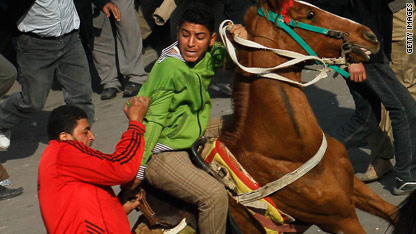
CNN's Hala Gorani got caught Wednesday morning in a stampede of demonstrators, some of whom were riding on camels and horses."I got slammed against the gates and was threatened by one of the pro-Mubarak protesters who was ... telling me to 'get out, get out!'" Gorani said. "The pro-Mubaraks, whoever they are, whoever sent them, are being threatening toward camera crews, journalists, anybody who looks like they may be onlookers."


A BBC correspondent, Rupert Wingfield-Hayes, and his crew were "arrested by members of the secret police" on Wednesday after interviewing a presidential adviser, the BBC reported. They were later released, the network said.The Dubai-based Al-Arabiya news network was among the worst hit, with its office damaged and several of its staff targeted. Among them was correspondent Ahmed Abdullah, who his editor confirmed Wednesday was found bloodied after being severely beaten by his captors. He was transported to a hospital,


Maurice Sarfatti told the Brussels-based Le Soir newspaper, which he writes for along with publications in Switzerland and France, that he "received a stream of blows to the face" from men claiming he backed leading opposition figure Mohamed ElBaradei."I am being guarded by two soldiers with Kalashnikovs (rifles) and bayonets," said Sarfatti, according to a translation from Le Soir. "They say I will be taken before the intelligence services. They say I am a spy."


The Committee to Protect Journalists, a New York-based advocacy organization, claimed that such accounts were all too commonplace around Cairo.In a news release, the group detailed about a dozen incidents, accusing men -- most of them described as pro-Mubarak demonstrators, "plainclothes police," uniformed officers and military -- of perpetrating attacks on reporters seen with cameras and notepads.


The group laid the blame for this violence squarely on Mubarak's administration, accusing it of scheming to suppress and stifle news coverage."The Egyptian strategy is employing a strategy of eliminating witnesses to their actions," said Mohamed Abdel Dayem, the committee's Middle East and North Africa program coordinator. "The government has resorted to blanket censorship, intimidation and, today, a series of deliberate attacks on journalists carried out by pro-government mobs."

Thursday, February 3, 2011

Clashes erupt amid Cairo protests


The struggle for control of the future of Egypt continued in Cairo
Continue reading the main story
There have been fierce clashes in the Egyptian capital between supporters of President Hosni Mubarak and protesters calling on him to resign immediately.

Officials say a member of the security forces was killed and more than 600 people wounded in pitched battles in and around Cairo's Tahrir Square.

Gunshots have been heard in the area.

Earlier, the army urged people to go home following nine days of protests that led Mr Mubarak to vow not to stand for re-election in September.

The violence comes after more than a week of opposition demonstrations that have left about 300 people dead, according to UN estimates.

Counter-protests
Up to 2,000 anti-Mubarak demonstrators had spent Tuesday night in Tahrir Square, the main focus of the protests, saying the president's pledge was insufficient and chanting: "We will not leave!"

Continue reading the main story
On Wednesday, thousands of supporters of President Mubarak arrived in buses and surged into the square, dismantling barricades.

"Let the man (Mubarak) take care of you until his time is up," Mohamed Shafik, 51, told Reuters news agency. "Mubarak wants stability and we want stability as well."

One anti-government protester told the BBC that pro-Mubarak activists had initiated the violence.

"They started throwing stones at us," the man, named as Zaccaria, said. "Then some of us started throwing stones at them and then we chased them out of the square. They returned once again with the horses and the whips and the thugs."

Opposition supporters say many in the pro-government camp were paid by the authorities to demonstrate, and allowed into the square by the troops surrounding it.

Repeated bursts of gunfire have been heard. Some reports say troops fired warning shots to disperse the crowds.

Ibrahim Zadran, co-ordinator of the opposition National Association for Change, told the BBC that some pro-government activists had used firearms and shot 15 protesters.

BBC Middle East editor Jeremy Bowen, who has been to Tahrir Square, said he had seen people with nasty wounds.

Egyptian Health Minister Ahmed Sameh Farid told the Associated Press news agency that the dead man was a member of the security forces who fell off a bridge.

As darkness fell, people were seen throwing rocks and petrol bombs from rooftops on to the protesters below.

The clashes later died down, although there were petrol bomb incidents into the night. Many anti-government protesters remain in Tahrir Square.

The BBC's Yolande Knell in Cairo says the situation remains tense there as fires continue to burn outside the museum building.

International reactions
Clashes between the rival groups were also reported in Egypt's second city, Alexandria.

Continue
Late on Wednesday Vice-President Omar Suleiman urged "all citizens to return to their homes and abide by the curfew".

The violence drew condemnation from British Prime Minister David Cameron.

"If it turns out that the regime in any way has sponsored or tolerated this violence, that is completely unacceptable," he said after meeting UN Secretary General Ban Ki-moon in London.

Mr Ban said: "Any attack against the peaceful demonstrators is unacceptable and I strongly condemn it."

In Washington, the state department reiterated a call for all sides to show restraint.

In its earlier statement, Egypt's army called for demonstrators to return to their homes.


In a speech on Tuesday night Mr Mubarak - who has been in office for nearly 30 years - promised to leave at the next polls and pledged constitutional reform.

He said he would devote his remaining time in power to ensuring a peaceful transition.

US President Barack Obama responded by saying an orderly transition "must begin now".

Opposition leader Mohamed ElBaradei dismissed Mr Mubarak's move as "a trick" to stay in power, and Tahrir Square protesters have vowed to continue their demonstrations until Mr Mubarak quits.

Abdelhalim Kandil, leader of Egypt's Kifaya (Enough) opposition movement, said Mr Mubarak's offer not to serve a sixth term was not enough.

"I will tell you very simply that there is an unprecedented popular movement that rejects the presence of the president on a scope that has not been seen before, that is calling for the will of the people to be imposed," he said.

If Mr Mubarak does not step down, demonstrators have planned to march on the presidential palace.

Meanwhile, internet services were returning to the country, having been cut off for days by the government.

Wednesday, February 2, 2011

Who are the pro-Mubarak demonstrators?

By the CNN Wire Staff


Cairo, Egypt (CNN) -- For more than a week, opponents of Egypt's President Hosni Mubarak had the upper hand in Cairo, protesting with near impunity in the face of police and an army that did little to stop them.
That all changed on Wednesday.
The morning after Mubarak dramatically announced he would not run for re-election in September, his supporters waded into Tahrir Square by the thousands and suddenly, serious, prolonged violence reigned in central Cairo.


There were immediate suspicions that the pro-Mubarak demonstrators were not simply average citizens standing up for the man who has led Egypt for three decades -- suspicions that proved at least partly founded.


As battles raged between the two sides, some pro-Mubarak protesters were captured by his opponents. Some were terrified to be caught and begged for their lives, screaming that the government had paid them to come out and protest. Others turned out to be carrying what seemed to be police identification, though they were dressed in plain clothes.


Shadi Hamid, a Brookings Institution analyst based in Qatar, told CNN that the use of hired muscle to break up demonstrations "is a longtime regime strategy."


"There are usually a line of thugs outside a protest who are waiting there," he said. "They're dressed in plain clothes, and then they'll usually go and attack the protesters. Egyptians have seen this for quite some time, and that's why they were able to recognize what was going on fairly quickly."


The global rights group Amnesty International said it has documented the use of unsavory forces by Egyptian authorities to disperse political gatherings in election years.


"It looks like much of this violence is being orchestrated by the Egyptian authorities in order to force an end to the anti-government protests, restore their control and cling onto power in the face of unprecedented public demands for them to go," said Hassiba Hadj Sahraoui, the deputy director for the Middle East and North Africa at Amnesty International.\


An Interior Ministry spokesman denied on state-run television that police identification cards had been confiscated from demonstrators. He said if they had been, they were were stolen or fake. But state television reporting Wednesday did not always match CNN's own observations of what was happening in Tahrir Square.


Several CNN journalists heard from pro-Mubarak demonstrators that they worked for the government. Staff from the national petrochemical company said they had been ordered to come and protest.


Amnesty International researchers said witnesses told them of "lorry loads" of pro-Mubarak supporters leaving Wednesday morning from Mahalla, north of Cairo.


"These (pro-Mubarak) protests were organized by the government and the ruling National Democratic Party," analyst Kamal Zakher told CNN. The government mustered government workers and lawmakers whose seats are threatened, he said.


"They were ordered to go out today. They are well organized and that is suspicious -- especially the use of camels and horses. These are abnormal techniques to demonstrate," he said, referring to the shocking charge of about 50 or 60 mounted men through Tahrir in the middle of the afternoon.


And Emad Shahin, a Mideast analyst at the University of Notre Dame, said "reliable contacts in Egypt" told him the counter-protesters were organized "by Mubarak himself," with the aid of businessmen who support him.


"The whole objective is actually to give the impression that there is still support for Mubarak and to force the demonstrators out of Tahrir Square," Shahin said. He said the embattled president "is presenting a very difficult choice before the Egyptian people -- either liberty or security -- and he is hoping that they will choose security at the expense of liberty."


In Washington, White House spokesman Robert Gibbs expressed concerns about the outbreak of violence."The president and this administration strongly condemn the outrageous and deplorable violence that's taking place on the streets of Cairo," Gibbs said."Obviously, if any of the violence is instigated by the government, it should stop immediately," Gibbs added.


State television called the pro-Mubarak demonstrators tourism workers. At least some Egyptians working in the tourism industry are known to be genuinely upset at the anti-Mubarak demonstrators, accusing them of hurting their business by bringing instability.


Zakher also said it was suspicious that security forces did not intervene to break up the violence."There were no police or military to separate the two crowds at the beginning and that's also suspicious enough to implicate the security agencies," Zakher said.


Journalist and protestor Reham Saeed told CNN she saw men with police uniforms go into hotels on the way to Tahrir Square and then come out wearing civilian clothes, joining the pro-Mubarak protesters. She called that an act of "betrayal."


State TV interviewed several people at the demonstration who said they backed the president because he had provided stability and independence.


"For 30 years, we lived in peace. President Mubarak kept us safe and secure for 30 years instead of being a country that takes orders from external forces just like (U.S. President Barack) Obama now wants," Iman Abu Futuh, a pro-Mubarak demonstrator, said on Nile TV. "They want us to be another Iraq and this will not happen."


Another man said, "I didn't cry when my father died. I cried when Mubarak spoke yesterday. I grew up watching him, seeing him, having him as my leader and the great president of this nation."


And a female demonstrator said: "Mubarak is our father. No one can insult and ridicule their elders. If we do that, we belittle ourselves. This is how we destroy our country."